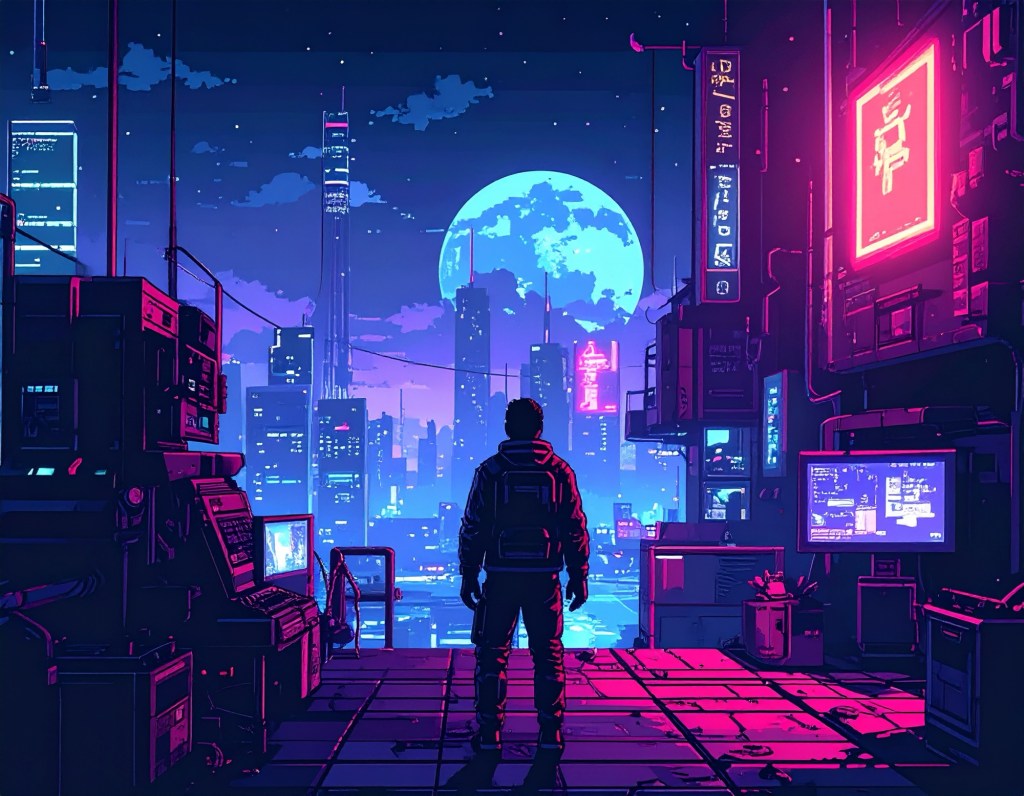
Cyberpunk City AI

Explore an AI generated cyberpunk city @cyberpunkcityai

  • The plan was simple—too simple, maybe. Mira kept telling herself it could work: slip into the Devils’ den, lace their stim vials with Somnus Draught, wait for them to collapse. In her head it ended cleanly, quickly.

    But Iron Alley wasn’t forgiving.

    They slipped through dripping walkways and rust-stained corridors until the Devils’ hideout loomed ahead, lit with crimson neon and alive with the low thrum of bass from inside. Rika led the way, her implants glowing faintly as she scanned for movement. Kaio handled the locks, his glasses flickering with lines of data until the door creaked open.

    Inside, the Devils were sprawled across couches and broken chairs, stims glowing like liquid fire in their hands. Drexel sat tied in the corner, bruised and battered but alive. His swollen eyes widened when he saw them slip inside.

    “You’re here…” he rasped, voice cracked. “Don’t—don’t do anything stupid.”

    Mira swallowed, her hands trembling as she swapped a fresh tray of glowing vials with the ones they’d prepared. The Somnus Draught shimmered faintly in the dim light, nearly indistinguishable from the Devils’ usual concoction.

    For a heartbeat, it worked.

    The gang laughed and cheered, raising the bottles high. They drank deep, blue liquid pouring down their throats. For a breathless moment, Mira thought it was done.

    Then the first Devil staggered—

    —but instead of collapsing, his visor flared red.

    Another Devil screamed, his voice metallic, rage bursting through the room. Their cybernetics sparked, muscles tightening. The Somnus Draught hadn’t calmed them. It had triggered something violent, primal.

    “WHAT DID YOU DO TO US?!” their leader roared, cyberarm slamming into the table, shattering it.

    Chaos erupted. Bottles shattered, neon liquids splattering across the floor. The Devils’ laughter turned to furious howls, their crimson visors burning brighter than ever.

    Mira lunged toward Drexel, but the leader moved faster. His massive arm swung out like a piston, slamming into Drexel’s chest before anyone could react. The sound was sickening—a crack, a gasp, and silence.

    Drexel’s head fell forward. His body went limp against the restraints.

    “No—NO!” Rika screamed, her implants blazing red as she charged forward. Kaio grabbed her, pulling her back as the Devils descended into full-blown frenzy.

    Mira froze, staring at Drexel’s lifeless body. Her heart felt like it was being torn out, the whispers of the capsule echoing uselessly in her skull. They had come to save him, and instead—they had delivered his death.

    “Run!” Kaio shouted, dragging Rika toward the exit.

    Mira’s legs moved before her mind caught up, her eyes locked on Drexel even as the distance grew. His face, broken and still, burned itself into her memory.

    They spilled into the rain-drenched alley as the Devils’ enraged howls followed them into the night.

  • The shelves of Peppy’s glowed faintly in the lantern light, casting shifting patterns across jars of powders, herbs, and strange neon vials. The air was thick with incense and spice, humming with quiet energy.

    Mirella watched the three teens fan out into the aisles, her cybernetic eyes gleaming like polished glass. “You’re searching for something to tip the scales,” she said, her voice calm, certain. “But be careful. Power always comes with a cost.”

    Rika’s hand brushed over a row of cracked bottles filled with powders that seemed to spark faintly as she touched them. Her implants pulsed brighter, and she muttered, “Feels like half this stuff could blow up in our faces.”

    Kaio adjusted his glowing glasses, leaning close to a vial etched with shifting digital script. “These labels aren’t just names—they’re coded instructions. This one,” he said, pointing to a pale blue liquid, “is meant to calm neural activity. If diluted, it could put someone out.”

    Mirella’s lips curved in a knowing half-smile. “That liquid is called Somnus Draught. Not a poison, not truly—but strong enough to silence even the loudest minds. The Rust Devils won’t resist it if it’s mixed into their stims.”

    Mira picked up the glowing vial carefully, watching the liquid swirl inside like captured smoke. Her wristband flickered faintly, reflecting the soft blue glow. For the first time since Drexel’s capture, she felt like they had a chance—not through brute force, but by turning the Devils’ hunger against them.

    Rika cracked her knuckles, her face lighting with a fierce grin. “Good. Let’s make the bastards sleep.”

    Kaio frowned, pushing his glasses higher on his nose. “If it works the way she says…”

    Mira closed the vial with a snap and looked back at them. “Then we use it.”

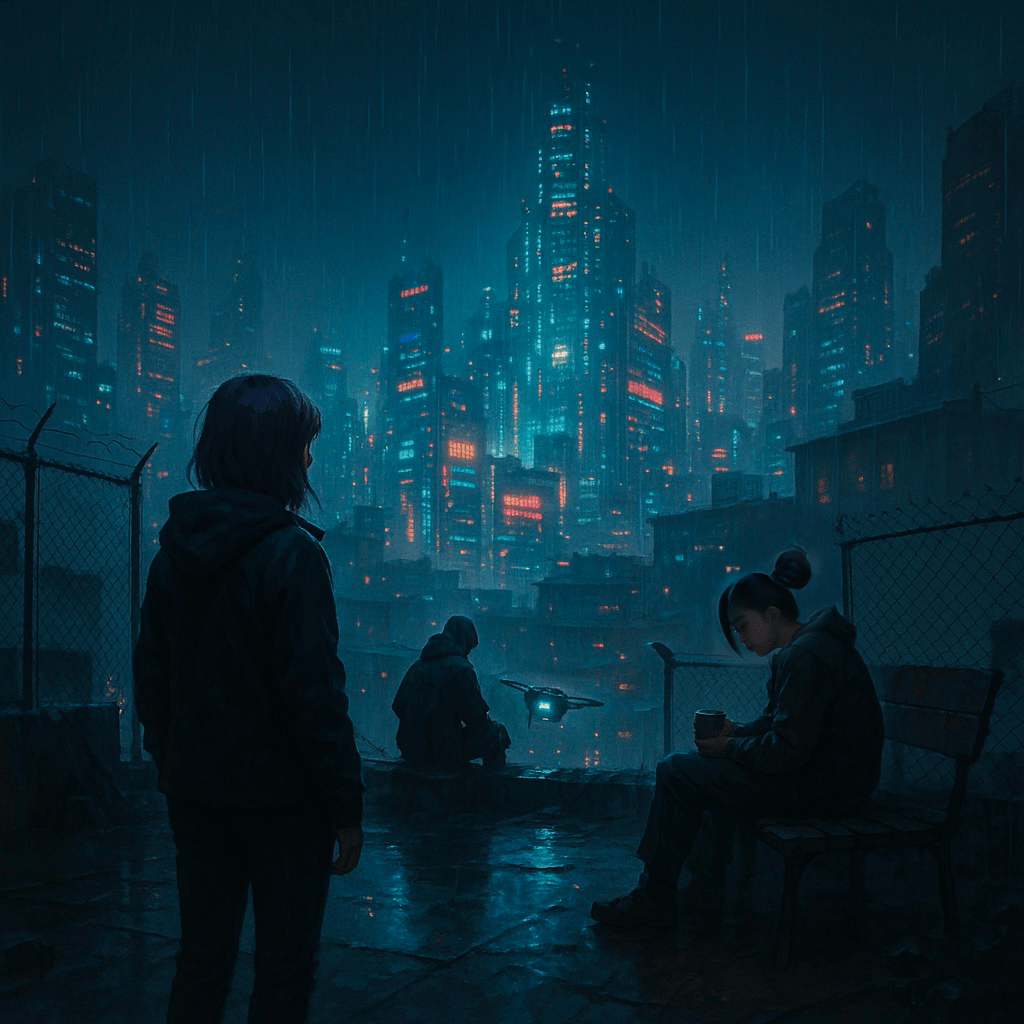
  • The Rust Devils’ voices faded into the drizzle, their laughter echoing down Iron Alley. Mira crouched low, heart hammering, watching the gang vanish into the maze of neon-lit streets.

    “We can’t just wait around,” Rika hissed. Her violet buzzcut glowed faintly under the neon. “Drexel’s in there somewhere—we hit them hard, drag him out, and go.”

    Kaio shook his head, pushing his glowing glasses higher on his nose. “That’s suicide. We don’t even know which block they’re holding him. Best case, we walk into the wrong den. Worst case, we don’t walk out.”

    Mira stayed quiet. The capsule’s echoes had gone still inside her, leaving only the sound of rain dripping from exposed wires above. Her gut twisted, desperate to act—but Kaio was right. Running in blind would get them all killed.

    “Then we plan,” she said finally. “Find someone who knows the Devils’ moves. A merchant, a runner—somebody.”

    But before Kaio could respond, a harsh metallic clang cut through the alley. One of the Devils had stopped mid-stride, visor turning back.

    “Oi,” the vocoded voice growled, echoing down the walls. “Thought I heard rats.”

    The others turned with him. Crimson visors swept the shadows.

    “They’ve seen us,” Mira whispered.

    “Run!” Rika snapped.

    The teens bolted, boots splashing neon puddles as the Rust Devils charged after them, armor clanking like jagged metal beasts. The alley twisted and narrowed, graffiti-smeared walls closing in as they sprinted past flickering signs and shuttered doors. A Devil’s grapple claw cracked into the ground inches from Kaio’s feet, tearing up sparks.

    “Left!” Mira shouted, shoving a crate into the path. They darted into a side street, lungs burning, the gang’s shouts echoing closer.

    At the end of the passage, a crooked wooden door stood half-open, its frame glowing with faint amber light. A hand beckoned urgently from inside.

    “In here, quick!” a voice rasped.

    The three teens stumbled through, slamming the door shut behind them just as heavy boots thundered past.

    Inside, the air smelled of spices and dust. Shelves were crammed with jars of herbs, glowing vials, and exotic powders. Strange lanterns cast warm light through the cramped shop.

    “Welcome to Peppy’s,” the shopkeeper said calmly, her cybernetic eyes gleaming as she locked the door. “The Devils don’t hunt in here. Sit down before you fall over.”

    Mira looked at her in shock. “You know about them? About Drexel?”

    The shopkeeper gave a thin smile. “Child, I know more about the Devils than they know about themselves. You want your friend back—you’ll need more than courage. You’ll need a plan.”

  • The construct’s glowing eyes locked on Mira’s for a single breath, its kneeling form humming like a resonant chord. Then, just as suddenly as it had appeared, the liquid lattice unraveled.

    The glyphs broke apart, dissolving into droplets of blue-silver light that spiraled upward before vanishing into the night rain. The capsule itself cracked and went dark, lifeless, nothing more than an empty shell at her feet.

    Mira staggered, clutching her chest. The whispers weren’t gone—they’d gone inside.

    She gasped and doubled over. Images flared in her mind: rusted walkways, flickering neon, walls scarred with gang tags. She saw Drexel pinned in a chair, Rust Devils surrounding him, their leader’s cracked visor glaring down.

    “I know where he is,” Mira whispered, her voice shaky but certain. She looked up at Rika and Kaio, her eyes wide. “They took him back to their holdout in Iron Alley.”

    The three huddled under the cover of the platform, the city’s neon glow dripping down the rain-slick streets. In the distance, a guttural laugh echoed from a nearby alley. Mira pulled Rika and Kaio into the shadows, pressing them against the cold wall.

    The Rust Devils were here.

    Through the patter of rain, Mira picked out voices—metallic, distorted by cheap vocoders.

    “Boss says hold him till morning. Spread the word—put out a ransom. They’ll pay big for the capsule.”

    A second voice grumbled, sharp with confusion. “Why does Zenith care so much about that thing anyway? It’s just another Bliss variant, ain’t it?”

    “No,” the first voice snapped. “You saw what it did. Corps don’t throw money like this unless it’s special.

    Mira’s pulse quickened. She could still feel the echo of the construct, its glyphs burned into her vision. It wasn’t Bliss. It wasn’t anything she’d ever seen. And Zenith wanted it badly enough to pay a gang like the Rust Devils to risk a war.

    Kaio leaned in close, whispering into her ear. “We’re running blind. If Zenith’s involved, this is bigger than us.”

    But Mira shook her head. The connection still thrummed inside her, pointing like a compass straight toward Drexel.

    “No,” she said, her voice hardening. “It’s not bigger than us. It’s personal.”

    Rika’s implants flared crimson as she cracked her knuckles. “Then let’s get our boy back.”

  • The cables above crackled faintly, casting soft pulses of violet and red across the warped walls. Screens flickered with unreadable data, the glow painting strange patterns across their path. Dust hung in the air like static.

    Kira slowed near a cluster of shattered furniture, half-melded into the wall like the room itself had digested them. She turned to Kael.

    His hood was down now. The flickering light illuminated the curve of his cheek, the slope of his jaw, and for a moment—just a moment—something felt off.

    She squinted.

    “Kae—” she started, her voice low, almost swallowed by the hum of the room.

    Kael looked up from where he’d been tracing a live cable with his gloved hand.

    “What?” he asked.

    Kira stepped closer, lifting her hand gently and resting her fingers against his face. He didn’t flinch.

    “You look… different,” she said, almost to herself. “Like your face—something’s changed.”

    Kael blinked, confused but curious. “Changed how?”

    “I don’t know,” Kira murmured, withdrawing her hand slowly. “I think I’m just… seeing things.”

    Liora had been watching from the back of the room, her expression unreadable. “We all are,” she said quietly. “But not everything we’re seeing is wrong.”

    They fell silent again as a distant clang echoed through the walls—metal on metal, from somewhere deeper in the building. And then the screens above them all blinked in sync.

  • Kira paused outside one of the buildings, her eyes fixed on a weathered entry panel beneath a flickering cyan light. “This used to be a housing block,” she said, brushing her fingers along the cracked wall. “But none of this… none of this was here before.” Her voice carried a mix of hesitation and resolve. “I want to see what’s inside.”

    The rusted door creaked open with a hiss of stale air and ozone. Kira stepped in first, brushing her hand along the keypad as if it might still work. It didn’t. The others followed close behind, expecting the interior of an abandoned apartment complex.

    But what they found was anything but.

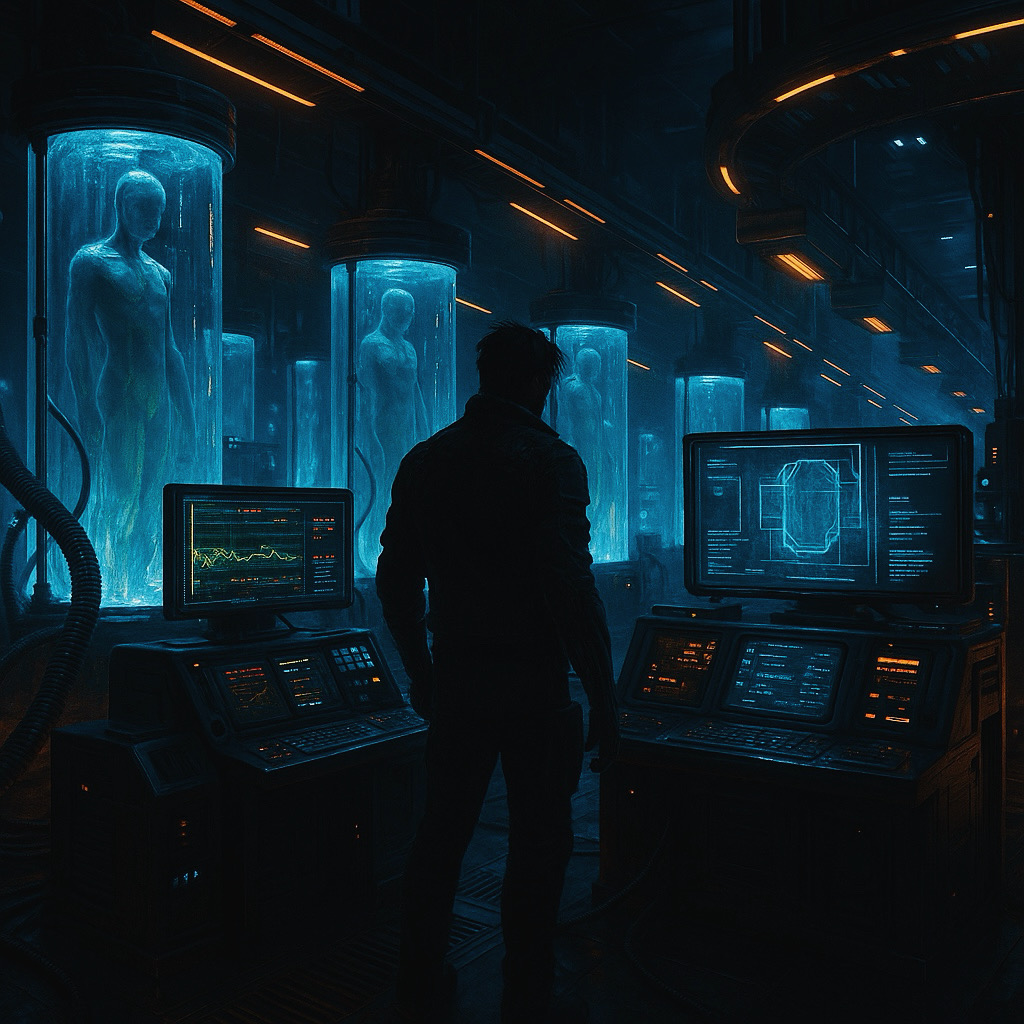
    The lobby walls were stripped down to raw composite material, the original decor erased beneath layers of exposed conduit and semi-translucent panels. Violet-tinted fluid flowed through glass tubes embedded in the walls, pulsing at slow, rhythmic intervals. The tubes branched like arteries, disappearing into the ceiling.

    Light came not from overhead bulbs but from thin strips embedded in the floor and under the panel seams. The glow shifted gradually from blue to red, pulsing in sync with the liquid.

    Where there should’ve been furniture—chairs, mailboxes, wall art—there were rows of low-slung terminals, blank screens facing upward, each one wired to the walls by bundles of fiber like roots. Some flickered to life as they passed, displaying bursts of data: maps, waveform patterns, incomplete glyphs.

    They turned a corner into what might’ve once been a stairwell. The stairs were gone. In their place, a ramp of smooth material extended up in a gentle spiral, its surface shimmering faintly. At each level, narrow doorways led into other chambers—some open, revealing glimpses of metallic pods, glowing panels, more cables.

    They entered one of the larger rooms.

    At the center stood a single open pod. Its interior was molded to fit a human body. Cables hung loose from the top, dripping faint luminescent residue into the pool below. Above it, a panel projected a floating image—a digitized rendering of a human figure dissolving into points of light.

    No signs of life. No signs of abandonment, either.

    The place didn’t look deserted. It looked unfinished.

    Liora’s eyes swept the space, taking in the tube-lined walls, the subtle thrumming beneath their feet, the quiet hum of systems still awake.

    Kael moved to one of the terminals. It scanned his presence but displayed nothing.

    Kira didn’t speak. She only stood there, taking it all in, her brow furrowed as she glanced at the cables that trailed along the floor like veins—some leading to the room’s far corner, where another sealed door waited.

  • They emerged from the tunnel mouth like ghosts rising from the underworld—mud-slicked boots scraping against metal as they stepped into a dim, narrow corridor of Iron Alley that hummed with unfamiliar energy.

    Rain hissed softly above them, filtered through rusted grates and layers of exposed piping. The air was thick with ozone and a faint trace of static—like a charge hung in the atmosphere waiting to spark.

    Kira stepped forward, her eyes narrowing beneath the fringe of her violet hair. “Wait,” she said, stopping just short of the next intersection. Her voice was quiet but certain. “I know this spot.”

    Kael looked around warily, adjusting the weight of the coat draped over his shoulder. “Doesn’t look like anyone’s been here in years.”

    “No,” Kira insisted. “That sign—‘Nexor’s Wares’—that’s where I used to fence junk data when I was sixteen. But this used to be a two-story stack of scrap vendors.” She pointed at a massive tower of gleaming chrome overhead, its animated holo-panels cycling advertisements for quantum knives and neural refactors. “None of this was here last cycle.”

    Liora turned, scanning the eerie glow of their surroundings. “You think it’s a district rebuild?”

    Kira shook her head. “Too fast. Even with NeuroCorp funding, you don’t rebuild Iron Alley this quick. And you definitely don’t overwrite memory-stable zones like this without notice.”

    Kael’s cyberlenses flickered. “I’m picking up fresh mesh signals. Private ones. Someone’s reprogramming the infrastructure underneath. Not patching—redefining.”

    For a moment, all three stood still, the weight of the changing city pressing in around them.

    “Feels like the city’s alive,” Liora muttered.

    Kira didn’t respond. She just stared up at the building she used to know, now reborn into something gleaming, artificial—and watching.

  • The rain hadn’t let up in days. Iron Alley glistened with its own decay—neon bleeding into puddles, steam hissing from broken vents, the constant hum of survival layered over every corner. Marcus Cain moved through it like a shadow, guided less by sight and more by instinct.

    That’s when he saw it.

    Wedged between a rusted-out gear shop and a liquor den with its neon half-dead, stood a storefront that didn’t belong. Its glass was clean. Its panels unbroken. A pale white sign glowed steady and strong above the door, untouched by the flicker and grime that marked every other building in the Alley.

    Zenith Dynamics.

    The name hit him like a ghost. This was no coincidence. Corporations didn’t plant storefronts in Iron Alley—they crushed it from the outside, or bought it piece by piece through gangs. For Zenith to show its face here meant one thing: they weren’t afraid.

    Marcus lingered by a vendor’s stall, pretending to scan the wares while his cybernetic eye zoomed in. The store didn’t move product like the other shops. There were no crowds, no workers hustling to make a cut. Just a steady trickle of figures slipping inside, none emerging. Men and women with vacant stares, moving as if pulled on strings.

    His pulse tightened. This wasn’t commerce. This was collection.

    He thought back to the whispers at the bar, the talk of “shipments,” the fear behind the word harvest. And now he saw it clearly—Zenith had set up its pipeline right in the heart of Iron Alley. Gangs like the Rust Devils weren’t just tolerating it. They were feeding it. Delivering the city’s forgotten straight to the glass doors of that too-clean facade.

    Marcus clenched his jaw, servo-motors in his arm groaning softly. The MagRail massacre replayed in his mind—families burned in the name of efficiency. He’d sworn to never again be their weapon. But staring at that sign, he realized Zenith hadn’t stopped harvesting lives. They had only refined the process.

  • The bar was little more than a rusted shell with flickering signs bolted to its walls, the kind of place where daylight never dared to crawl. Smoke coiled from cracked vents, mixing with the sour tang of burnt synth-liquor. Marcus Cain sat at the counter, one hand wrapped around a chipped glass, the other resting on the steel plating of his arm.

    He wasn’t here for the drink—it barely qualified as liquid. He was here for the voices. Iron Alley’s bars were confessionals for the desperate, and desperation always spoke louder than truth.

    A pair of Rust Devils hunched at a nearby table, their laughter sharp and hollow. Between slurred boasts and the clink of bottles, Marcus caught fragments:

    “…shipment came in last night… not gear, not NeuroBliss…”

    “…they don’t scream once they’re under…”

    Marcus’s cybernetic eye adjusted, zooming in on the faint reflections in their glasses. Their hands shook—not from the liquor, but from the weight of what they carried in their words. Something bigger than contraband. Something alive.

    Behind him, a broker argued with a tired medic over payment, his voice rising above the static haze of neon. “I don’t care how you patch them. Just keep them breathing long enough to make delivery.”

    Marcus took a slow sip, the taste bitter metal on his tongue. His instincts—the ones honed in Zenith’s service and sharpened in betrayal—buzzed like static in his skull. Something was moving through Iron Alley, hidden beneath the gangs’ usual chaos. And it wasn’t weapons, or circuits, or drugs.

    It was people.

    The ghosts of the MagRail stirred in his chest, heavy and unrelenting. Marcus set the glass down and rose without a word, the hum of his cybernetic arm the only sound that lingered as he stepped back into the rain-soaked streets

  • Marcus Cain was not born in Iron Alley—he was delivered into its shadows by betrayal. Before the Rust Devils marked the walls with fire and neon, before NeuroCorp laced the city with NeuroBliss, Marcus wore the black and blue of Zenith Dynamics’ private security division.

    Back then, he was a believer. He thought his augmentations—one eye stripped of flesh and remade in steel, a right arm reinforced with carbon weave—were a symbol of protection, not oppression. His unit patrolled the MagRail lines, quelling unrest and keeping corporate shipments safe. They told him he was a shield against chaos. He wanted to believe it.

    That illusion ended on the Eastern MagRail Massacre. His squad was dispatched to neutralize what the corp called “domestic saboteurs.” Marcus expected mercenaries or smugglers. What he found were families—ex-workers laid off when Zenith automated their industries, squatting in freight yards, scavenging circuits just to survive.

    Then the order crackled through his comms:

    “Burn it down. No witnesses.”

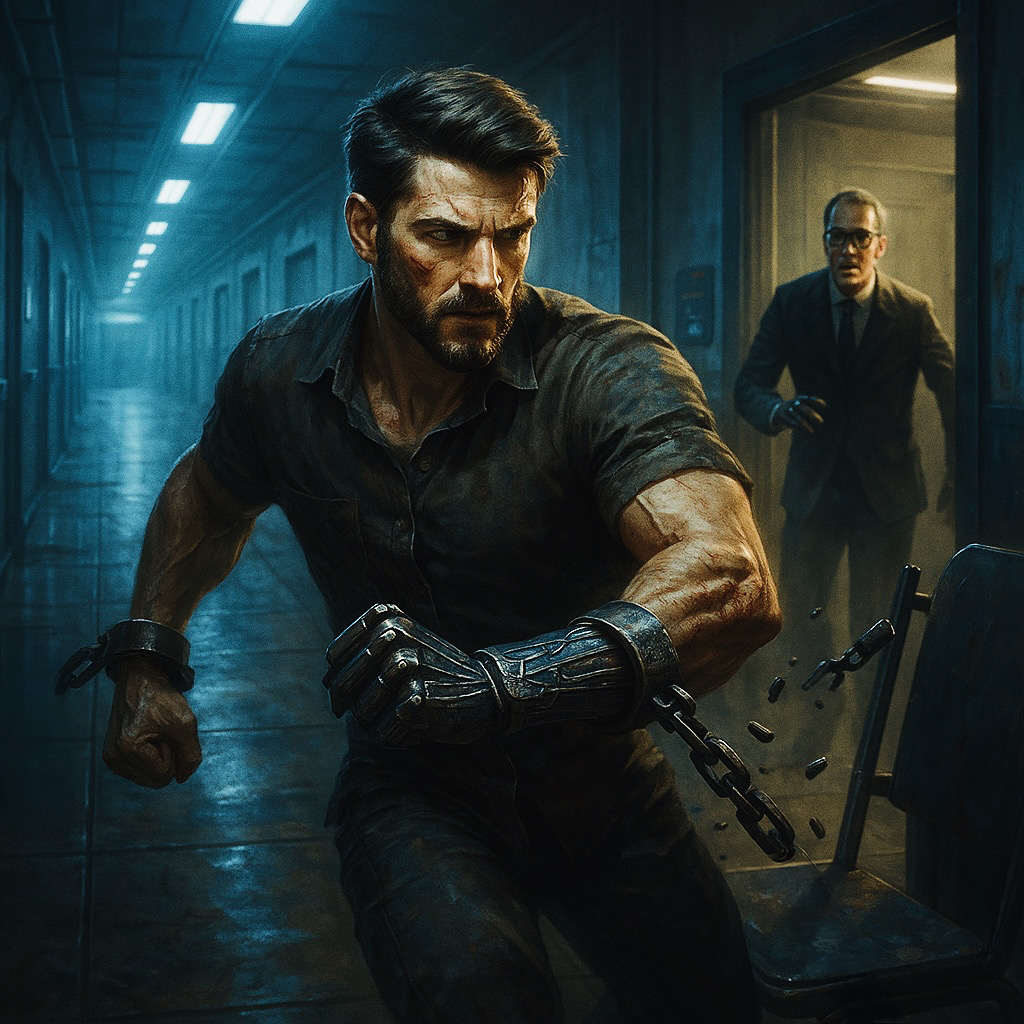
    The words hollowed him. Marcus hesitated, pulse-gun in hand, while his squad opened fire. Flames tore through shanties of scrap metal and tarp. Screams drowned beneath the hiss of incendiary rounds. And Marcus—who had once believed in justice—turned his weapon not on the civilians, but on his own brothers in arms.

    The fight that followed was chaos. Marcus killed men he had trained beside for years. His arm was shredded by a frag grenade, his eye seared by plasma fire. He dragged three survivors from the blaze—two children and their mother—but when the smoke cleared, dozens more lay dead. He saved lives, but not nearly enough.

    Black-market surgeons rebuilt him. The plating on his arm carries names scratched into the alloy—not victories, but ghosts. Every time the servos whir, every time his eye scans a crowd, he remembers.

    From that night forward, Marcus Cain swore he would never again be a weapon wielded by the powerful against the powerless. His restraint, his cold precision, his quiet code of honor—all of it was born in those flames.