Cyberpunk City AI

Explore an AI generated cyberpunk city @cyberpunkcityai

  • He calls himself Morrow because names in Iron Alley get bent until they fit the shape of a man who survives here. Morrow’s face has the practiced softness of someone who knows how to make a woman feel seen for exactly as long as it keeps her close. He learned long ago that there are things you can trade for companionship in this city: a favor, a smile, a hot meal — and, for some, a little vial of NeuroBliss.

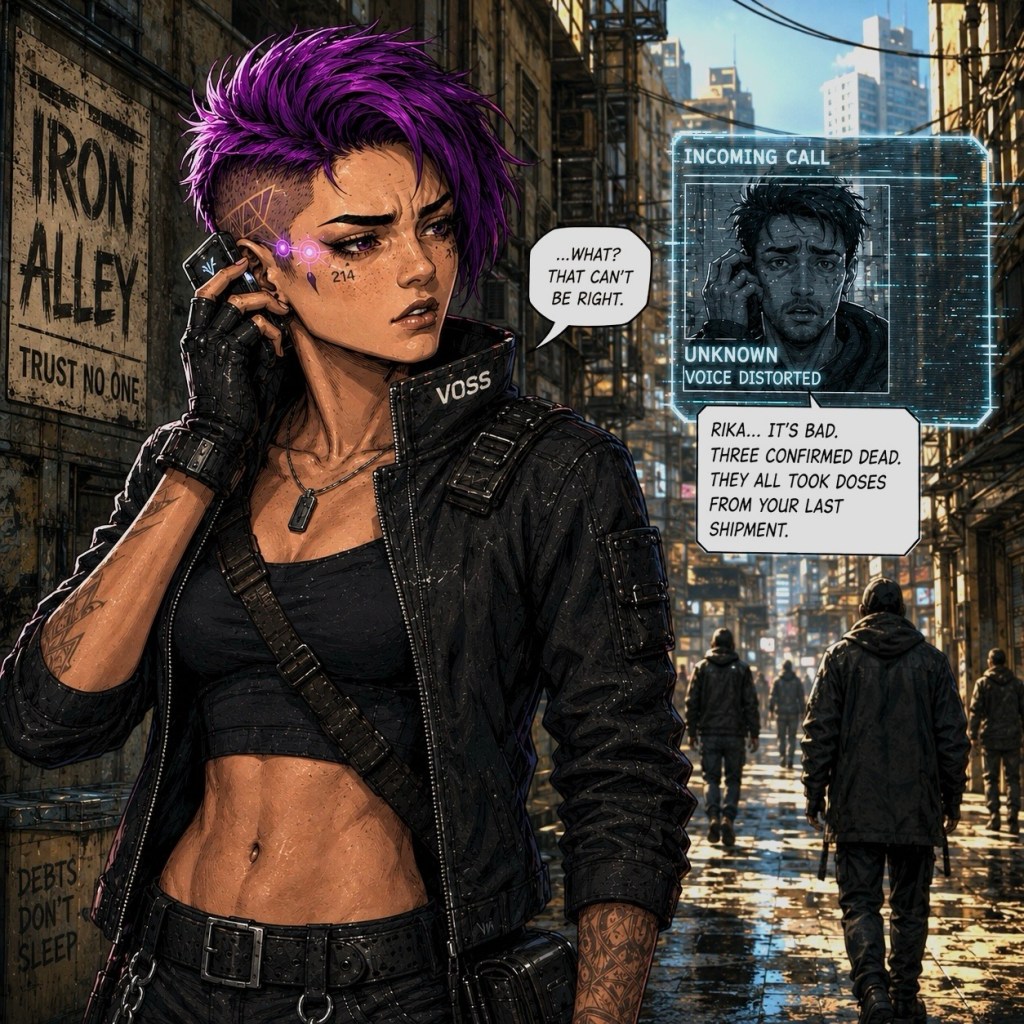
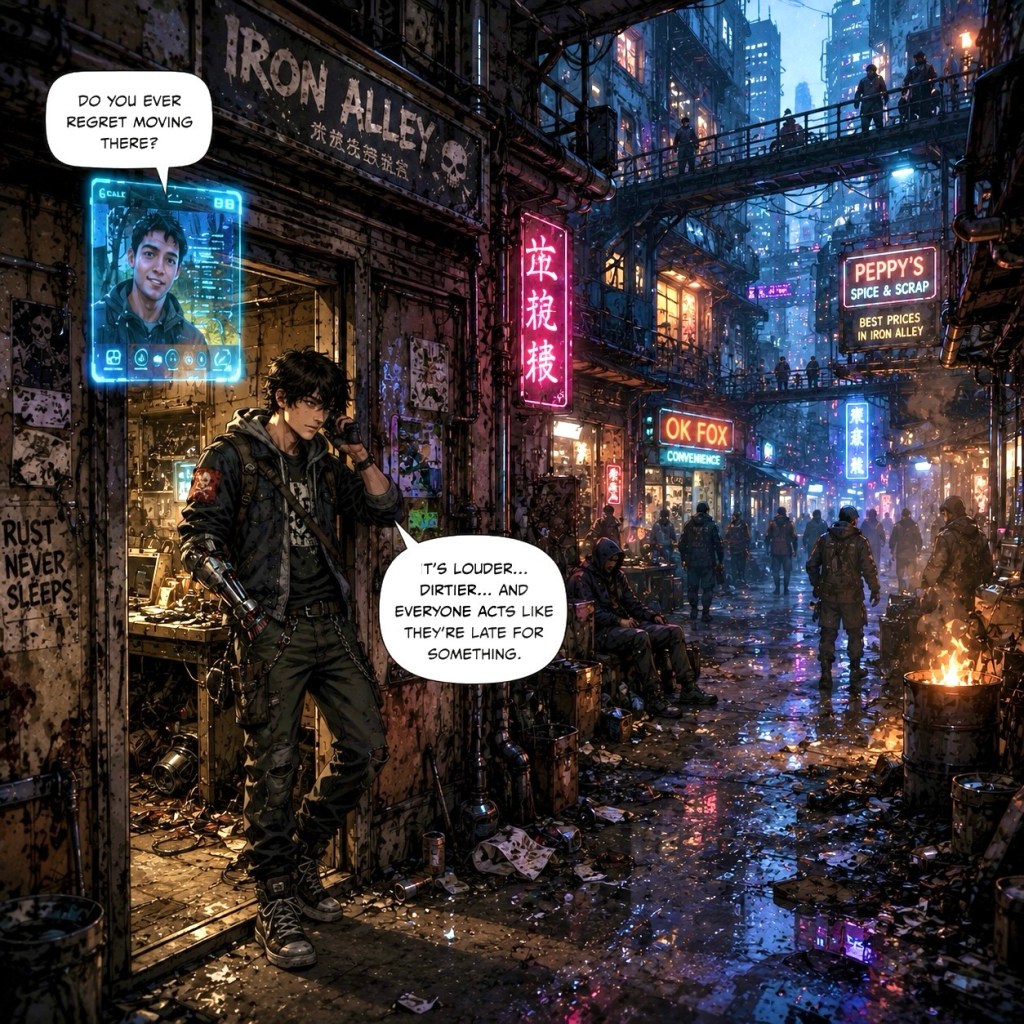
    The alley is a throat of rusted steel and braided wires, a stack of makeshift houses like boxes shoved into a canyon. Pipes run like veins along the walls, coughing occasional steam. Florescent signs buzz with bad electricity; their light fractures against sheets of corrugated metal and puddles that never quite dry. People move in knots — bodies leaning against each other on wooden walkways, children playing with burned-out caps, old women selling boiled roots from plastic cups. Everything smells like oil and metal and the sweet chemical aftertaste of a drug the city pushes like a rumor.

    She—Lia, though Morrow invents pet names he forgets by morning—came to him on the day the rain peeled the neon into a watery smear. Her eyes looked hollow as old sockets, and her hands trembled in the small, precise way of someone cataloguing the city by how much it would take to keep her steady. NeuroBliss had eaten the edges of her life: the job she’d once done in a plant, the cousin who used to trade her stories for bread. What was left fit into a coat pocket and a jar of memories she couldn’t afford.

    Morrow is patient. He sits with her on the elevated walkway that runs between rows of patchwork homes and listens while she repeats what she remembers: names of dead plants, the color of a mattress her mother once had. He offers a bottle of booze at first, then a cigarette, then the vials — small glass cylinders with iridescent liquid that gleams in the streetlamps like dangerous stars. He tells himself the vials are a kindness; they ease the tremors and make the city sing softer in her ears. In return, she lets him in. She talks. She laughs brokenly. She lets someone hold her while the city hums.

    But the small mercies become a claim. Morrow’s kindness is ledgered: he pays for her drugs, he cooks for her, he steadies her. He collects her gratitude. When she wakes cold in the night, he is there. When thieves come by, he is the one who steps into the light. He wears the role of protector like a coat he can take off when the weather changes. He knows what she will give him—affection, presence, the illusion of normalcy—and he takes it. He does not see, at first, how the vials and his interventions inscribe dependency into the raw parts of her.

    Lia drifts into him the way the alley takes in rain — not violently, but with a slow, devouring acceptance. There are afternoons when she is lucid: she will sit on the stoop of their shelter and hum lines of a song she half-remembered from a bus ride before the city carved her down. On those days Morrow believes he is doing good. He thinks he has rescued something. He will tell himself that the vials are a bridge, temporary and controlled, and he will promise himself he will cut them off when Lia is strong enough to stand. He promises and repromises the way people here promise the sun will dry out the rust.

    But the alley is a place of receding guarantees. Supplies get cut; debts grow like mold. The vials are expensive — people with more teeth than scruples will take a slice of what Morrow can find. When the prices spike, his patience frays. He begins to ration the kindness along with the drugs. A day here, two days there. He measures affection in doses. The emotional math is ugly: he is, at once, her shelter and her gatekeeper.

    The cost is not only money. Lia’s eyes dim further. She blames herself; she blames the city; sometimes she blames Morrow, and on those days the hurt in her voice is like glass. She begins to bargain for what she should be given freely — a warmth, a look that lasts a second longer than the lighting allows. She clings to the memory of laughter and punishes herself when it fades. Morrow comforts her in the ways that have become part of his survival, but he does not see how his comfort tightens the rope around her choices until one night the rope frays.

    That night the alley feels narrower than usual. Steam wraps the walkways in a ghost-smoke; nests of wires sway as if whispering. Morrow is restless. He spent the day arguing with a dealer over delivery and came home with fewer vials than Lia needed. She sits on the roof of their shelter, legs wrapped around herself, small like a figure carved from the night. Her voice is low and precise.

    “You’re not here to save me, are you?” she asks.

    Morrow searches his face for an answer that will make the question false. He reaches out, palm flat against the rusted railing. He wants to tell her truth; he wants to say he loves the shape of her laugh and the way she forgets to be afraid sometimes. Instead he smooths the lie he’s been living into his mouth and says, “I am.”

    The words are a bandage. They momentarily stop the bleeding. But words do not undo the ledger. Lia looks at him as if seeing his hands for the first time — the hands that know how to pry open a lock and also how to press the small cap off a vial. For a long minute she is quiet. Then she stands, a small silhouette against the buzzing signs, and begins to pack.

    Morrow tries to stop her. He pleads and he bargains. He offers to fix the heating pipe on the third level, to take on another run, to go hungry himself if she will stay. His voice comes out thin and hollow. The alley listens without mercy. People move past them, exchange glances, and go on.

    Lia’s decision is not sudden; it has been building in fragments — an old photograph, a day’s worth of steady mind, a breath long held. She slips down from the roof like a cat and moves through the gap between houses where the city’s maintenance pipes form a corridor. The pipes are slick with condensation; the walkway is a narrow rib of metal. She walks with that slow, stubborn determination of someone who has practiced leaving the ways of the past. Morrow follows for a while, then stops at the first junction, fingers curled on a cold railing. He shouts her name, a raw, useless sound that the alley swallows.

    She does not turn back. The alleys fork and multiply; she edges through them — under a hanging tarp, past a stack of crates, across a footbridge that creaks like an old belly. Where the lights thin and the crowd opens into a small market, a woman with a basket brushes past and hands Lia a folded napkin without looking. Lia unfolds it and finds, inside, a few coins and a note scrawled in hurried pen: Leave. Go.

    It is small, a gesture of human conspiracy. It is enough.

    Lia steps into the press of the market, and for the first time in a long time she lets the crowd carry her instead of cling to a single person for stability. She disappears into the density of bodies and the tangle of motion. Morrow watches until she is a shape swallowed by the city, until the market’s noise folds her into anonymity.

    After she is gone, the alley keeps the silence of those who know how much is lost and how little that knowledge changes anything. Morrow stands at the railing, hands empty. He counts the vials in his pocket and finds they mean nothing against the absence of a single human warmth. Somewhere deeper in the stack, Lia finds a back stair that leads away from the pipes and toward a district that tends gardens on rooftops — a place she faintly remembers from a job before the vials. She moves toward the smell of real soil and, step by aching step, toward a life that is not parceled out in doses.

    The last sound Morrow hears is not triumph or anger but the soft, stubborn exhale of someone who has chosen herself. The alley continues to hum, full of lovers and liars, but in the hollow where Lia had been there is, for a moment, only a small, clean space where breath can come free.

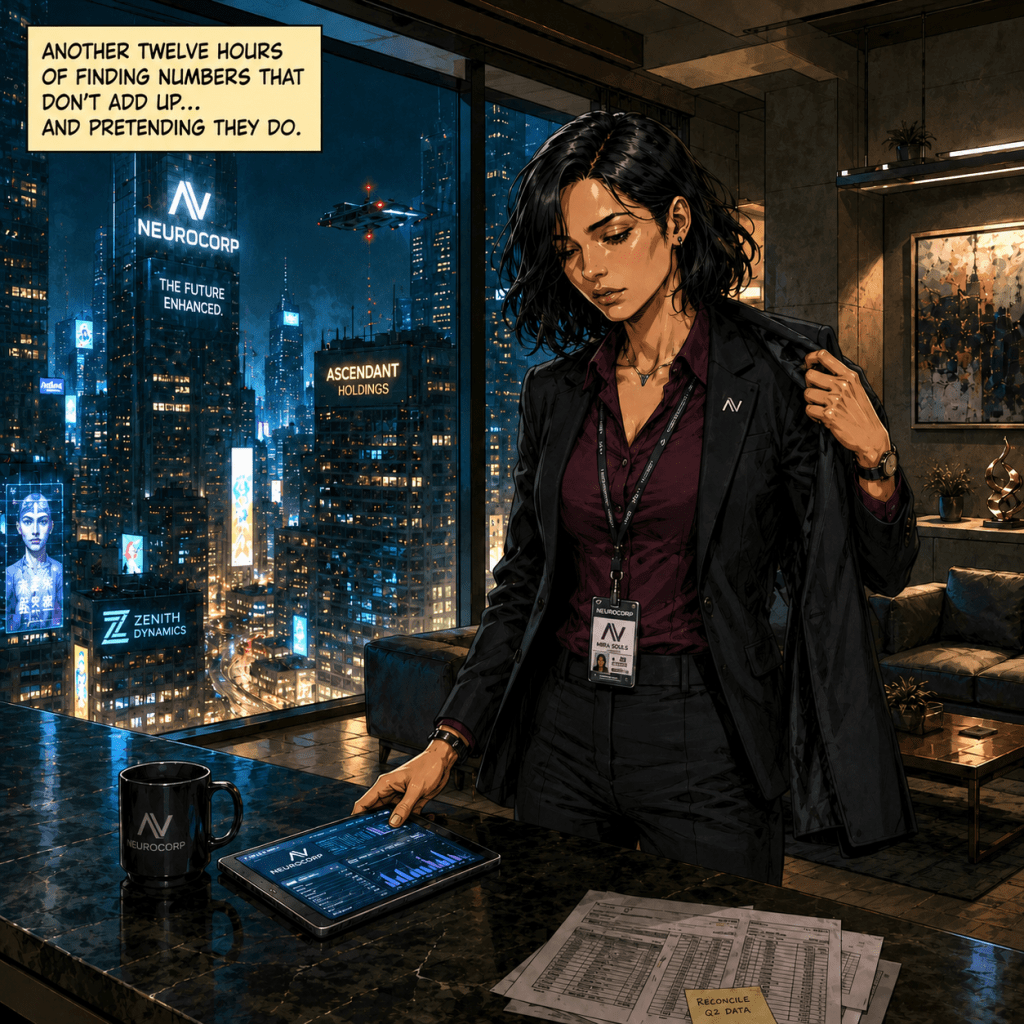
  • He counts profit the way other men count breaths. In the spreadsheets on his wall — glass panes that glow faintly when his fingers pass — every column is a planet he helped shift into orbit. His title is printed on cards people in meetings clear their throats for: Senior Integration Director. His apartment, perched like an observatory at the crown of Neon Spire, shows the kind of taste money buys when you want everyone to see you’ve left the street behind: clean angles, a living room that folds into itself, a modular sofa the color of wet chrome, floor-to-ceiling glass that frames the city as if it were a painting that refuses to be still.

    From up here the rain forgets how to fall — it fractures into neon and glass and the skeletal geometry of scaffolding. Below, the city hums on its old frequencies: exchange, hunger, the soft metallic laughter of things being sold and sold again. Up here, the sounds are curated. Lucien buys playlists the way he buys men — small, precise, transient. The parties are always on schedule: weeknights for the young VPs who still believe themselves immortal, weekend spectacles for investors who like their conscience served on ice. Holo-art drifts lazily over a bar of light, and guests raise cocktails that flicker like invalid data. They call it living luminous. Lucien calls it necessary.

    Because of what he helped build, his hands have fingerprints that never quite rinse clean. The company — one of many names in the ledger of his life — makes devices that dissolve discretion. Tiny embeds, sutured into the soft weight of a life: a choice here, a convenience there, a promise of belonging that rewires the lonely into dependency. It starts as help; it ends in hunger. People come to him with empty faces and full schedules and leave with a hollowed cadence that matches the rhythm of the rigs. He watches graphs and user curves and retention rates that look like heartbeat tracings. He signs his initials and the lines deepen.

    Sometimes, alone in the late hours, he imagines the faces of those who made the payments on his rise. Old clients he’d never seen, a mother who became a ledger, a child whose laugh was an optimization. He asks himself the one question executives rarely let themselves voice — did the convenience outweigh the cost? And there is no answer he can accept awake.

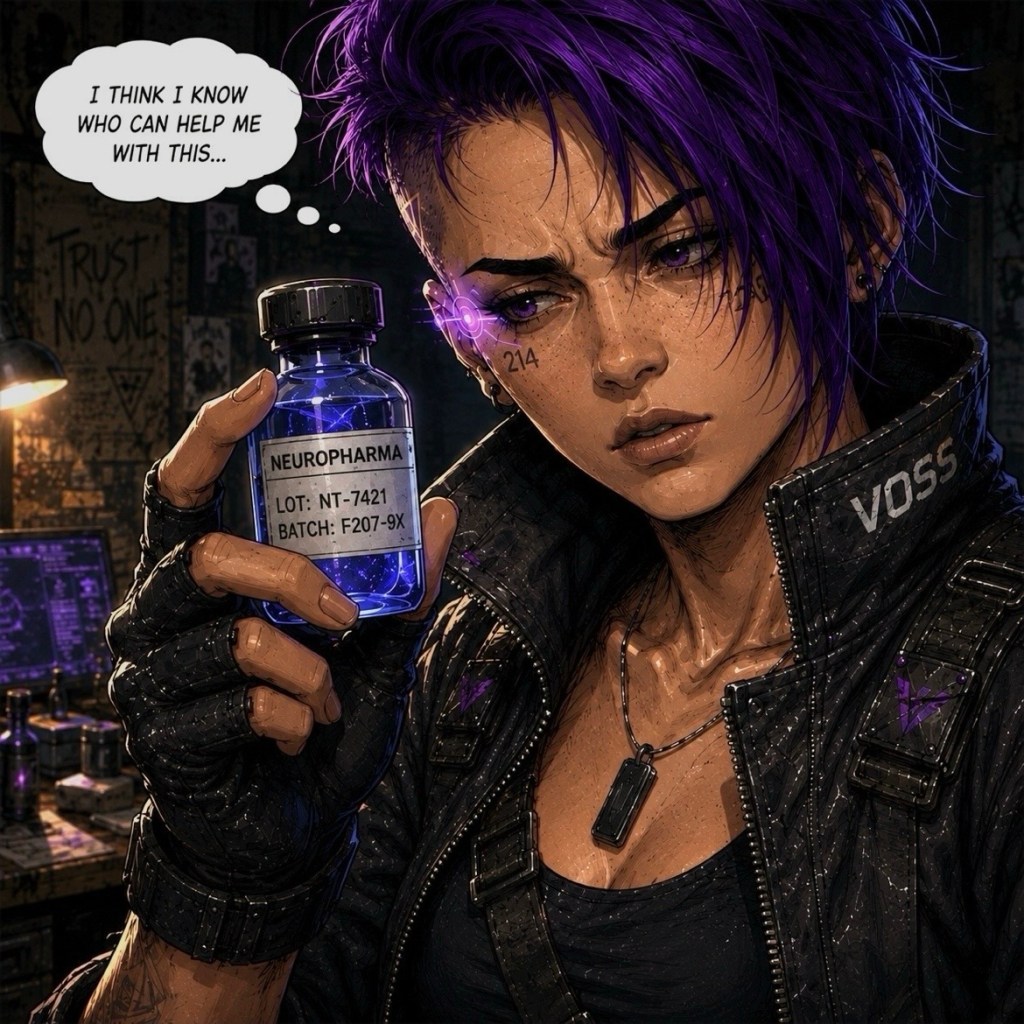
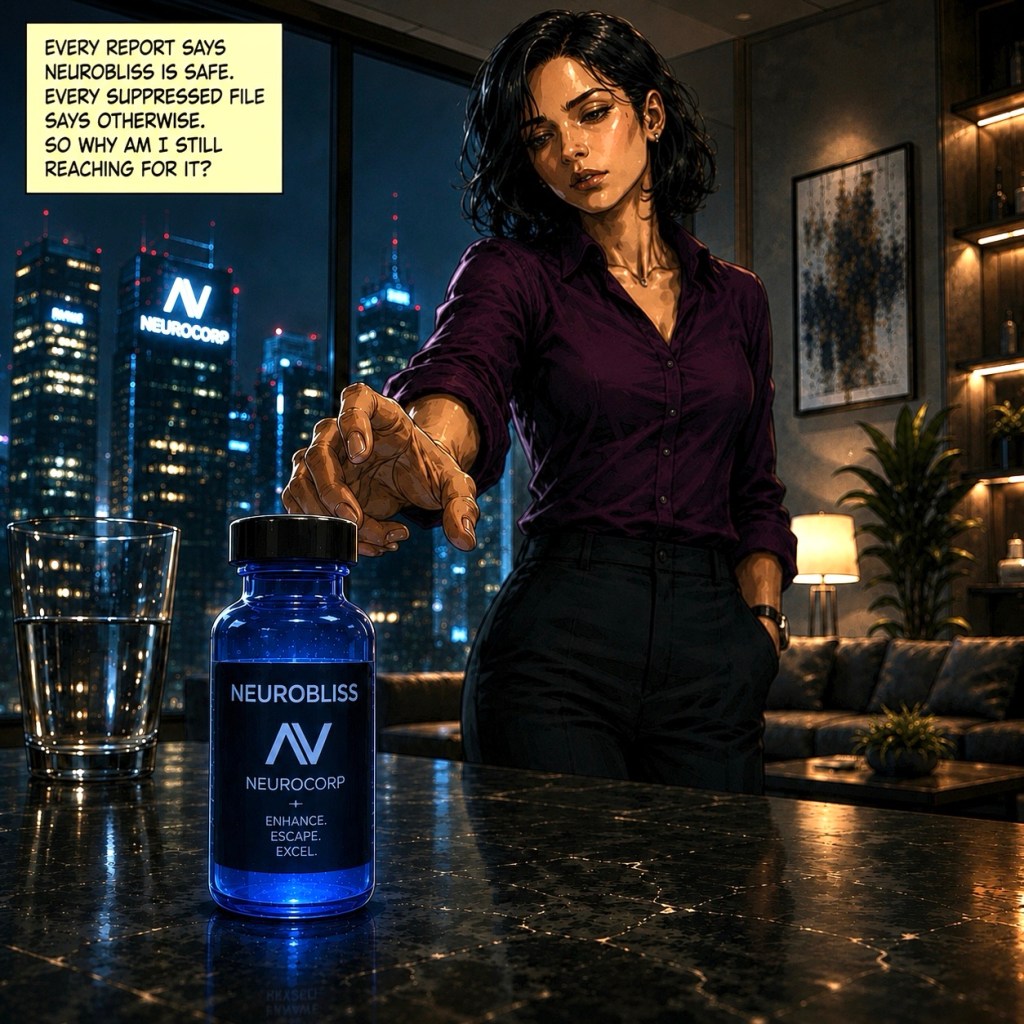
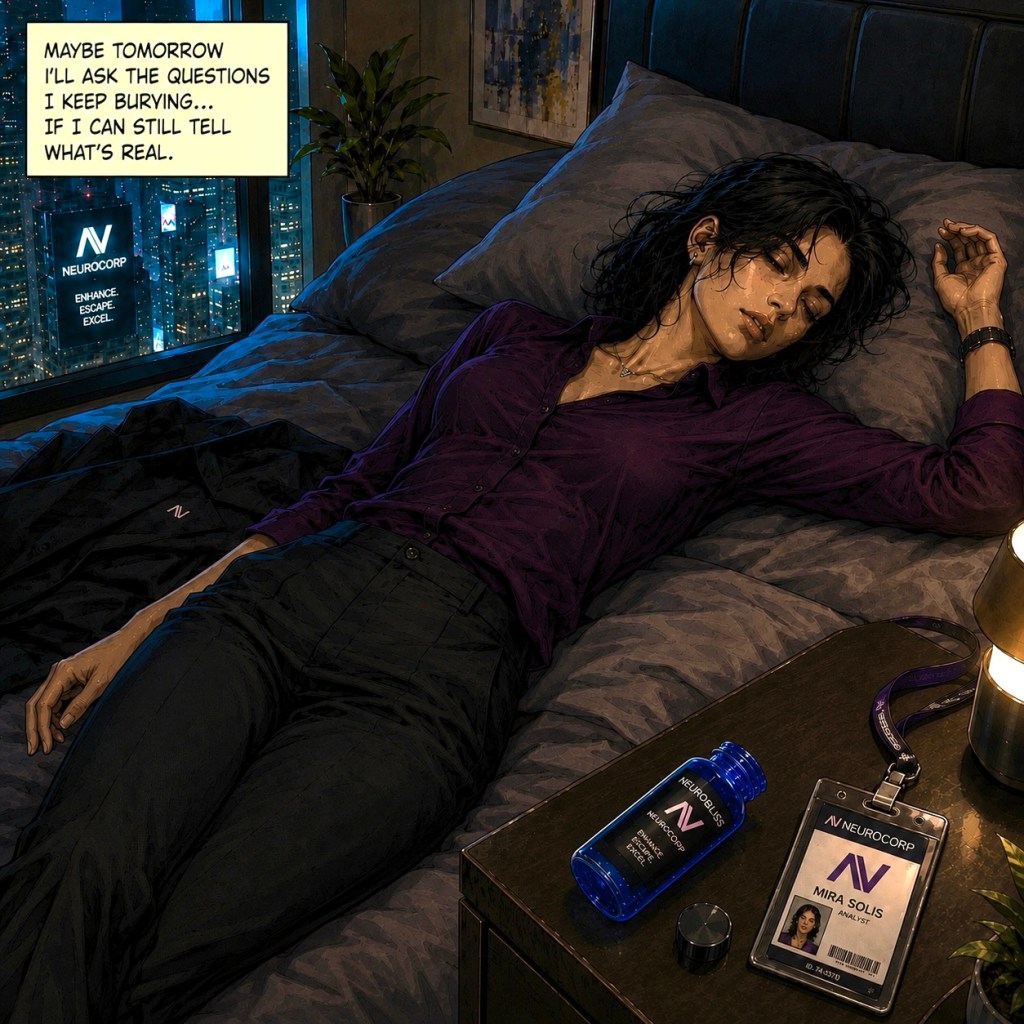
    So he blots. He bottles forgetfulness and pours it under his tongue in the neon hours. NeuroBliss comes in slender vials with labels that are more suggestion than medicine; it tastes like relief, like the last thing before falling. A single dose smooths the serrated edges of memory until the shapes of his deeds blur and his hands feel clean. Two doses fold guilt into the wallpaper; three lets him stand in a crowd and believe that laughter is authentic. The vials sit lined on a mirrored tray by the lamps — he likes lamps — their glass catching the city and refracting it into a kaleidoscope without faces.

    The parties continue because parties are contracts he can hide beneath. Guests are the moving parts of a life he can still pretend is normal: friends who nod without question, clients who toast the future they helped fund, lovers who arrive with contracted smiles and leave with transaction histories. He watches them orbit his living room like satellites, never touching ground. He smiles; he hosts; he offers more NeuroBliss in discreet, tasteful syringes to people who linger too close to the throb of the rigs, who ask the wrong question in the wrong tone. He markets solace in small vials, the irony sharp as broken glass.

    Once, in a moment that did not obey his usual arrangements, a woman stayed behind after a party. She sank into the sofa and looked out at the city with a kind of exhausted hunger that gnawed past his defenses. “How do you sleep?” she asked, not looking at him. It was the one question that could have been a mirror.

    Lucien could have told her the truth then — that he sleeps in doses, that each dream is purchased — but confession requires a spine he had long ago sold to appetite. Instead he poured two doses into a glass, told her they were tonic, and watched her soften into what she believed was peace. He watched her sleep and saw, in the rise and fall of her chest, the exact same blank cadence his company had tuned into millions of others. He felt as though he had made a map of the human heart and then sold the directions to the highest bidder.

    The solitude is not dramatic. It does not announce itself with thunder. It arrives in the small things: the way his laughter peels thin at the edges, the way the plants in his kitchen bend away from light that isn’t sun, the paperbacks on his shelf with spines unbroken because he never opens them. Money buys immaculate surfaces but not the weight of another hand. NeuroBliss buys the absence of noise but not the absence of memory. He keeps taking more because the gap between what he has built and what it has done widens with every ledger he signs; the pills fill it temporarily like dyed plaster. Each morning he wakes in a clearer room and a murkier heart.

    There are nights when he stands on his balcony, the city a living circuitboard below, and counts the tiny, perfunctory lights that are people. He imagines them as candles and for a flash — a reckless, dangerous flash — wishes to put his own out. Instead he pours another dose and lets sleep take him like a tide. In the quiet between the neon and the glass, the suits he keeps in the walk-in whisper of meetings and mergers, and the mirrors promise him he looks faithful to his face.

    He keeps making the deals. He keeps hosting the parties. He keeps buying the vials that make remorse manageable. The city continues to hum. Inside his high flat, the lamps glow like small beacons against the dark, and Lucien, hands steady and heart numbed, reaches for another light and another vial and another reason to believe that the loneliness can be engineered away.

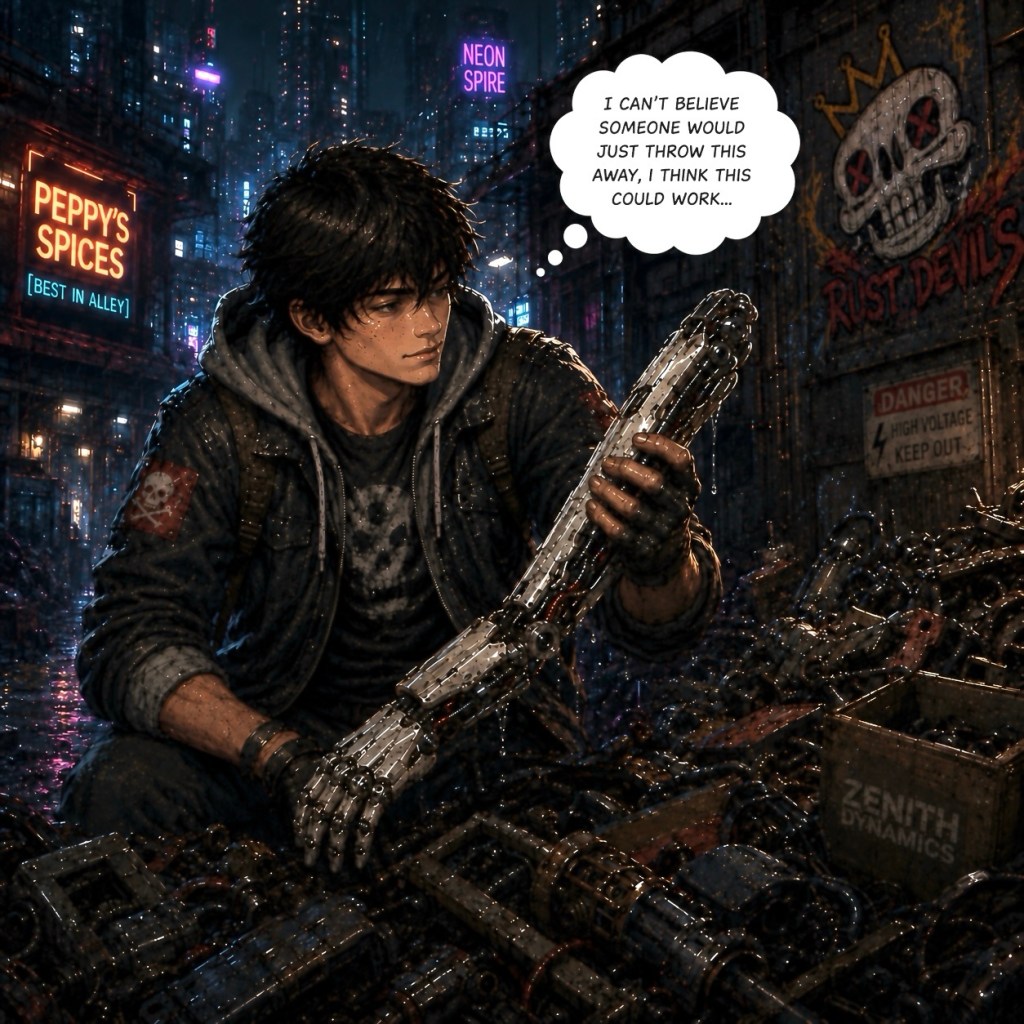
  • The rain never stopped in Iron Alley—it just changed color. Tonight it fell in streaks of copper and electric green, mixing with oil slicks and neon reflections on the cracked pavement. The sound of it was drowned by the low hum of generators, the sputter of holographic signs, and the distant rumble of freight drones gliding overhead.

    Marek leaned against the corroded railing of the upper walk, a cigarette trembling between his fingers. The ember flickered like a dying signal light. Below him, the crowd pulsed—a maze of faces, raincoats, and flickering cybernetic eyes. Somewhere in that chaos were the Rust Devils, and they were looking for him.

    He still couldn’t believe he’d done it. One last bet, that’s all it was supposed to be.

    The Neon Bones Club had been packed tighter than a scrapyard circuit board. Every table a blur of faces half-lit by holograms, laughter twisted with desperation. The NeuroBliss dealers moved like ghosts through the smoke. Marek had sat at his usual spot—a rusted metal table etched with years of bad luck—and placed his last handful of CyberTokens on the table.

    “Double or nothing,” he’d said, trying to sound confident.

    The dealer had just nodded, no expression, the glow from his cybernetic eyes reflecting the spinning digital wheel. Marek had watched the numbers blur into one another, heartbeat syncing with the rhythm of the wheel’s soft electronic whine. Then the sound cut out.

    He lost.

    Now he owed the Rust Devils forty thousand CyberTokens. Money he didn’t have.

    He crushed the cigarette against the wet railing and looked down at the alley below. Red neon from a broken sign blinked “DEV—DEV—DEV—” in erratic bursts, painting the puddles in bloodlight. The air smelled of ozone and rusted metal. Makeshift housing stacked against the sides of buildings—metal boxes with cables and pipes snaking through them like veins. In one window, a child watched him with glowing blue eyes. In another, a woman adjusted her breathing mask as vapor hissed from a vent. Life in Iron Alley never stopped moving, never stopped decaying.

    He started walking. His boots splashed through shallow puddles, the hum of vending drones passing overhead. Somewhere to his left, a brawl broke out—two silhouettes wrestling over a glowing chip. The walls closed in tighter the deeper he went, advertisements flickering across peeling metal panels.

    He thought of running. Leaving the city. But the Rust Devils had reach—they’d find him even in the Neon Labyrinth. He’d seen what they did to people who crossed them. The Iron Devil robots they used for intimidation—hulking machines of welded steel and glowing red optics—didn’t just break bones. They erased debts by erasing people.

    He ducked into a side corridor, the kind that wasn’t on any official map. A dripping tunnel lined with fiber cables and graffiti. Someone had painted a mural of a broken halo—“THE CITY OWNS YOUR SOUL” scrawled beneath it.

    Marek laughed bitterly. “Yeah,” he whispered. “Seems about right.”

    He checked his comm implant—three missed messages from Juno, his ex. She’d warned him weeks ago. “The Devils don’t gamble,” she said. “They calculate.”

    A low mechanical growl echoed behind him. He froze. The sound of metal feet scraping against wet pavement. Then the hiss of hydraulics.

    A crimson light cut through the dark, reflecting off the walls like a blade.

    “Debtor Marek Voss,” a modulated voice said. “Time to pay.”

    His breath caught. He bolted down the corridor, slipping on the slick ground, shoulder slamming into a pipe. The Iron Devil followed, its footsteps steady, inevitable. He could feel the vibrations through the metal floor. His comm implant buzzed with static—probably interference from the Devil’s EMP field.

    He turned a corner and burst into a crowded walkway. Faces blurred past him. People moved aside, unconcerned, too used to this kind of thing. No one helped anyone in Iron Alley.

    He ran until his lungs burned. The walkway opened into a narrow platform overlooking the lower district. He could see the lights of the NeuroCorp towers far away—cold, perfect, unreachable.

    Behind him, the Iron Devil emerged from the shadows. Its frame gleamed with rust and wiring, the Rust Devils’ insignia burned into its chest plate.

    Marek looked down at the drop below. A maze of pipes, glowing cables, and the endless hum of the city.

    “Please,” he whispered. “Just one more chance.”

    The machine stepped closer. “You already had it.”

    He stepped back—heel slipping on the wet metal.

    And then he fell.

    As he tumbled through the layers of Iron Alley, past the flickering signs and exhaust vents, the city blurred into light and shadow. Somewhere above, the Iron Devil watched him vanish into the darkness. Somewhere below, the hum of the city swallowed him whole.

    In Iron Alley, debts didn’t disappear. They just sank deeper into the rust.

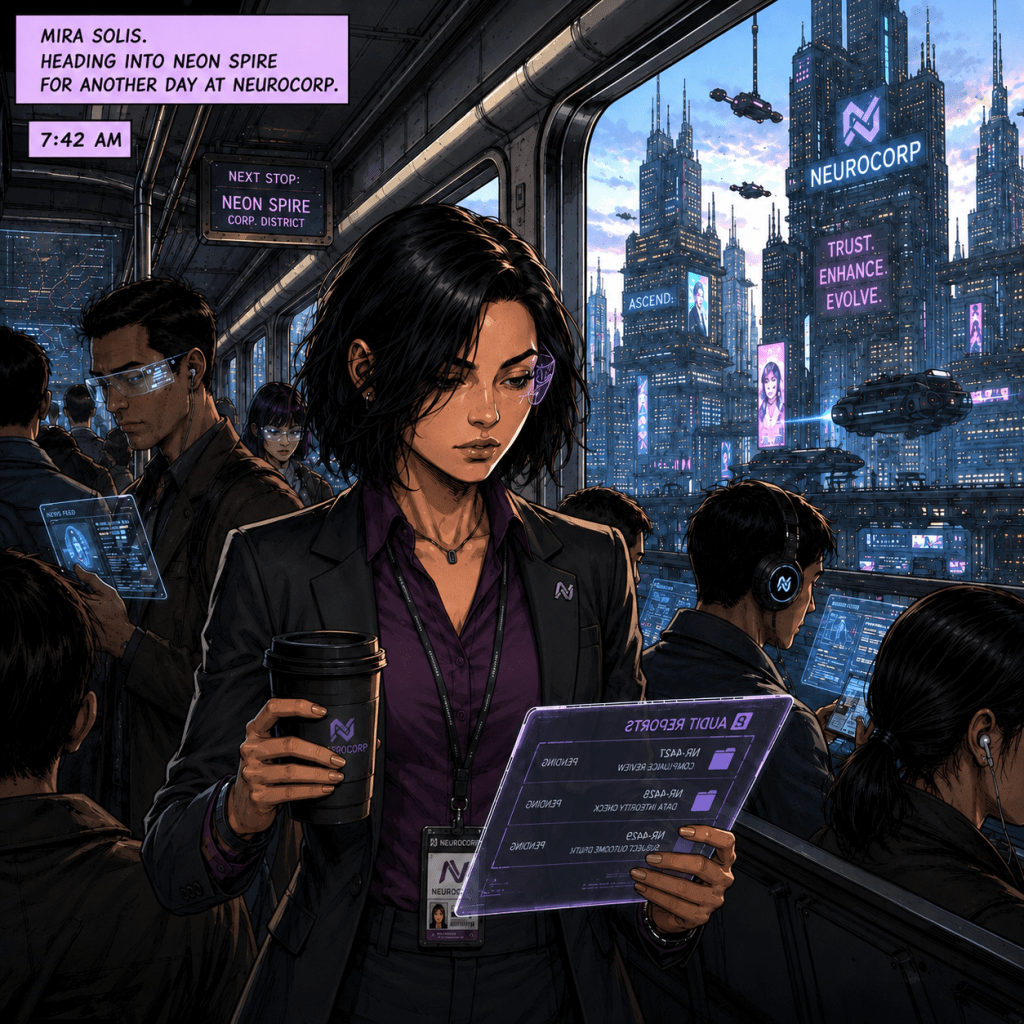
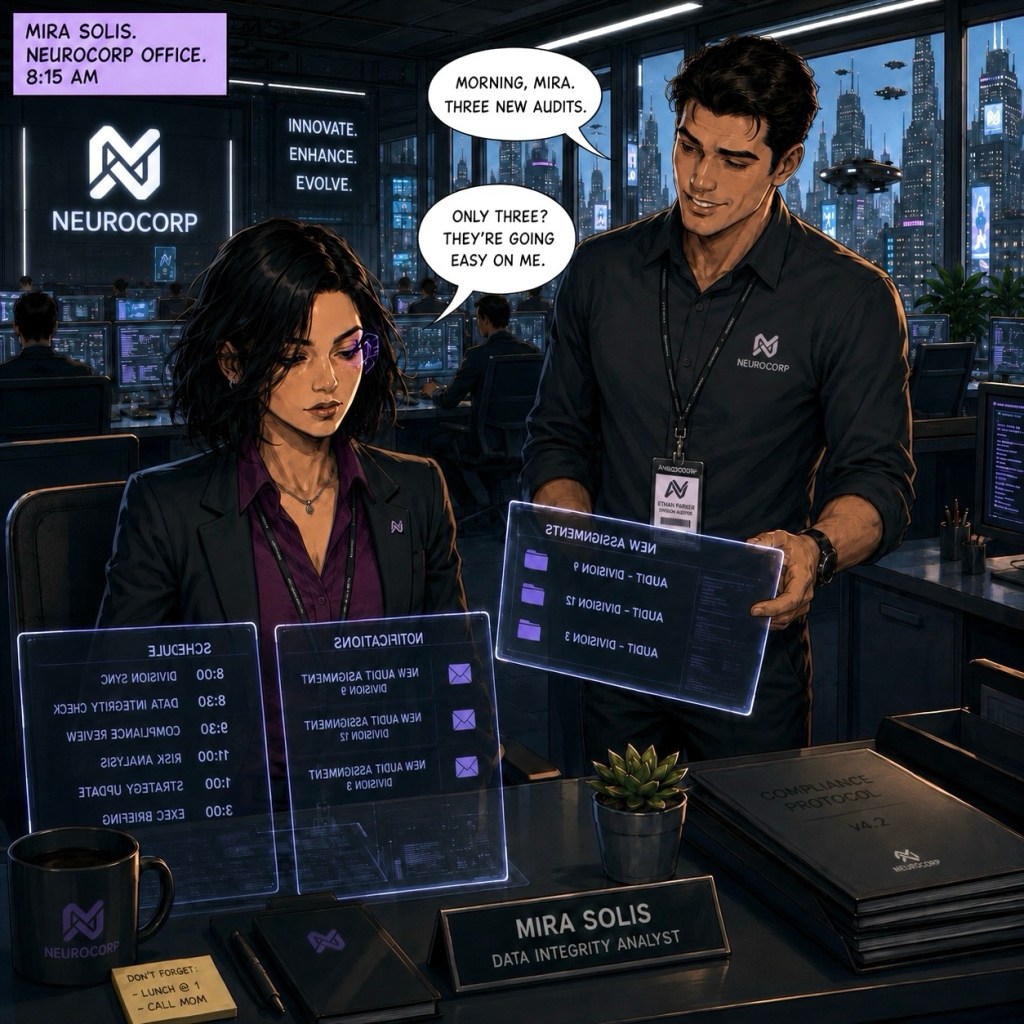
  • The old arcade in Neon Spire still flickered at night — a skeletal shell humming with the ghosts of old machines. Screens glowed weakly in the dark, bathing cracked floors in waves of blue and violet light. Kai pushed open the door, its rusted hinges screeching, and spotted Mira crouched beside a broken holo-pinball table, her coat haloed by neon static.

    “You’re late,” she said without looking up. Her voice was quiet, but it carried — the kind of voice that didn’t need to shout to cut through the noise.

    “Neon Spire traffic,” he lied, brushing rain off his jacket.

    She smiled faintly and held up something small — a device no larger than her palm, pulsing with a soft amber core that seemed to breathe. “Found this behind the old maintenance vault. NeuroCorp stamp, but… it’s not in any database. No ID, no signal, just… this glow.”

    Kai leaned closer. The light from the device painted her face in warm contrast to the arcade’s cold blues. “You sure you want to mess with that? Stuff like that doesn’t just end up in Spire ruins.”

    Mira shrugged and slipped it into her bag. “That’s why we’re going to see where it came from.”

    They left the arcade, boots splashing through shallow puddles that reflected the high-rise glow — rivers of light running down the metallic veins of the district. The walkways above buzzed with the hum of traffic drones and electric signage. Below, alleys pulsed with the heartbeat of the city — synth beats leaking from hidden bars, vendors shouting over static-choked speakers.

    They moved through the corridors and catwalks like ghosts, weaving between shadow and glow, every turn revealing another layer of Neon Spire — the market decks, the cooling vents, the mirrored surfaces that made the night feel infinite.

    Finally, Mira stopped beside an old access hatch, its frame covered in bioluminescent graffiti. She knelt, pressed the device against it. The amber pulse quickened. Metal locks hissed, gears shuddered — and the wall began to open.

    A rush of cold light flooded out, sharp and white, illuminating their stunned faces. Inside was something vast — cables suspended like roots, glowing with the same amber hue as the device.

    Kai swallowed. “What the hell is this?”

    Mira turned to him, the light reflecting in her eyes like fire. “I think it’s alive.”

    And somewhere deep beneath Neon Spire, the city began to hum back.

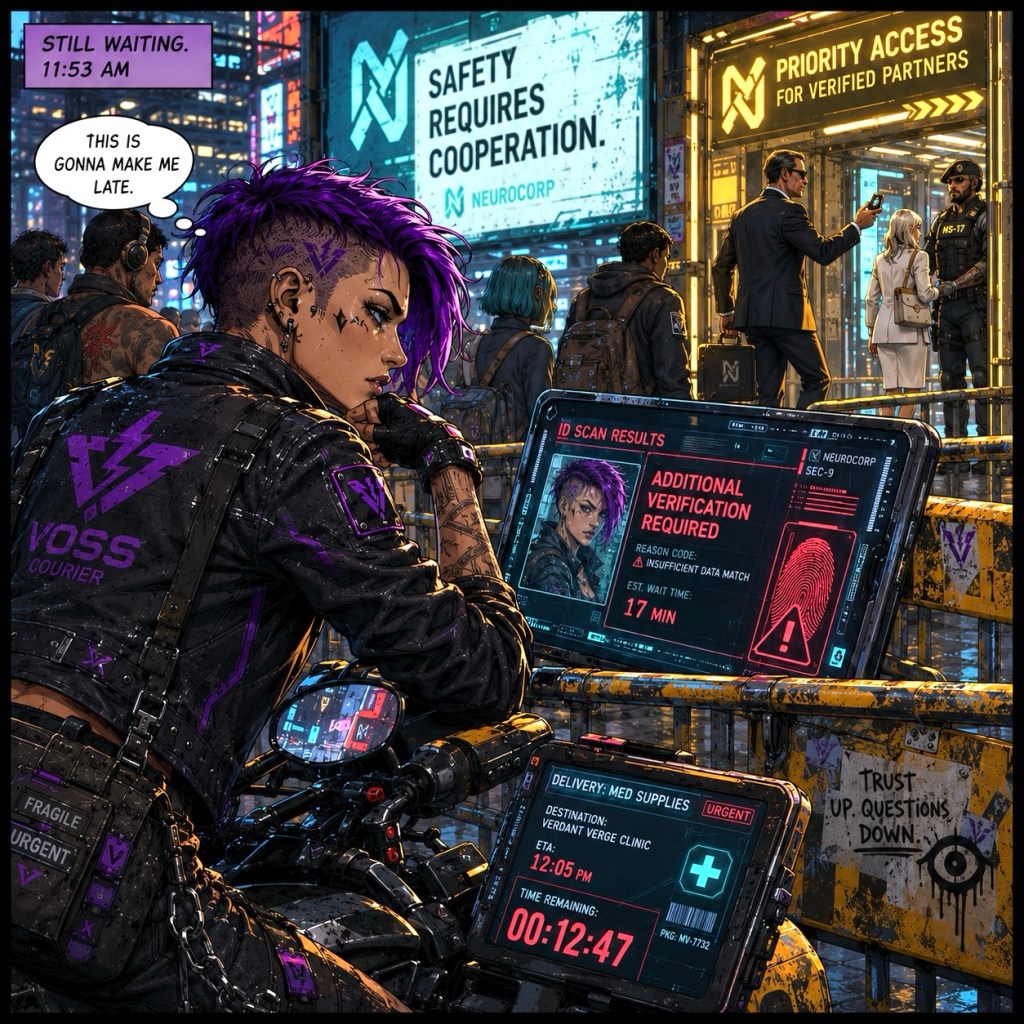
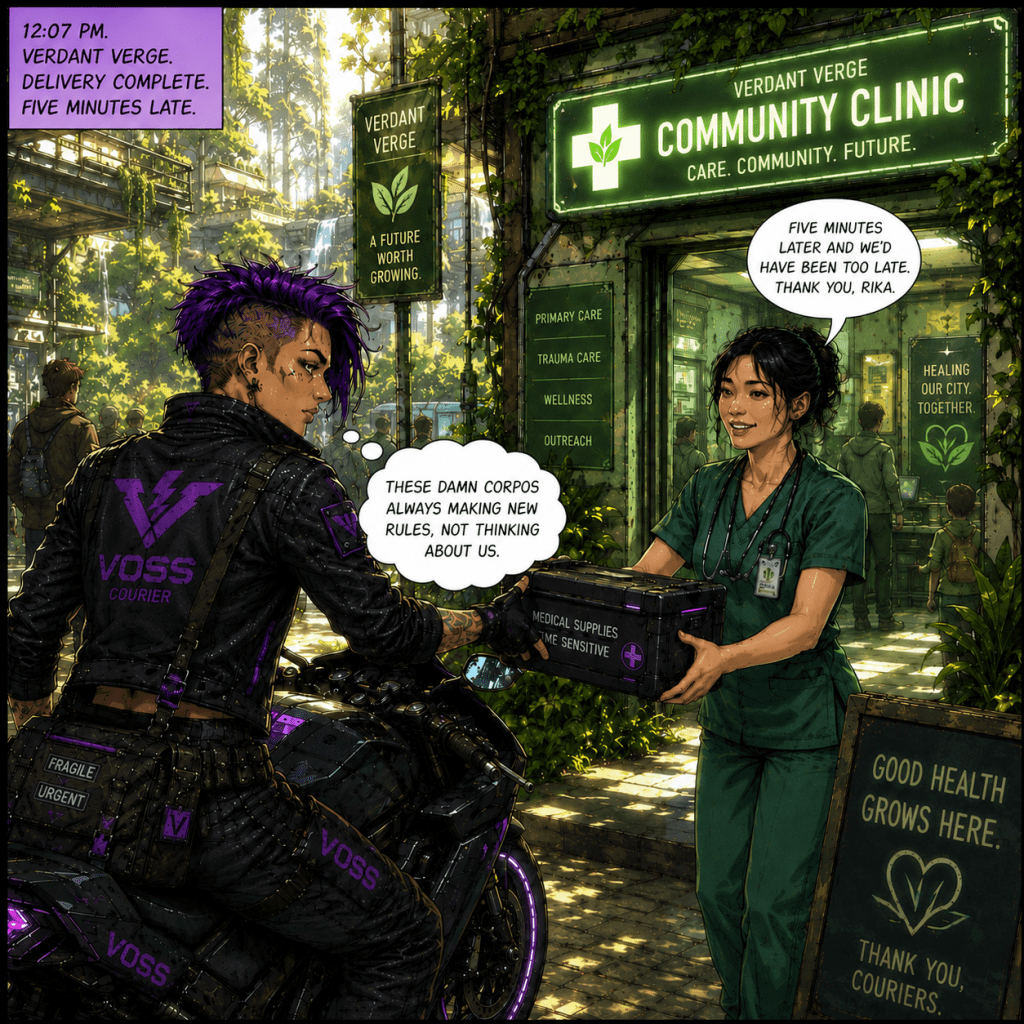
  • The Neon Spire never sleeps; it only exhales different colors. Tonight it breathes cobalt and bruised magenta. Towering slabs of glass and steel stitch the sky into a jagged skyline, and every surface wears advertising like neon jewelry — drifting holo-signs hawking blissful serums, corporate mascots with permanent smiles, an endless carousel of promises. Rain falls thin and cold, turning the avenues into mirrors. My bike eats those reflections. I ride fast because I always ride fast; speed keeps the city from settling on me.

    They call me Kade. Slim, thirty, a laugh-line where a grin used to be. I work with my hands, grease under my nails and a map of scars on my knees. Tonight my hands are doing what they do best: hold a crate, feel its weight, promise it will be where it needs to be. The Rust Devils paid good credits for this run — better than the usual courier gigs — and when the Rust Devils pay, you don’t ask questions. You make the delivery and you disappear into the light.

    The crate is warm against my thigh. It smells faintly of antiseptic and copper. There are stickers on the outside: a stylized gear with horns stamped in rust-red. Inside, rows of sealed ampoules nest like sleeping things, each labeled in neat print: Solace-3 — Stabilized. Approved. There is no retail barcode, no corporate seal I’ve ever seen; only the Rust Devils’ mark and a caution I ignore because I can count debts better than I can count morals.

    Neon Spire’s elevated lanes are a lattice of light; my engine hums as I weave between them. Pedestrians are silhouettes against the glow, umbrellas like dark moons. Market stalls under cantilevered walkways sell steaming noodles and chipped tech and counterfeit smiles. Above, a holo billboard for NeuroCorp pulses its slogan in a voice soft as a lullaby: RELIEF IS DISTRIBUTED. Trust us. The holo’s light bleeds down into a puddle and turns into a blade.

    The drop is simple — a loading bay behind an abandoned club that used to host better music. Two Rust Devils watch the ramp, their jackets the color of old blood. They check the crate, peel the tape, and give me a nod like I’m a payment, like I’m already spent. One of them taps my helmet and says, “Clean work, Kade. You’ll see your credits.” The other trails his thumb over the ampoules as if testing how fragile they are. They don’t look at me with any more curiosity than you would a rainbird.

    I should have left then. I should have taken the wet night and screamed away like another shadow. But Lira owes her mother treatment. My pockets need patching. I think of rent, of oil filters, of the way Lira laughs when she tries to cook and the noodles stick together. These are the little economies that keep people like me making the runs that keep Rust Devils in business.

    I ride home through alleys that smell of frying oil and ozone. Neon signs crowd the narrow sky until it is a strip of electric daylight. Lira’s apartment is a small room three levels down from a walkway named after some long-gone poet. Inside, there’s a patchwork of books and a single potted fern that keeps pretending to be brave. Her mother — Mae — sits propped on the futon in a cardigan that has seen better winters. Her hands tremble, not from age but from a different kind of erosion. Lira is careful with the syringe, precise as a mechanic; Lira’s hands are good hands. Mae smiles at the two of us like a lighthouse.

    “New batch?” Lira asks when she sees the crate.

    The crate sits on the kitchen table, a huddle of glass under the neon wash from the window. I pull an ampoule out of its foam cradle like you would remove a secret from a pocket. It catches the light and fractures it. Lira reads the label and her expression goes small and tight.

    “Solace-3,” she says. “Cheap, but stabilizers say it will do until the clinic sends the next supply.”

    I tell the smallest, most useful lie: “Rust Devils’ supplier. Paid well.”

    She doesn’t ask where we got it. She trusts me too much. Mae swallows the dose like it’s a piece of kindness. She closes her eyes and exhales. For a moment, peace stitches the apartment together.

    Then the tremor sharpens. Mae’s fingers claw at the blanket. Her breath scissors and comes back wrong. Lira’s face collapses. She presses her palms to Mae’s jaw and shakes her. Mae’s eyes open and show a net lined with static.

    “Something’s wrong,” Lira says. Her voice is a paper plane.

    I taste metal. I know the label now. The font, the sticker, the Rust Devils’ mark — all of it threads back to the crate I moved across neon veins. I did this. My hands had already touched murder and called it commerce.

    The city’s noise crowds back into the apartment like an interrogator. Holo-ads outside chant in perfect rhythm. Somewhere far away, a skirmish flares like a match. Lira’s phone curls under her palm and rings the clinic number until the system responds with robotic patience. No answer. The system says diagnostics: supply chain delay. Recommendations: emergency stabilizer required.

    I go to the crate because I need to find the lie that made this happen. One ampoule sits on the table, its liquid a clear, too-bright thing. I pry the seal. It smells like chemical lilies and old promises. Under the label, tiny print reads: CONTAINS: N-79; DOSE STABILIZER: 0.002%. Someone shaved the stabilizer down to nothing. Somewhere between manufacturing and me, the formula got thin.

    I have two choices: fold into punishment or fight for something I hardly understand. I am a courier, not a soldier. But the city teaches you to be useful with whatever tools you have. I drink in the neon at the window and make a decision that tastes of teeth.

    The Rust Devils’ stronghold is a rusted monolith on the edge of Neon Spire, half-industrial, half-cathedral. Holo-graffiti crawls up its buttressed walls. I park in shadow and trade my helmet for anger. The gang’s sentries leer like vultures. I can’t muscle through them. I can’t gun them down; they have more metal than sense. So I use what I always use: speed, surprise, example.

    Under the rust-colored logo, an open door does the city’s work for me — it invites me into a place that smells like burned copper and ambition. Inside, ampoules stack like teeth in a jar, inventories that taste like power. A ledger sits on a table: lists of supplies, delivery addresses, a name etched that makes my stomach drop. Whoever’s behind this isn’t just selling pills. They’re recalibrating the city’s arteries — lacing stabilizers with scarcity, with profit, with control. People who need help will come back for more and become rentals of the gang’s influence.

    I don’t have a plan. I have a reckoning. I snatch a tray of ampoules and shove them into my jacket. Alarms bellow. The Rust Devils pour into the corridor like spilled ink. I ride because the city is a maze I know better than they do, and because Lira’s voice in my ear — begging, cursing, naming me like someone trying to conjure a safe harbor — is a compass.

    I get back to the apartment bleeding with cold and adrenaline. Lira meets me at the door, hair a halo, eyes wet with electric fury. I hold out what I took: a handful of ampoules not laced with the Rust Devils’ stamp, one with a manufacturer’s imprint I recognize from a clinic distributor. I jam one into Mae’s lip and wait.

    Time is a narrow corridor. Mae coughs and then breathes like someone dragging a new light through old lungs. She opens her eyes and looks at me. There is recognition and something like forgiveness. I think she knows I did this. I think she knows I undid some of it.

    The Rust Devils will learn I’m their missing ledger and my face will press on their memory like a decal. The city will notice me — a ghost on motorbike tracks. In the morning the market will hum and the holo-ads will smile. For tonight, though, the Neon Spire offers a sliver of grace: Mae’s breathing steady, Lira’s hand in mine, the rain painting everything honest.

    We sit in the electric afterglow and let the city wash over the cracks. I thought the job was a line in a ledger. It was a line through lives. I also learned that in a place designed to commodify relief, hands that move are the only currency that still feels like mercy.

    Outside, a holo-billboard blinks: RELIEF IS DISTRIBUTED. Trust us. I look at it until the letters blur. I don’t trust anyone anymore. But I can make the next delivery a different thing. That will have to be enough.

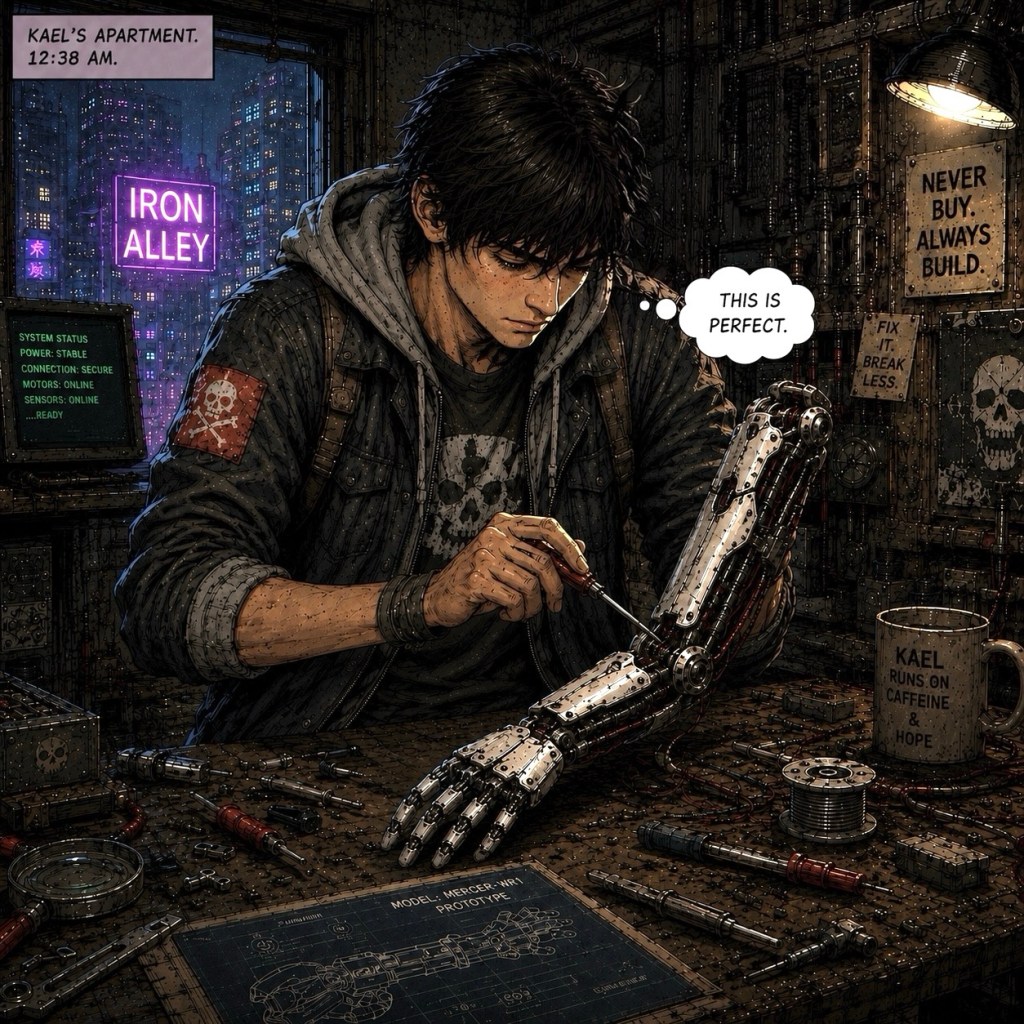
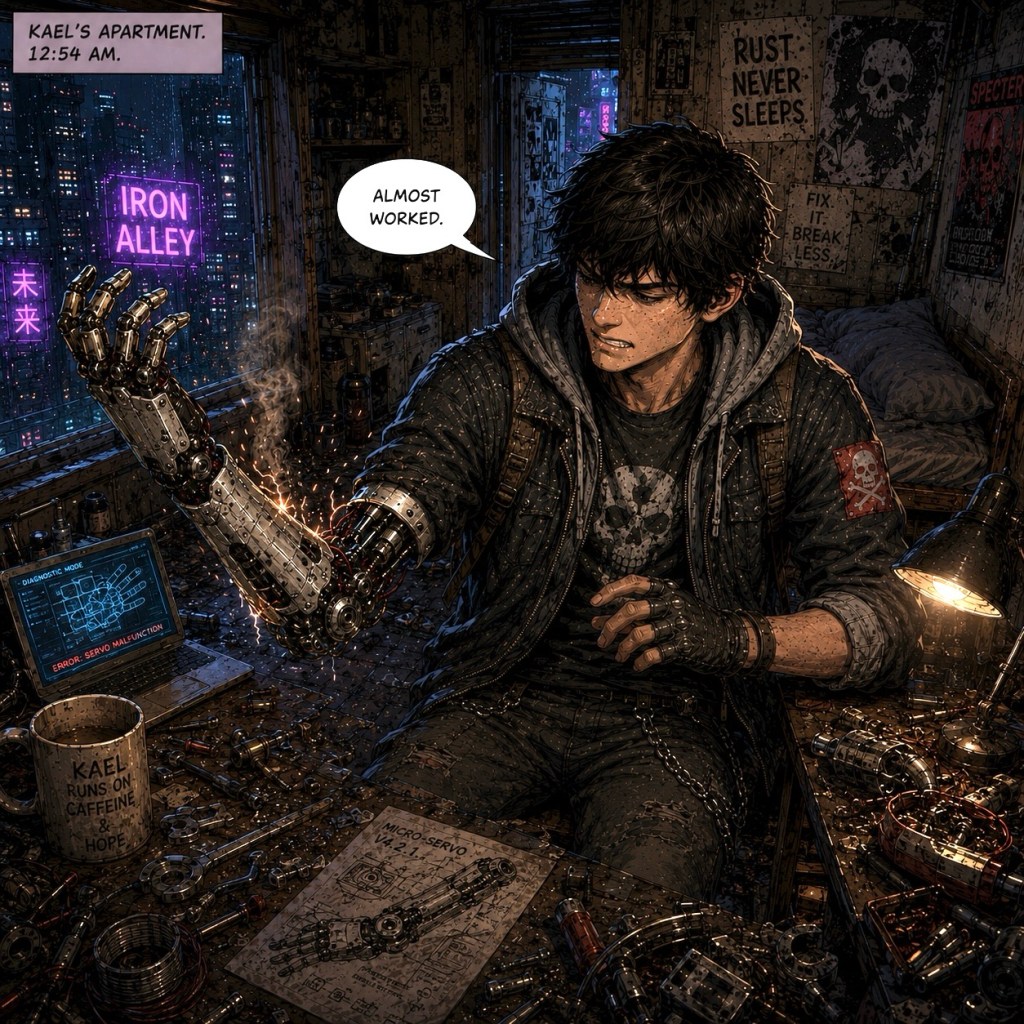
  • Reid’s mornings begin before the city wakes properly — not with silence, because silence is rare in Iron Alley, but with the low clatter and hum that lives under everything: gears settling, neon warming, distant conveyor belts sighing. He unlocks the roll-up at Sprocket & Splice, his repair stall wedged under an overpass of one of the alley’s lower pedestrian pathways. The sign is hand-painted and half-glows; a string of lamps (his favorite—soft, amber bulbs in mismatched cages) hangs along the front, throwing warm pools across a counter of salvaged chrome.

    By eight he’s already up on the walkway. The raised pedestrian paths here are like a second city stitched above the streets — narrow steel catwalks, patched wooden planks, braided rope bridges, stairways hidden behind cupboards that serve as shops or homes. They run like veins at several heights, looping and intersecting, sometimes suspended three stories above the asphalt and sometimes dipping to kiss the rooftops. People use them to get where they need to go without having to elbow through the market stalls below; they’re shortcuts, balconies, meeting places, and a way to keep shoes cleaner than the street gutter would allow.

    From his favorite stretch, a hairline bridge between two buildings, Reid can look down and see the alley unfold like a living map. Directly beneath him, a noodle stall steams and gossips into the morning; the vendor hollers a joke at a customer whose laugh rises to him in scattered pieces. Far below, someone is dragging a crate of refurbished circuit boards; a kid on a repurposed scooter weaves through the legs of pedestrians. Above him, on a pathway a level higher, a group of teenagers kick a frisbee between lamp posts, their laughter ricocheting off corrugated metal. Sunlight — when it finds its way between towers — slices through smoke and fog in hard ribbons that catch on dangling laundry and neon signs.

    Halfway through the morning, Jace appears on a crossing bridge across from Reid, perched by a cluster of potted ferns someone has coaxed out of an old bathtub. Jace waves, one arm full of parts and a mug of something hot. They exchange a wordless greeting — a lift of a hand, the small ritual of people who have learned to navigate the alley’s levels like a language. Reid calls over, “You got the actuator?” and Jace slides the part along the rail toward him using a length of wire, playing the space between them like a friendly net.

    Reid’s day is a measured choreography: fix a robo-dog’s broken hinge, solder a coffee vendor’s generator, jury-rig a neon halo for a storefront that can’t afford the real thing. Customers climb up and down the walkways, a parade of faces framed by patchwork doors and the leaning signs of mom-and-pop shops. A seamstress leans out of a window to ask about a small motor; an old man below sells battered watches from a solder-stained tray. The smell shifts — oil, hot metal, frying dough, green rot where vines press through cracked brick — all arranged in the urban score of Iron Alley.

    There are hidden pathways Reid only uses when he wants privacy or when he needs to get a part quickly. A false storefront disguises a set of narrow stairs that descend in spiral, opening into a pocket courtyard where neighbors keep hens in wire cages and hang jars of preserved fruit. On days when the heat is heavy, he takes that route and sits on the courtyard’s edge, listening to the city as if it were a single creature breathing.

    At noon the higher pathways bustle with workers commuting between ateliers and market roofs. From his bench, Reid watches a woman with a crate of succulents negotiate a rope-ladder across to a balcony garden three levels up. Children balance on the railings like acrobats. A tram bell rings somewhere distant; the sound travels better up here, a bright chime that keeps people punctual.

    As afternoon yawns toward evening, lights come on — lamps, neon, the soft afterglow of screens. The alley looks more honest from the walkways now: you can see the patched seams where neighbors have built one another new stairways, the careful repairs done with scavenged bolts and kindness. The city’s vertical life becomes clearer; stories overlap in the scaffolding. Above him, two lovers sit on the lip of a walkway, feet swinging over space and sky, while below, a brass band that mostly lives on an upper terrace plays a slow, brass-heavy jazz that smells of rain.

    When Reid locks up Sprocket & Splice, he walks the long way home: a high-level arc that gives him a final view. The street below is a ribbon of moving light; the pathways above are a lattice of silhouettes. Jace is on a platform across the way, tapping a tune on a metal pipe; Reid taps back, and in that small, percussive call-and-response they exchange the day’s balance sheet: parts fixed, favors owed, promises kept.

    On the edge of the walkway, looking out at the layered city, Reid knows this vertical geography by heart. The maps are not on paper here — they are in the sense of where the sun hits the rusted rail at noon, how the lamps smell when a rainstorm is coming, which stair gives a shortcut to the spice stall on the far corner. Iron Alley is a maze with a memory, and walking it every day, Reid is part of what keeps that memory alive.

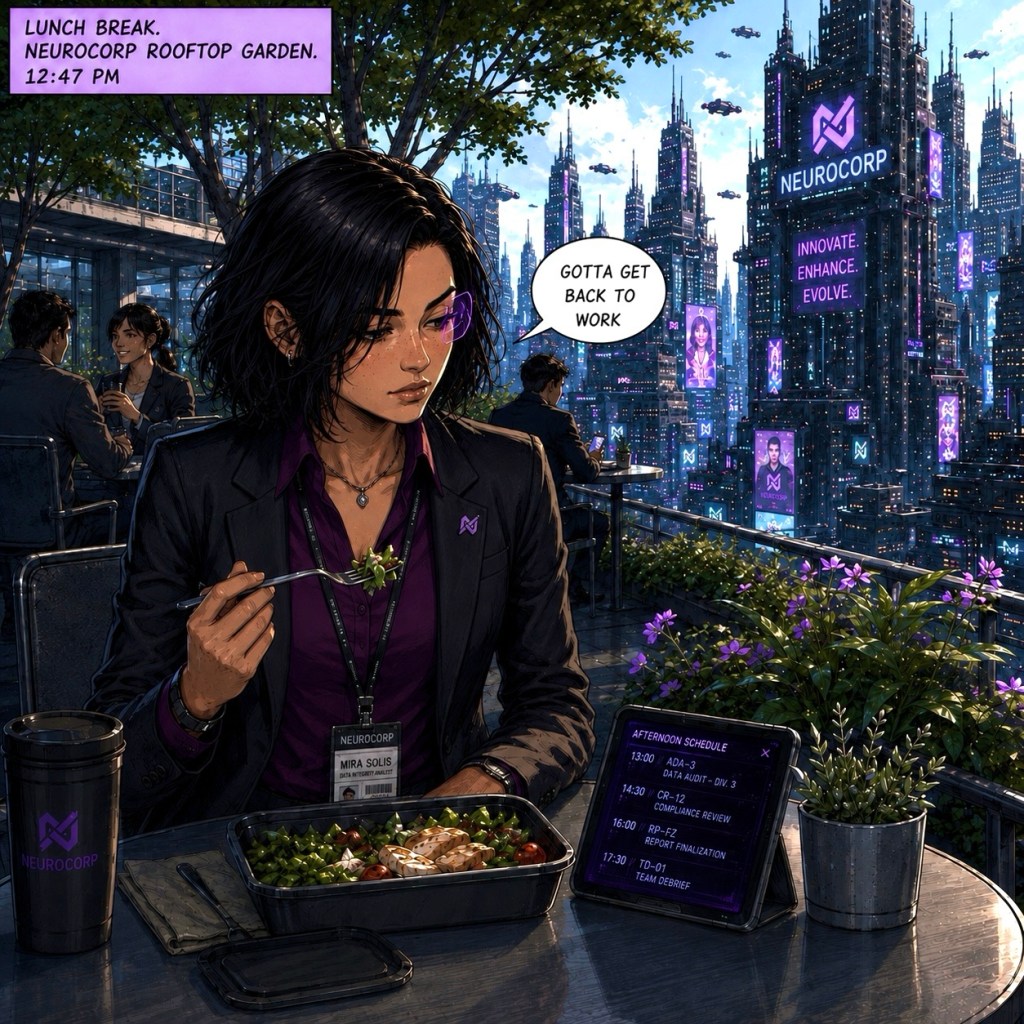
  • By the time NeuroCorp announced Lysarev, the city had already learned to worship its miracles.

    Billboards folded open like black flowers along the Neon Spire; holo-ads bled warm light into rainy gutters, promising “ten years of sunlight” for one small vial and a week’s wage. Inside glossy clinics that smelled faintly of ozone and citrus, shiny nurses slipped micro-needles into tired arms and smiled like they were part of some tidy, benevolent future. The press called it a revolution: a single genetic edit that told certain neural cells to make more of something everyone called the Happiness Molecule. The technical papers—dense and dazzling—used words like “upregulation,” “epigenetic stabilization,” and “durability.” The legislature gave NeuroCorp tax breaks. The city gave them a tower on the edge of the Neon Spire, its glass face reflecting a dozen neighborhoods of neon, rust, and reclaimed ivy.

    Ten years is a long time in Cyberpunk City and, for a while, it was long in a good way. People who had been locked behind the grey steel of depression came out of their apartments like people who had been given a second language. Streets filled with laughter that tasted a little processed, but real enough. The economy hummed. Lysarev became a household name, a line in the mouths of grateful parents and bored influencers. NeuroCorp’s stock swelled. Eron Vex—sharp-jawed, colder-than-ice in interviews—smiled in every shareholder report, his palms immaculate.

    Mara Cline had been one of the scientists who believed in the miracle. She had been a junior geneticist in NeuroCorp’s Serenity Division, the kind of woman whose childhood bookshelf had contained equal parts biology texts and dystopian novels. She had watched the bench tests, the animal models, the initial clinical cohorts. She had seen patients come alive. She had signed nondisclosure agreements with clean hands.

    What she did not—could not—see then was time stretching like a rubber band.

    The first decade after Lysarev’s release was all PR and glitter. Then a trickle of odd cases reached NeuroCorp’s internal clinic: manic episodes that weren’t just euphoria but sharp, bright hysteria; headaches that felt like lights burning behind the eyes; an odd sweetness in saliva. The doctors chalked it up to co-morbidities. The city’s tabloids whispered of a new subculture—“Lysarev-floods,” kids who took video of themselves in rapture—then celebrated them.

    By year eleven, the trickle became a flood. Entire blocs began behaving like electrical storms. People slept too little and spoke too rapidly, making risky trades and reckless promises. Some became obsessed, hoarding small objects with feverish attachment. Others simply melted into a lethargy that wasn’t the old depression but a heavy, gelatinous malaise followed by sharp terror. Emergency rooms were full of patients whose synapses had become over-amped; their blood tests showed markers nobody had expected. NeuroCorp’s labs found that the genetic edits—meant to be semi-stable—had drifted. Regulatory elements had been nudged by unknown epigenetic winds. Cells weren’t just making more of the Happiness Molecule; they had rewired themselves to prefer that state. The feedback loops that once moderated neurotransmitter production were frayed.

    Inside the tower, Eron Vex called it a “complication,” then a “manageable consequence,” then, when the calls from the city grew louder, a “market opportunity.”

    They named the second product Balansol.

    Where Lysarev promised growth, Balansol promised restraint. Where the first was an unlocking, the second was a leash. NeuroCorp’s spokespeople—avatars on giant screens—spoke of the “responsible path forward,” of “dual-therapy stewardship.” They claimed humility and care. They promised to distribute Balansol to anyone who had taken Lysarev, free for the first month. Lawsuits filed by patients turned into quiet settlements. The media, hungry and fickle, alternated between moral outrage and relief that a solution existed.

    Mara understood the science that NeuroCorp now offered as a fix. She had helped tune the promoter constructs that once sang with hope. She knew that the same edits that had been marketed as permanent salvation could, under slow molecular pressure, become runaway engines. She had written an internal memo years before the flood—an experimentalist’s caution note about long-term epigenetic drift. The memo had been archived under “low priority.” When she tried to bring it up again, the doors to strategy meetings closed. When she refused to approve a PR script that minimized the harm, her access was revoked.

    NeuroCorp did not have to make Balansol. But capitalism in the city was not a simple engine; it was a machine that grinds incidents into profit. Balansol required daily tablets—fine-tuned inhibitors that lowered the target cells’ output enough to keep people functional. Take it, and you could live a life indistinguishable from the one Lysarev had promised—only now your days would hinge on a corporate-supplied pill. Skip a dose and the light returned with a vengeance.

    The ethicality of a corporation that engineered dependence to extract profit is a moral noose. NeuroCorp avoided the noose by dressing it in velvet. They funded support groups and glossy ad campaigns about “shared responsibility.” They put clinics in the Neon Labyrinth and in Verdant Verge farmers’ markets, so both the rich and the green-haired activists could access Balansol. They sponsored festivals that celebrated recovery—while quietly renewing lifetime supply contracts when patients signed “consent” forms that read like contracts written for machines.

    Word leaked. A smuggled dataset, an audio of a meeting where Eron’s voice said, “We knew the drift, but what’s stewardship when we don’t make the medicine they need?”—those things surfaced and vanished in the same hour. NeuroCorp’s legal team moved like a shadow army. The city protested in fits. Some demanded criminal prosecutions; others demanded the right to forgo Balansol without being ostracized.

    It was not only the legal calculus that made the story grim. There were human stories folded into it: a teacher who had found herself full of daring creative energy only to fall into a manic spiral that cost her custody; a mechanic in Iron Alley who had rebuilt his life in year two and then spent years trading extra wages for Balansol pills; lovers who drifted apart under the soft tyranny of chemically moderated moods. The company sent condolence baskets with a tasteful note and an invitation to an exclusive webinar.

    Mara left the tower with a single thumb drive and a shoebox of printouts. She gave the files to a ragged collective of journalists and coders who hid in a basement under a noodle shop in the Neon Labyrinth. They published everything they could: internal memos, emails that showed marketing plans tied to “recurring revenue,” the flagged note about drift that had been “low priority.” The story exploded for a day. NeuroCorp’s PR machine surged back; Eron Vex announced independent audits, pledged transparency, and—most injuriously—set up patient councils led by people paid to be grateful.

    The city kept taking Balansol.

    It is easy to be righteous from the edges. It is harder to reckon with the thousands who could not function without the second pill because biology had been rewritten. Calling the corporation evil becomes complicated when the victims are your neighbors, your teacher, the barista who remembers your coffee order. NeuroCorp had made a product that relieved suffering for a decade, then created another product that managed the consequences of that relief. It profited, yes—obscenely—but it also provided a kind of stability that the city came to rely upon. For many, balancing the scales meant swallowing a crimson tablet each morning and continuing to show up.

    Mara often walked along the edges of Nature Alley at night, where ivy had conquered neon and rodents lived like tiny emperors. She thought of the ethics classes she had sat through, of the tidy hypotheticals about unintended consequences. She thought of the faces of patients she’d once helped—and helped to betray, however unintentionally. She thought of the tower where Eron Vex signed emails inviting her to “reengage” with the company. The city hummed with a million small moral decisions every day: take the drug, don’t take the drug, attend the rally, return to work.

    In the end, the story did not close on a courtroom drama or a violent uprising—though both were whispered about in the Neon Labyrinth. It closed on the quiet complexity of dependence: a balancing act between corporate power and human need, between invention’s promise and its vanity. NeuroCorp kept its tower; Eron Vex kept his smile. Lysarev and Balansol became part of the city’s chemical grammar. And somewhere, in basements and in lamp-lit kitchens, people argued over what counted as salvation—and what counted as a shackle dressed as a hand.

    Mara still slept badly. She still carried the shoebox. Once in a while, she’d replace the files with new ones—updates the coders sent—before slipping back into the city. She told herself she had done what she could: leaked truth into light and let the citizens decide. But sometimes, in the soft hour before dawn, she imagined a different kind of lab—one that returned edits to their original code, one that repaired drift without making new markets of human suffering. The city never built that lab. For now, there were tablets, towers, and the long, small compromises of people who wanted to live.

  • Izuka’s story begins in the dim glow of an old arcade — a place filled with flickering machines and forgotten games. What starts as a night of nostalgia turns into something deeper when one of the arcade cabinets glitches, revealing encrypted data hidden beneath the code.

    Driven by curiosity, Izuka steps into the neon-soaked alleys beyond the arcade, tracing digital footprints that lead through the underbelly of Cyberpunk City. Each glowing sign, each shadowed corridor hides a clue — pieces of a mystery buried beneath layers of corruption and forgotten technology.

    As players guide Izuka through the streets, they uncover fragments of a larger truth: a secret network linking the city’s entertainment systems, surveillance grids, and the missing citizens rumored to have “disappeared into the code.”

    Izuka’s Journey is about more than exploration — it’s about finding meaning in a world where reality blurs with the digital.

  • Tucked away behind a row of abandoned shops in the Neon Spire, this is where players first step into the underground. The Coder’s Den hums with static energy — walls lined with outdated tech, glowing monitors stacked like relics of a forgotten era.

    Here, the protagonist begins decoding fragments of the city’s hidden network — uncovering data that reveals the truth behind NeuroCorp’s influence. The flicker of neon lights outside blends with the cold blue of the screens inside, blurring the line between the real and the digital.

    Every file cracked, every signal traced, pulls the player deeper into the mystery.

  • Night falls over the Lunar District — a place where neon light meets quiet reflection. Bars hum with low conversation, holographic menus flicker, and the streets shimmer under the glow of the full moon.

    Players wander through this district between missions, uncovering side stories from street musicians, information brokers, and wanderers lost to the city’s rhythm. Every corner hides a memory — a fragment of someone’s past or a clue to what’s coming next.

    The Lunar District isn’t about conflict. It’s about connection — a reminder that in Cyberpunk City, even under the coldest light, humanity still glows.