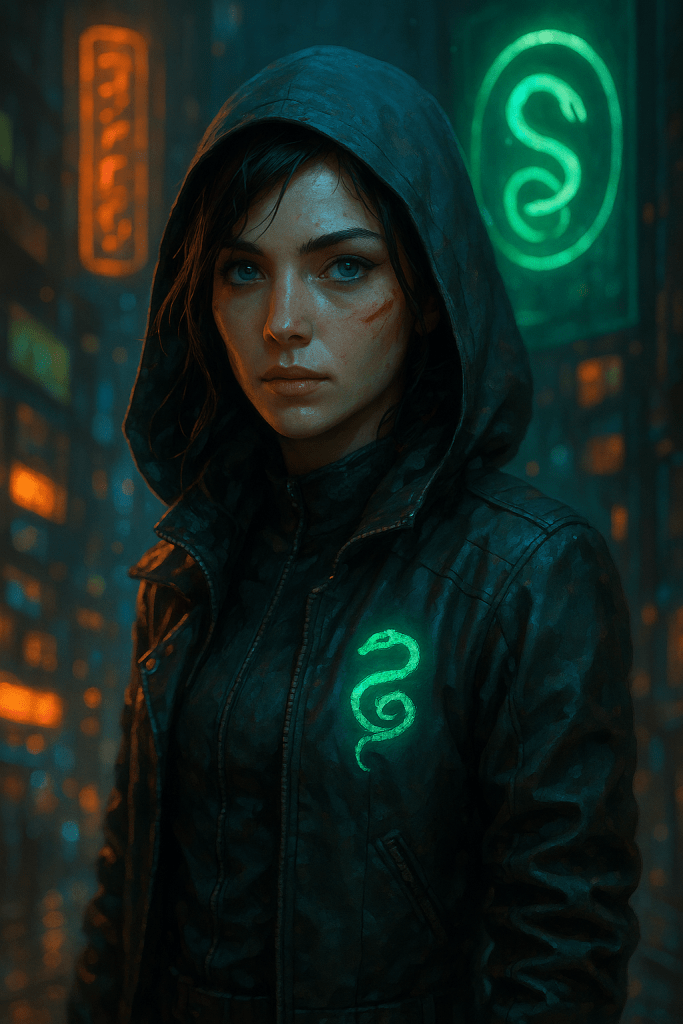
Born in the Rust
The first thing Kira ever remembered was the hum of broken neon. She grew up on the fifth level of a gutted tenement in Iron Alley, where the walls dripped with condensation and the floor vibrated every time a cargo hauler screamed overhead. Her grandmother kept a tiny workshop in a corner of their room—spools of salvaged wire, cracked data‑slates, and half‑dead neon tubes scavenged from shuttered storefronts.
“Kira,” her grandmother would say, soldering by lamplight, “everything in this city can be rewired if you’re patient enough.”
Outside, Iron Alley was a maze of stacked bridges and shadow markets. Gangs patrolled the upper rails, toll collectors shaking down merchants. The ground level was worse—tangles of pipes, leaking coolant, and dark corners where people disappeared. But in the mid‑levels, there was life: food stalls built on rusted catwalks, music drifting from hidden dens, and kids like Kira running messages between vendors for a handful of CyberTokens.
By ten, she could splice a data cable faster than most grown techs. She’d sit cross‑legged under a hanging lantern, fixing cheap synth‑lamps for traders while her grandmother told her stories of the serpent spirit—how it lived in cracks between stones, how it endured by slipping through spaces no one thought to guard.
One night, a firefight broke out between the Rust Devils and the Wraith Syndicate. Plasma bolts lit the skywalks, setting old signage ablaze. Kira watched from a maintenance shaft, clutching a tangled neon tube she’d rescued from the rubble. By dawn, half the block was burned out, but she’d dragged that tube back to the workshop and spent hours coaxing it back to life. When it finally glowed—a faint green spiral curling like a serpent—she felt something click deep in her chest.
If I can light this up again, she thought, then I can light up anything.
By sixteen, Kira was known along the walkways as the Neon Ghost—the girl who could bring dead signs back to life, who left glowing serpents on forgotten façades. She never joined a gang; she survived by slipping between them, trading repairs for safe passage, leaving her mark high above the streets where no one could touch it.
Iron Alley shaped her—its chaos, its danger, its hidden sparks of beauty. Every serpent she mounted, was a tribute to those nights under dripping ceilings, to a grandmother’s whispers about survival, and to the belief that even in the darkest corners, you can carve out your own light.
⸻
Crossing the Coil
By nineteen, Kira’s serpents had become a quiet language among the mid‑level runners. Her glyphs marked safe routes through Iron Alley—paths to stalls that didn’t cheat you, catwalks not watched by gangs. But with every new sign, she felt the net tighten: more gangs demanding protection fees, more corps scanning walls for unlicensed signals.
One night, a crew of Rust Devils cornered her on a high skywalk.
“Cute art,” their leader sneered, boot grinding against the glass panel. “But you’re not paying us.”
Kira’s pulse hammered, but she met his eyes. “I don’t pay for airspace.”
They chased her anyway—through shadowed scaffolding, across dripping cables. She darted into an abandoned lift shaft, slammed the hatch, and descended into the forgotten under‑layers where even gangs hesitated to tread. There, amid the hum of old conduit lines, she found something better than safety: a service tunnel leading outward, beyond Iron Alley’s mapped territory.
She followed it for hours, climbing through nests of cables and ancient ventilation ducts until the darkness thinned to electric blue. When she emerged, she wasn’t in Iron Alley anymore.
⸻
First Glimpse of the Neon Labyrinth
Before her stretched a tangled district alive with color. Narrow walkways overlapped in impossible patterns, glowing with signs layered three high. Aromatic steam curled from food stalls, and sound spilled everywhere—music, chatter, the whine of drone rotors.
For a moment she just stood there, rain dripping off her hood, watching the city breathe. Here, no one owned the walls. Façades shifted with every level, a mosaic of ads, murals, and coded graffiti. It was chaos—but not the kind that devoured you. The Labyrinth was a place you could disappear, reinvent yourself, or claim space without a gang tattoo.
Kira found a narrow alley framed by two teetering buildings, both abandoned but humming with scavenged power. She climbed until her knees ached, hauled herself onto a ledge, and mounted a fresh serpent glyph—the brightest she’d ever built, coils glowing in amber and emerald.
Below, vendors and couriers stopped to stare. Someone called up, “Who owns that sign?”
Kira smiled, sweat and rain streaking her face.
“I do,” she said softly, though no one could hear.
The serpent pulsed once, twice, then settled into a slow rhythmic glow—its hidden signal spreading through the Labyrinth’s mesh. A new chapter began that night, her past in Iron Alley left behind but never forgotten. In the Neon Labyrinth, her light would burn louder, freer, and reach farther than ever before.
⸻
The Circuit Under the Serpent
Months later, Kira’s serpents weren’t just art anymore—they were infrastructure. Couriers traced them. Smugglers paid her to mark hidden entrances. And whispers spread fast.
One whisper reached her late one night: NeuroCorp was moving something through the Labyrinth—something they didn’t want traced.
A fixer named Arlen found her on a rain-slick skybridge.
“You’re the one with the serpents,” he said.
“They light routes no one else maps. You have reach… and discretion.”
He offered her a job: install hidden glyphs to piggyback NeuroCorp data streams.
Payment: CyberTokens and access to NeuroCorp’s pharmacy nets.
Kira hesitated. “What are you moving?”
Arlen’s smile didn’t touch his eyes. “Neural prototypes. Nothing you need to worry about.”
Kira’s grandmother was sick then, tucked in a crumbling clinic near Verdant Verge. The meds she needed were locked behind NeuroCorp patents. Arlen knew it. He dangled the codes like bait.
“You help us,” he said, “and your grandmother gets her meds. Simple.”
Kira agreed.
⸻
The Dark Realization
Her covert glyphs bloomed across the Labyrinth—on a noodle stall awning, beneath a rusted balcony, woven into a holo‑mural. To most eyes, they were just serpents. But through their coils, NeuroCorp moved secrets unseen.
Until one night, recalibrating a glyph, Kira intercepted a data fragment:
Specimen 42-B en route. Biohazard protocol. Do not disclose human origin.
Her stomach knotted. NeuroCorp wasn’t just moving tech. They were moving people—or what was left of them.
But by then her serpents were essential to their network, and Arlen reminded her of it:
All those shipments trace back to you.
Your grandmother’s next dose is in my pocket.
Kira kept working. But inside, a fire had started.
⸻
Breaking the Coil
Rain drummed against her hideout roof as Kira crouched over an open conduit, the glow of a half‑assembled serpent glyph painting her tired face green. Arlen’s latest instructions scrolled across her cracked datapad:
Install Node 7B. Priority: Ultra‑Sensitive.
She zoomed in—and froze. Node 7B wasn’t just a relay. It was a neural siphon, designed to drain memories from anyone passing beneath. The output stream bore one word: Harvest.
Below, through the grated floor, voices rose—a kid crying, a woman pleading. Two men in NeuroCorp jackets dragged someone toward a drone container. The kid’s eyes caught the glow of Kira’s glyph. Fear. A silent question.
Something inside her snapped.
“No more,” she whispered.
She ripped out NeuroCorp’s chip, replaced it with a bypass rig of her own. The glyph lit, coils pulsing with a new signal:
⚠️ SERPENT STRIKE – NEUROCORP ROUTES EXPOSED ⚠️
Within minutes, couriers and smugglers saw it. Within hours, rival gangs and Verge activists tore into NeuroCorp relays, smashing siphons, hijacking shipments.
Kira watched as her serpents blazed across the city—no longer silent markers, but beacons of rebellion.
⸻
Hunters in the Rain
NeuroCorp didn’t call the police. They sent Trackers—cloaked hunters whose visors scanned like predators.
Kira saw the first one step onto a walkway. She ran. Plasma bolts hissed past, slicing a glyph in half. Sparks rained as she vaulted over a lantern stand and crashed through a curtain of plastic strips into another alley.
Ahead, the path split: a market above, a half‑collapsed tunnel below. She knew the market—too exposed. The tunnel? A forgotten artery toward Verdant Verge. She dove for it.
The hum of neon faded as vines crawled along the walls. Green light spilled from hydroponic planters strung like lanterns. The Naturas waited there, faces painted with moss pigment, drones and bows at the ready.
“You’re the serpent maker,” one said.
Kira nodded, breath ragged. “NeuroCorp’s coming.”
The woman smiled grimly. “Then they’ll meet the roots.”
⸻
The Stand
Behind Kira, the tunnel roared with approaching boots and drone wings. The Naturas moved, rerouting cables, setting traps that pulsed with soft green light.
Kira climbed a scaffold, mounting one last glyph high above the tunnel mouth—a serpent coiled around a blooming flower, a signal and a challenge.
When the first Tracker emerged, Kira whispered into her comm: “Now.”
The glyph detonated in a surge of EMP light. The Tracker’s cloak flickered, systems failing. Naturas surged forward, nets and pulse weapons flashing.
Kira watched from above, rain streaking her face, as her serpents glowed brighter than ever—art turned weapon, a network of resistance stretching across the city.
⸻
A New War
NeuroCorp wouldn’t stop. Kira knew this.
But as she watched the first Tracker fall, surrounded by living walls of green and coils of her own neon serpents, she felt something shift in the city.
For the first time, her light wasn’t just about survival.
It was about fighting back.
And Kira—born in Iron Alley, tempered in the Labyrinth—was ready to burn her name into every wall of Cyberpunk City.
 Cyberpunk City AI