Cyberpunk City AI

Explore an AI generated cyberpunk city @cyberpunkcityai

  • It started with a sign she’d never seen before.

    Tucked between a shuttered arcade and a storefront selling rebranded body mods, the glowing triangle caught Zoey’s eye: ZENITH DYNAMIC / HUMAN FUTURE DIVISION. No blaring music. No hawkers. Just soft white lights behind perfectly polished glass, and a door that hissed open at her approach like it already knew her.

    She almost turned away. Zenith Dynamics wasn’t street-level. They were a top-tier corp—bioware, cybernetics, neural mesh infrastructure. Corporate Olympus. Not the kind of place that welcomed greasy-apron food vendors from the alley grid.

    But the sign had that weird pull. Like a lucid dream.

    Inside, the lighting was clean. Unsettling. White and violet glows spiraled along the walls, illuminating rows of display cases with chrome-plated joints, subdermal interface patches, and memory-thread implants she’d only seen in elite black-market dumps. It was too quiet. Too sterile. And it smelled nothing like the city outside.

    She wandered further.

    No other customers. No clerk. Just ambient hum and silent motion-tracked lights that followed her as she passed.

    She paused at a display marked “Cognitive Enhancement Bundle – Beta Access.” Beneath the label, a small crystalline shard pulsed with slow blue light. She leaned in, just curious—just enough to see the serial etching on the core.

    Then the lights flickered.

    Her vision shimmered for half a second.

    And then—

    Black.

    She woke to pain. Not sharp, but… wrong. Like her muscles were fighting movements she hadn’t chosen.

    She was upright. Restrained. Metal against her skin. The air was cold and clean, with a synthetic tinge she couldn’t place. The walls were matte steel, interrupted by soft-glow panels pulsing to some invisible rhythm.

    Her mouth was dry. Her mind fuzzed at the edges.

    A voice crackled in.

    “You weren’t invited.”

    She tried to respond, but her vocal cords weren’t responding right. Her head lolled sideways. She could just make out a logo on the wall—sleek and sharp, a minimalist Z intersecting a hollow triangle.

    Zenith Dynamics.

    “You showed initiative,” the voice continued. “Curiosity is the first trait we measure. Most ignore the door. You didn’t. You entered.”

    A figure stepped into frame. Clad in dark synth-armor with no visible face, only a mirrored mask and a blue-lit headset blinking data she couldn’t read.

    “What do you want?” she managed, barely.

    The agent tilted their head.

    “To understand you. Your choices. Your resistance to imprint.”

    Zoey blinked. Her heart pounded. She wasn’t wired. She didn’t even have implants. What were they testing?

    “You think you’re nobody,” the agent said, turning away. “But the Labyrinth keeps secrets. And we think one of them is you.”

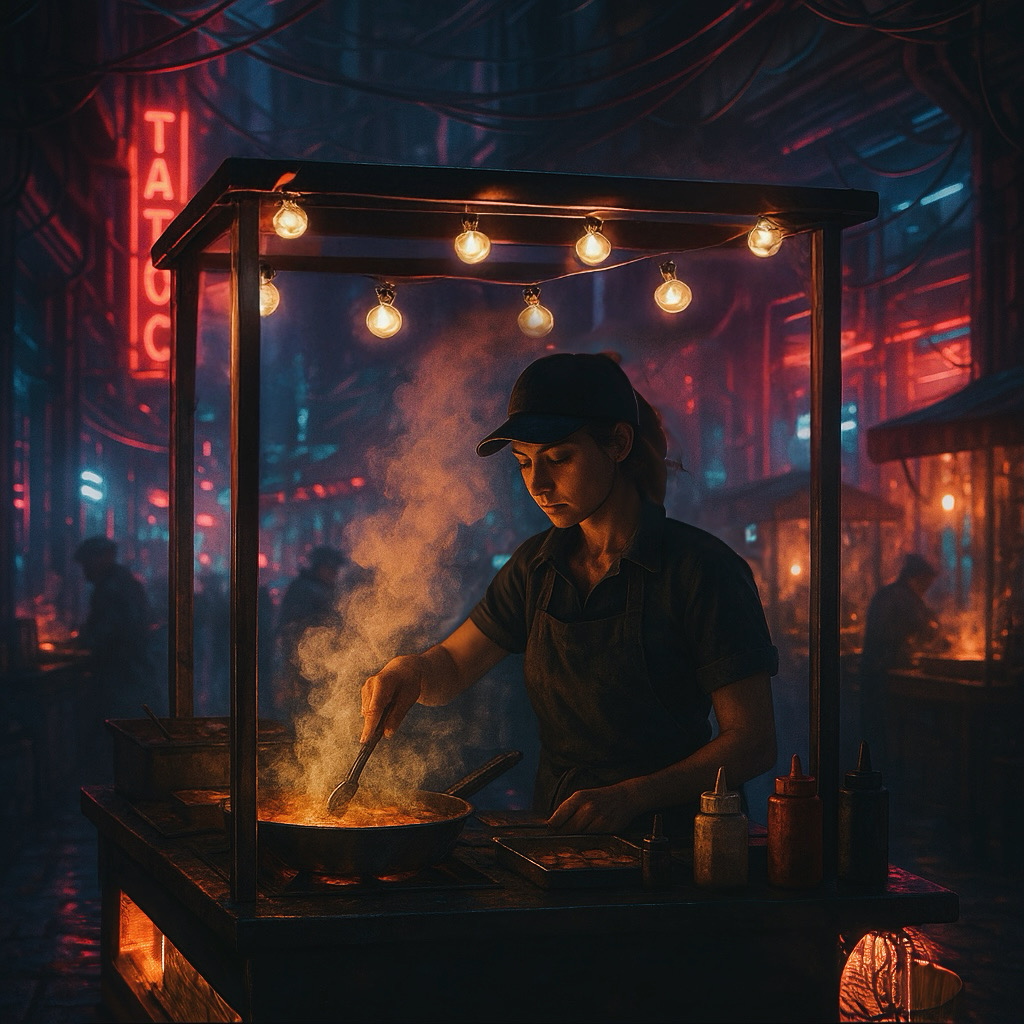
  • Zoey leaned against the rusted support beam beside a shuttered juice bar, the scent of her own fry oil still clinging to her clothes. The internal alleys of the Neon Labyrinth were alive tonight, pulsing with magenta signage, flickering blues, and the constant buzz of vending drones overhead.

    She hadn’t eaten. Not really. She’d nibbled on a few gritcake ends, sipped someone’s abandoned synth-tea. But food didn’t feel like it mattered here—not with the smell of artificial vanilla mist and energy drink fog hanging in the air, tricking the senses into thinking you were already full.

    Across from her, a holo-wall shouted a looped advertisement for glow-ink tattoos: “Your skin deserves a voice!” Another corner store had aisles of soft-eyed plush creatures embedded with dopamine triggers. Some little kid clutched three of them, none matching, their neon fur lit by blue storefront lights. His mother was still scanning through self-care implants.

    Zoey squinted against the haze.

    How did it come to this?

    The Labyrinth wasn’t built for shopping. It was built by accident—by necessity. Tunnels that had once led to nowhere had filled with junk, then stalls, then shops. The concrete bones of a city forgotten by planning commissions became a self-sustaining organism of need and hunger.

    But now? It looked like a parody of itself. Decorated alleys disguised as community. Everything had a subscription. Even the air, filtered through branded scent-haze, was bought and paid for.

    She folded her arms, the synthetic warmth of her hoodie no comfort in the heat radiating from the neon above.

    Was she better?

    She sold food, sure. But not joy. Not escape. Just something hot and real to people who needed to touch something not wrapped in plastic or beamed into their cortex. Maybe that was enough. Or maybe it was just another illusion.

    A couple brushed past her, too wired into their visor feeds to notice her at all. She caught a glimpse of their feeds reflected in the glass—endless product reels, glowing deals, curated moments someone else had paid to manufacture.

    Zoey looked up.

    The maze stretched in all directions—bridges overhead, walkways below, and a thousand glowing windows selling the same promises dressed in different packaging.

    She used to love the chaos of the Labyrinth. The unpredictability. The way people made things out of scraps. Now it felt like the city had been dressed up for a corporate funeral and no one noticed the coffin was already closed.

    She took a breath.

    Then she turned, heading back to her cart. Back to the pan. Back to the only heat in this place that didn’t come from branding.

    Maybe no one saw her. But she saw them.

    And she still knew the difference between hunger and habit.

  • Zoey didn’t have a tragic backstory or a secret past. She wasn’t ex-military, didn’t owe anyone money, and had never touched a weapon more serious than a fry spatula.

    She was just one of the thousands making it work in the Neon Labyrinth—Cyberpunk City’s winding artery of night markets, vertical alleys, and sensory overload. She ran a food cart tucked under a rusted overpass where the lights always buzzed too loud and nothing ever quite dried.

    The Labyrinth had grown from old infrastructure that had nowhere to go but sideways and up. Streets became walkways. Walkways became homes. Homes became vending stalls. And somewhere in the mess, Zoey carved out a rhythm.

    Her day started late. The mornings were for shopkeepers, commuters, and the few fools still clinging to routines. But by dusk, the Labyrinth bloomed.

    The whole district pulsed like a living thing—neon reflected off rain-slick pavement, vapor rising from makeshift grills, the chatter of vendors hawking everything from modded noodles to bootleg holo-movies. Strings of bioluminescent ivy grew between scaffolding, leftovers from a failed Naturas outreach campaign years ago. They thrived anyway. Everything did here—if you let it.

    Zoey’s cart didn’t have a name, just the scent of sweet heat and spice that regulars followed through the maze of kiosks and flickering signs. She sold skewers, fryballs, and her signature soy-glazed gritcakes that stuck to your ribs in all the right ways. Her customers were couriers, local kids, tired dancers from upper-level clubs, and the occasional corporate burnout wandering too far downhill.

    She didn’t ask questions. She didn’t need to. The Labyrinth spoke for itself.

    And maybe that was the magic of it: no one here had to be anything more than they were. You didn’t have to chase glory or revenge or the next high. You could just… show up, cook your food, feed people, go home. And in a city full of secrets and surveillance, that kind of normalcy? It felt revolutionary.

  • The Naturas maintain Verdant Verge not by rejecting technology, but by rewiring its purpose—taking the cold logic of the city’s systems and turning them toward growth, healing, and collective memory.

    When the Naturas first reclaimed the forgotten district, it was little more than a cracked layer of the old city, buried under moss, rust, and broken infrastructure between Neon Spire’s glow and Iron Alley’s grime. The Verge wasn’t gifted to them—it was wrestled from decay. But they didn’t rebuild. They rewilded.

    The foundations of old skyscrapers now serve as nutrient towers. The Naturas use mycelial mesh networks—fungal-rooted systems paired with nanotech—to recycle waste, process air, and generate low-frequency power that feeds their needs without disrupting the ecology. These networks breathe. They grow. They adapt.

    Instead of neon signs and surveillance lights, the Verge glows with seedlights—bioluminescent flora engineered with soft AI, programmed to illuminate only when needed. They brighten when someone walks near, dim when the forest sleeps, and pulse when storms approach. Even their colors shift with the emotional tone of an area.

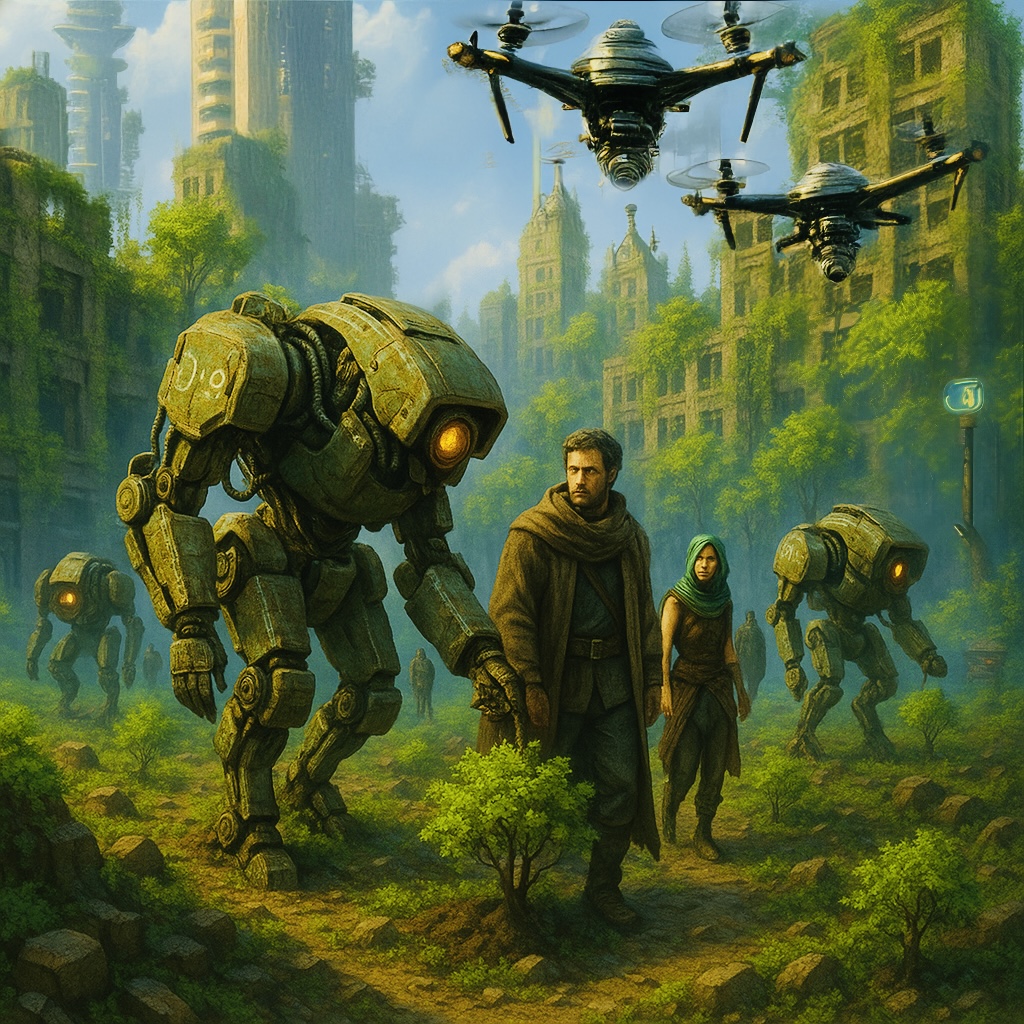
    The Naturas repurpose drones salvaged from NeuroCorp and Iron Alley. But instead of patrol or enforcement, their drones pollinate, plant, and monitor ecosystem health. They hum softly through the trees—painted with moss, their sharp lines dulled. Some even follow residents, acting as memory keepers and personal assistants.

    Structures in the Verge aren’t built—they’re grown. Trees are coaxed to form walls. Fungi create insulation. AI-assisted glyphweavers use embedded light-scripts to store oral histories, emotions, and decisions into bark, leaf, and root. These memory glyphs help guide future generations and serve as nonverbal communication across the district.

    Old power cores are rerouted into closed-loop solar-moss circuits, where energy is harvested from filtered sunbeams and stored in biodegradable capacitors. Nothing in the Verge is wasted. Water vapor is filtered through tree coils. Heat is stored underground and released during cold nights.

    In contrast to the oppressive gleam of Neon Spire and the industrial rust of Iron Alley, Verdant Verge is alive—not because the Naturas rejected the city, but because they rewrote its code. They didn’t flee from the concrete. They grew through it.

  • The rain hadn’t let up by morning.

    Kira was already gone by the time Liora emerged from the tiny room above Nari’s—its walls wrapped in old fabric woven with embedded light patterns that pulsed gently like a heartbeat. Kael was outside, seated under an overhang of flowering vines, sharpening a utility blade he didn’t seem to need but always carried anyway.

    They didn’t speak at first. The quiet between them wasn’t tense, just careful.

    Eventually, a tall figure approached—hooded, wrapped in a green cloak laced with glowing thread. One of the Naturas. Not a leader. Not a soldier. Just someone with sharp eyes and a careful step.

    “You can’t stay here long,” they said gently, almost kindly. “The market’s too public. NeuroCorp drones have been scanning the lower tiers. And the Rust Devils… they don’t respect borders.”

    Kael’s eyes narrowed. “How’d they know we were here?”

    “They don’t. But they will.”

    The figure handed Liora a folded seed-map, its surface shifting with subtle lines that responded to touch. “There’s a place near the edge of the Verge—north of the Mist Ridge. Old roots, grown into forgotten infrastructure. Quiet. Most don’t go there anymore.”

    “Why are you helping us?” Liora asked, studying the glowing folds.

    The Natura smiled faintly. “Because you haven’t decided what side you’re on yet. That means there’s still a chance you’ll pick the right one.”

    Later that afternoon, they walked.

    The Verge grew wilder the farther they went—less curated, more unruly. Bridges covered in vines. Walkways swallowed by moss. Bioluminescent butterflies flitting through heavy air.

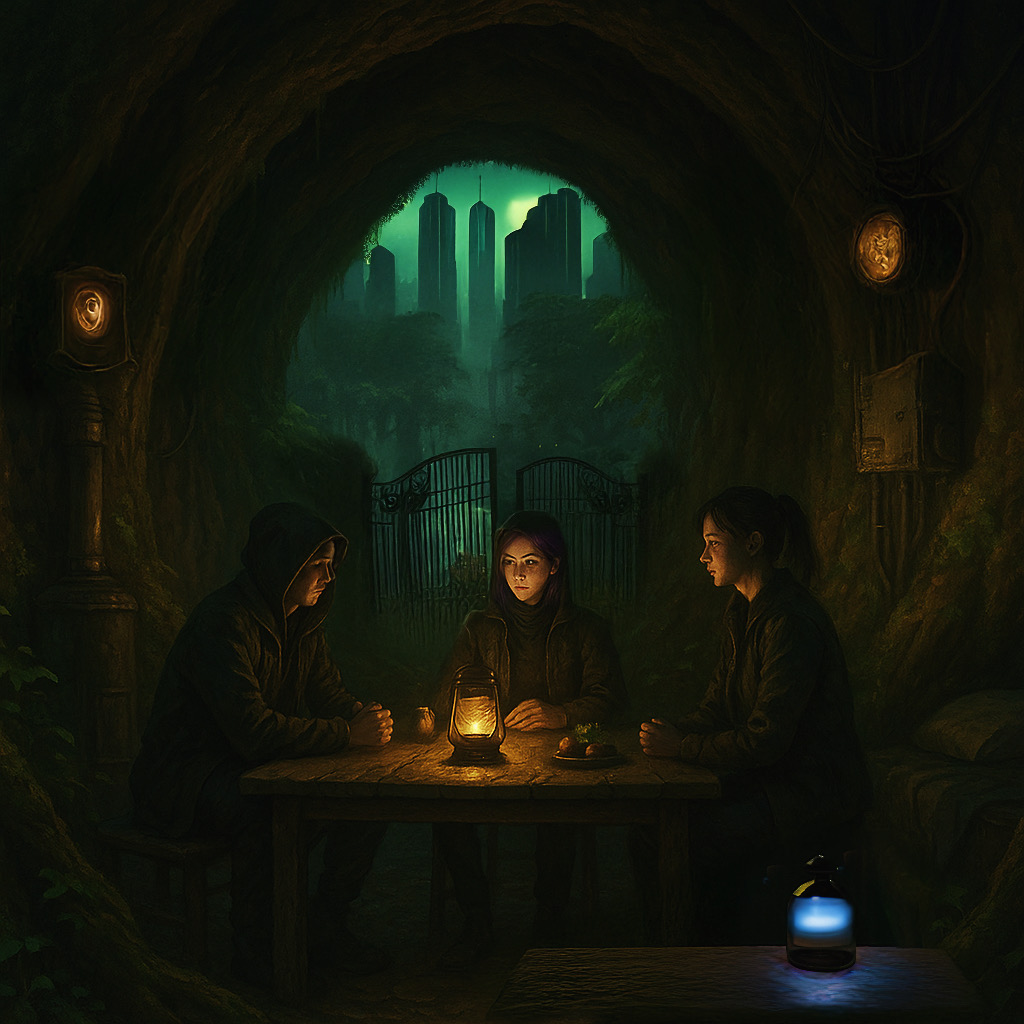
    The hideout wasn’t a building, not in the traditional sense. It was a massive hollowed-out tree, grown around the rusted skeleton of an old telecom tower. Someone had once lived here—cables ran like veins through the wood, and a small generator hummed just beneath a floor covered in thick leaves. A narrow slit in the bark offered a view of the forest canopy and, far off, the faint glow of the city skyline.

    Inside, there was a single table. A cot. A water purifier patched together with seedtech and old piping. And silence.

    Liora stepped in first. She reached into her jacket and placed the Luminis Serum—still sealed, still glowing faintly—on the table. A thin crack of blue light escaped the vial and bathed the bark in cold fire.

    Kael’s eyes followed the glow but didn’t ask questions. Kira stood in the doorway, silent. She’d seen it before. But here, surrounded by roots and breath and memory, even she looked unsettled by it.

    “It’s quiet,” Kael said eventually.

    Kira nodded. “This place remembers. That’s why the Naturas still trust it.”

    Liora sat down beside the serum, eyes fixed on the pulsing light. “We’ll only stay a few nights. Long enough to figure out what comes next.”

    Kael leaned against the wall, removing his gear slowly. “If they track us, we’re done.”

    “They won’t,” Kira said. “The Verge protects its secrets. And we’re not the only ones it’s hiding.”

    The vial glowed a little brighter then, like it had heard them.

    They didn’t talk about NeuroCorp. Or Klarna. Or the serum.

    They just existed—in the space between escape and decision, in a hollow tree shaped by rebellion and reclaimed by time.

    Outside, the Verge moved around them—alive, breathing, and watching.

    And Neon Spire felt far away.

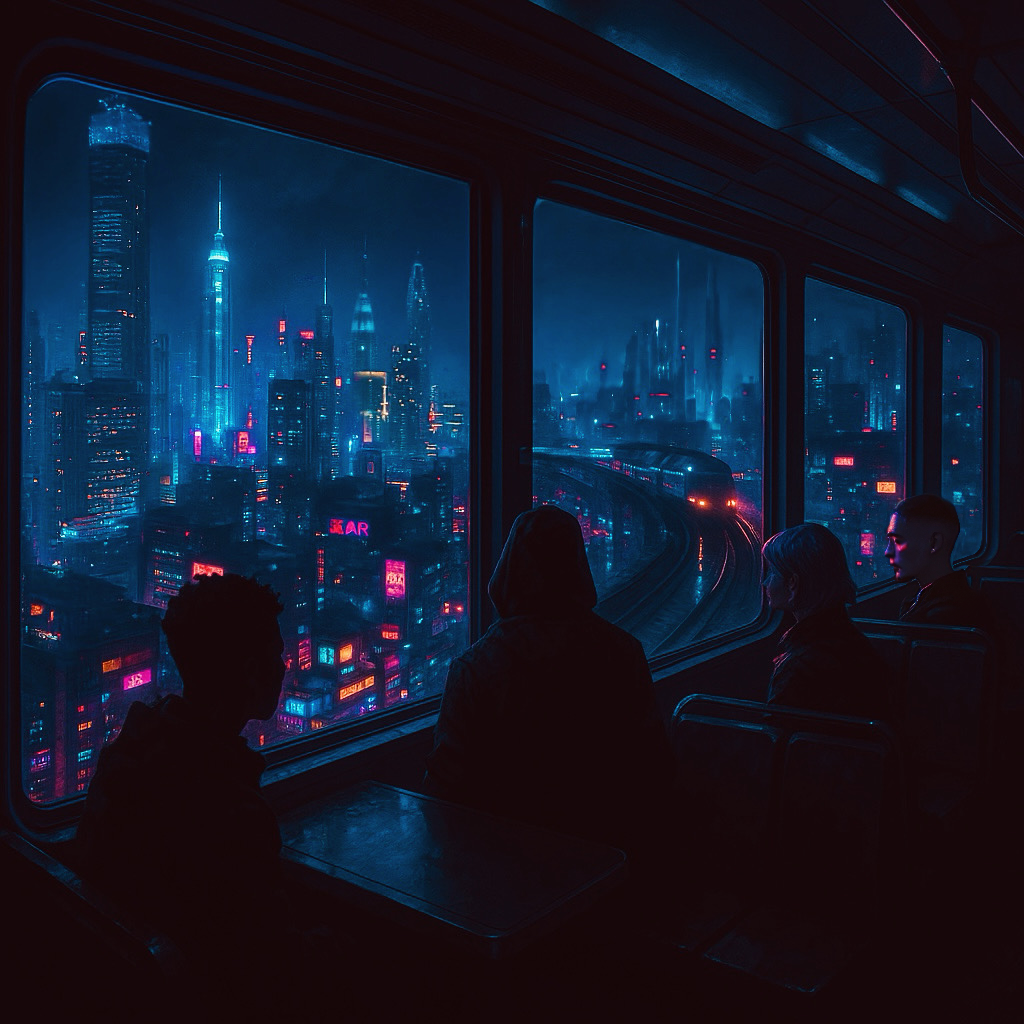
  • The MagRail hissed as it cut through the night, neon city lights flickering across the carriage windows. Mira sat with the capsule tucked beneath her arm, its faint glow leaking through the fabric of her satchel. The four of them had claimed a booth near the back, trying to look like nothing more than tired kids riding the late shift.

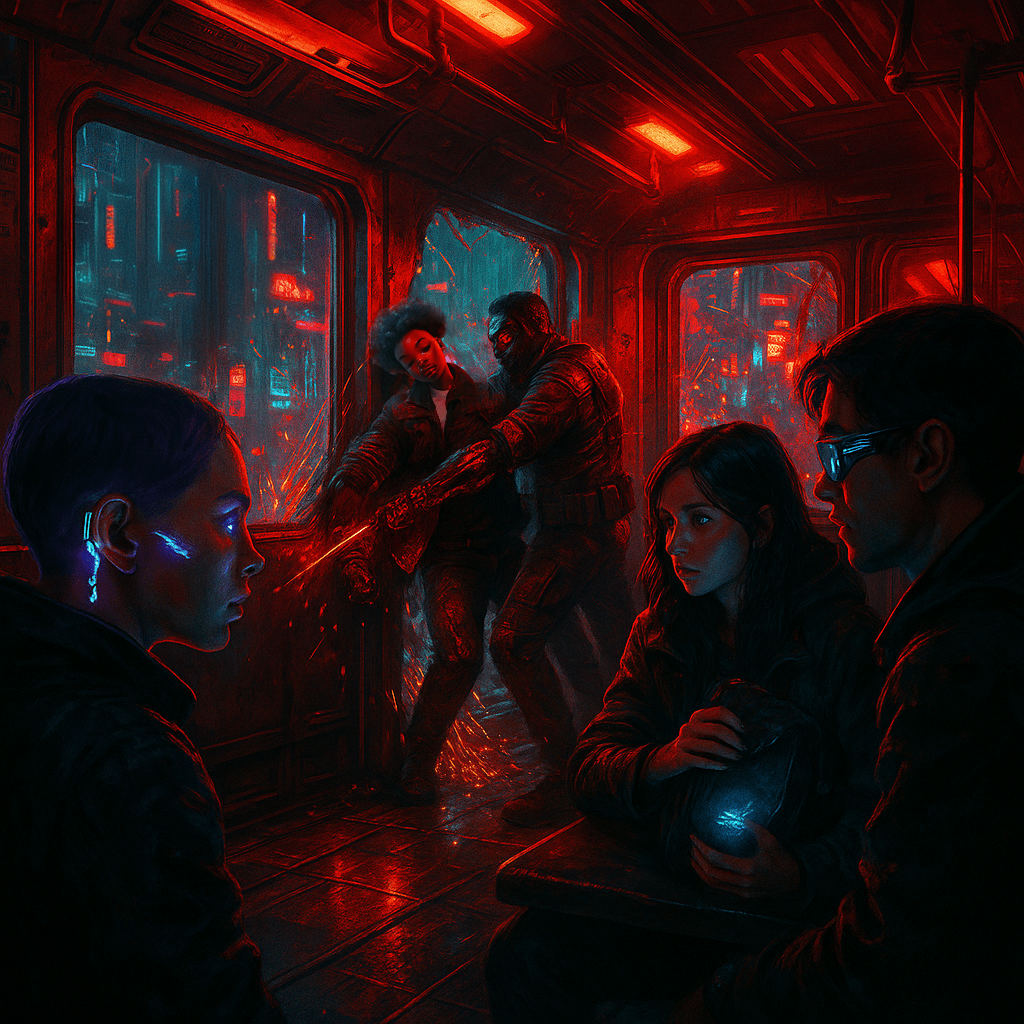
    Rika gnawed on a synth snack stick, her glowing ear implants pulsing in rhythm with the music faintly buzzing from someone’s headphones two rows down. Kaio, as always, was buried in his lenses, mapping possible exit points and jamming cameras along the line. Drexel tapped his metal wrist against the tabletop, each click-click of his joint making Mira’s nerves edge tighter.

    “Relax,” Rika muttered, watching him. “You’re gonna set the whole car on edge.”

    Before Drexel could reply, the MagRail lurched violently. Lights sputtered. Passengers gasped.

    Then came the grinding—metal tearing on metal, the sound of claws dragging against the train’s hull.

    Kaio’s lenses flashed red. “They found us.”

    The emergency lighting kicked in just as the side door blew open. Sparks showered the aisle, and the Rust Devils swarmed in.

    They were terrifying up close—patched-together armor, helmets streaked with rust paint, cybernetic limbs hissing with crude hydraulics. Their leader pushed in last, visor cracked, his massive cyberarm sparking as it flexed.

    “Evening, kids,” he rasped. “You’ve got something of ours.”

    Passengers shrieked, scattering down the length of the car. The train crew sealed themselves in the control cabin, ignoring the chaos.

    Mira shoved the satchel under the booth. “Stay sharp.”

    But the Devils didn’t hesitate. One lunged straight at Drexel, slamming him hard against the carriage wall. His shock-blade flicked open, crackling, but the Devil’s rusted cyberarm pinned him tight.

    “Got one!” the gang member barked.

    “Drexel!” Rika shouted, leaping to her feet, implants glowing hot.

    The capsule pulsed violently under the seat, light bleeding through the seams of Mira’s bag. She felt it in her skull again—the rhythm, the whisper. This time it wasn’t background noise. This time it was a command.

    Kaio snapped a smoke charge from his jacket and locked eyes with her. “We move now, or we lose him.”

    Mira’s hand hovered over the satchel. The capsule throbbed like a heart, begging to be unleashed.

    In the flashing emergency lights, Drexel struggled against the Devil’s grip, his eyes locked on Mira. “Don’t let them take it!”

  • The moment the capsule pulsed again—brighter, sharper, almost urgent—Mira knew they couldn’t fight their way out. Not with the Rust Devils already closing in and more boots echoing outside.

    “Run,” she hissed.

    No one argued.

    Kaio yanked open the maintenance hatch at the rear of the substation, and they slipped into the rain-slicked service tunnel. Drexel took the lead, slicing through a sealed grate with his shock-blade while Rika covered the rear, her pupils flickering with tracking data. Mira held the capsule tight, its rhythmic pulses now in sync with the pounding in her chest.

    They emerged near a forgotten MagRail platform—graffiti-coated, half-lit, the glass panels fogged by time and steam. A shriek tore through the air as the train approached, sleek and dark like a blade through the storm. Mira could feel the electromagnetic hum in her teeth as it slowed just enough to let them leap aboard.

    Inside, the cabin was empty save for a flickering ad board and rows of hard polymer seats. Blue overhead lights buzzed faintly. The doors slammed shut behind them, and the train launched forward with a low roar.

    Only then did they speak.

    “We barely made it,” Drexel said, slumping into a seat, his soaked coat hissing against the heating strip.

    “They were too fast,” Rika muttered. “They were waiting.”

    Kaio stayed near the window, eyes scanning the skyline. The city rolled by in layers—stacks of light and shadow. In the distance, Neon Spire glittered like a hallucination, its tallest towers piercing the stormclouds.

    And still, the capsule pulsed—its glow reflecting in Mira’s eyes as she held it in her lap.

    “I think it knows where we’re going,” she said softly.

    Rika looked up. “Does it want to help?”

    “I don’t know.”

    Kaio turned from the window. “Then we find someone who does.”

    Outside, the MagRail arced over the edge of Iron Alley, curving toward the outer districts—toward people who might know what this tech truly was, and why everyone from Zenith to the Rust Devils was willing to kill for it.

    Behind them, a glint of red appeared in the distance—another MagRail, trailing in silence.

    Someone was following.

    But for now, the city spread out beneath them, alive with neon veins and pulsing towers. And for a fleeting moment, they were in motion, in-between, untouchable.

  • The rain had slowed, but the humidity lingered, curling against the stained glass windows of the café. Strings of mismatched bulbs hung from the ceiling like tangled stars, their glow reflected in the lacquered leaves of the potted plants that seemed to grow straight out of the cracked floorboards. The sign outside just said “Nari’s”, etched by hand into a piece of old railway steel and barely visible behind the vines.

    Inside, the place was chaos in the coziest way—chipped tile counters, shelves overflowing with jars of preserved fruit and synthetic spice, music playing from an old speaker with a patchy signal. People talked with their whole bodies here. Orders were shouted across the room. Someone in the corner was playing a two-string guitar made from repurposed drone parts.

    And at a table near the back, almost invisible in their dark clothes and quiet presence, sat KaelKira, and Liora.

    They didn’t look like locals. Kira’s purple hair caught the light every time she moved. Liora’s dark eyes flicked around the room like she hadn’t let her guard down in weeks. And Kael, silent as always, kept his hood up, fingers wrapped around a chipped ceramic mug.

    None of them spoke much at first.

    The food arrived—bitterroot noodles and something called solarfruit dumplings. Kael blinked at the color. “Are these supposed to glow?”

    Kira smirked. “Only slightly.”

    “Try not to think about what makes them light up,” Liora added, stabbing a dumpling with her chopsticks. “Or do. It’s probably not worse than anything we’ve eaten in the Labyrinth.”

    Kael took a slow bite, then nodded once. “Not bad.”

    They ate. No plotting. No maps or plans. Just three people chewing in silence while the city hummed outside.

    “I forgot places like this existed,” Kira said eventually, leaning back. “That people could laugh like that. Loud, messy. Like no one’s listening.”

    “No one is,” Liora replied. “That’s the point.”

    Kael was watching the kitchen. A child ran by with a bowl too large for their hands, and no one yelled. In fact, someone clapped.

    “You think we’d ever have a place like this?” he asked quietly.

    Kira raised an eyebrow. “You mean like… run one?”

    “Live near one,” he said. “Stop thinking so far ahead.”

    Liora finished her tea. “I don’t think we’re built for that.”

    “No,” Kira said. “But maybe we could grow into it.”

    A silence passed between them—not heavy, just real. Then someone dropped a tray nearby and everyone burst into laughter, including the person who dropped it.

    Kael cracked the barest smile.

    “Next round’s on me,” he said.

    And for a few precious moments in the cluttered glow of Nari’s, they weren’t fugitives or insurgents or memory thieves.

    They were just people. Sharing a meal. Letting the city exhale around them.

  • The rain had stopped, but the metal still dripped.

    They stood together near the edge of the old pedestrian artery — one of the forgotten elevated walkways that hung like a vein between the hollowed-out towers. Below, Cyberpunk City pulsed and sparked like a wounded beast. Above, the wind dragged the scent of ozone and rust through fractured neon.

    Liora crouched by the rail, eyes on the street two levels down, where a broken NeuroCorp drone still sparked in the gutter. Her shoulders were tense, her jacket soaked through. She hadn’t spoken in a while—not since the last shot was fired.

    Kael leaned against a crumbling column, arms crossed. His pulse was slowing, but his grip hadn’t fully relaxed. He kept looking at Liora like he was waiting for her to break—because she didn’t, and that scared him more than if she had.

    Kira sat farther back, her fingers trailing through the edge of an old graffiti tag—her tag, from years ago. A spiral glyph half-consumed by moss and time. It used to mean resistance. Now, it looked like memory fading.

    For a long moment, none of them spoke.

    “You didn’t have to come,” Kael said finally, voice low.

    Kira didn’t look at him. “I was already here.”

    Liora glanced back over her shoulder. “What’s that supposed to mean?”

    Kira sighed, pushing up to her feet. “It means I’ve been walking these paths longer than either of you know. It means I’ve already seen how this ends—if we stay.”

    “We can’t just run,” Kael said.

    “I’m not talking about running,” she said. “I’m talking about rooting.”

    Liora stood now too, eyes narrowed. “Verdant Verge.”

    The words landed like an echo.

    Kael scoffed, just barely. “You want to go live in the trees? Make art out of ferns while the city burns?”

    Kira stepped toward him, not angry, but solid. “I want to go somewhere we can actually breathe. Somewhere I can think without being scraped by Klarna’s echo every time I close my eyes.”

    “We could go for a while,” Liora said carefully, the idea still forming even as she said it. “Just to recover. Regroup.”

    “No one recovers in this city,” Kael said.

    “Maybe not in it,” Kira replied.

    Another gust of wind rattled through the scaffolded railings. Below them, a neon billboard flickered and died.

    “I’m not promising to stay,” Liora said. “I’m not promising anything.”

    “I’m not asking you to,” said Kira.

    Kael looked at both of them. For a moment, it seemed like he might walk away. But then he shook his head and muttered, “You both talk like the Verge is some kind of myth.”

    “It is,” Kira said softly. “That’s why it still works.”

    They left before dawn—no plans, no announcement. Just three figures moving through the last stretch of the Walkway, stepping out of the city’s noise and into its roots.

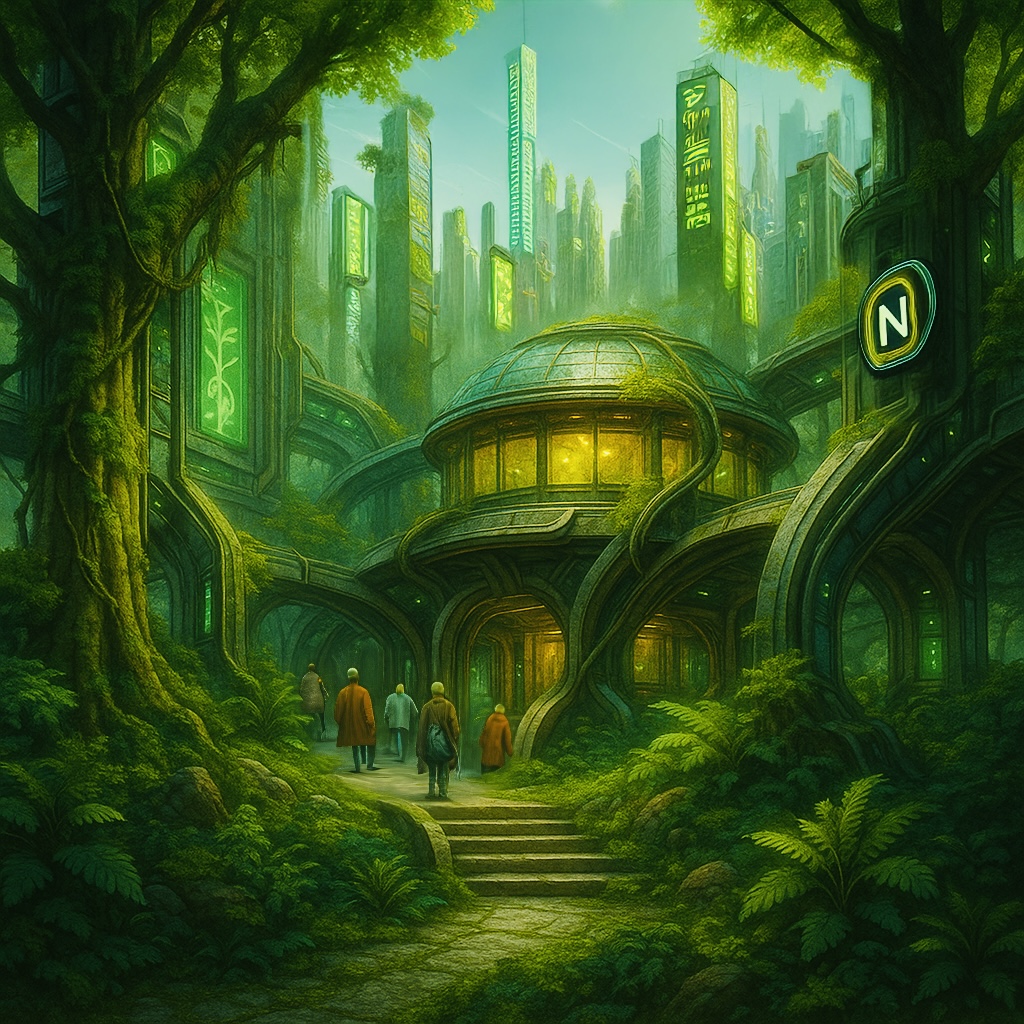
  • Tucked deep within the city’s overgrown arteries lies Verdant Verge — a place the corporations call “lost” and the Naturas call “liberated.” Here, where rusted highways have been choked by vines and glass towers softened by hanging gardens, the last hopeful faction of Cyberpunk City carves out a different kind of future — one not governed by NeuroCorp algorithms or Zenith’s surveillance drones, but by soil, sunlight, and shared breath.

    The Naturas are not rebels in the traditional sense. They don’t wear armor or move in shadow like the Wraith Syndicate. They move like roots: patient, unassuming, and impossible to kill once embedded. Born from ex-scientists, street farmers, and defectors from PulseGen’s eco-division, the Naturas formed during the Great Collapse, when the eastern grid fell and nature began bleeding through the concrete.

    Their headquarters — known as the Seedhouse — is a bioluminescent dome nestled in the canopy of rewilded spires, barely visible unless you know what to look for. The structure hums gently with solar resonance, absorbing power through moss-covered panels woven into its roof. Walkways made of living wood spiral into the treetops, connecting pods where herbalists, archivists, and engineers whisper, code, and grow.

    Though they renounce most corporate tech, the Naturas are not anti-technology. They grow it. Their processors are mycelium-linked. Their sensors are tuned to bees. They breed plant-strains that light walkways at night and filter poisons from the rains. Every piece of gear they wear is handcrafted — a blend of urban scrap and organic synthesis. Their most sacred tool is a seed-drive: a palm-sized orb holding the genetic memory of extinct species and pre-corporate flora, passed down through generations of custodians.

    They’ve become a threat now — not because they are violent, but because they offer the people of Cyberpunk City something no one else does: an alternative.

    When Klarna-7 tried to sync with neural rhythms in Verdant Verge, the signal faltered. Here, the minds did not obey. NeuroBliss shipments vanished. Drones lost connection. Something in the soil — or in the spirit — broke the loop.

    And now, whispers spread through the city:

    “There’s a path out. It begins in the green.”

    But getting there means evading the circuits.

    And once you arrive… you never quite see the city the same again.