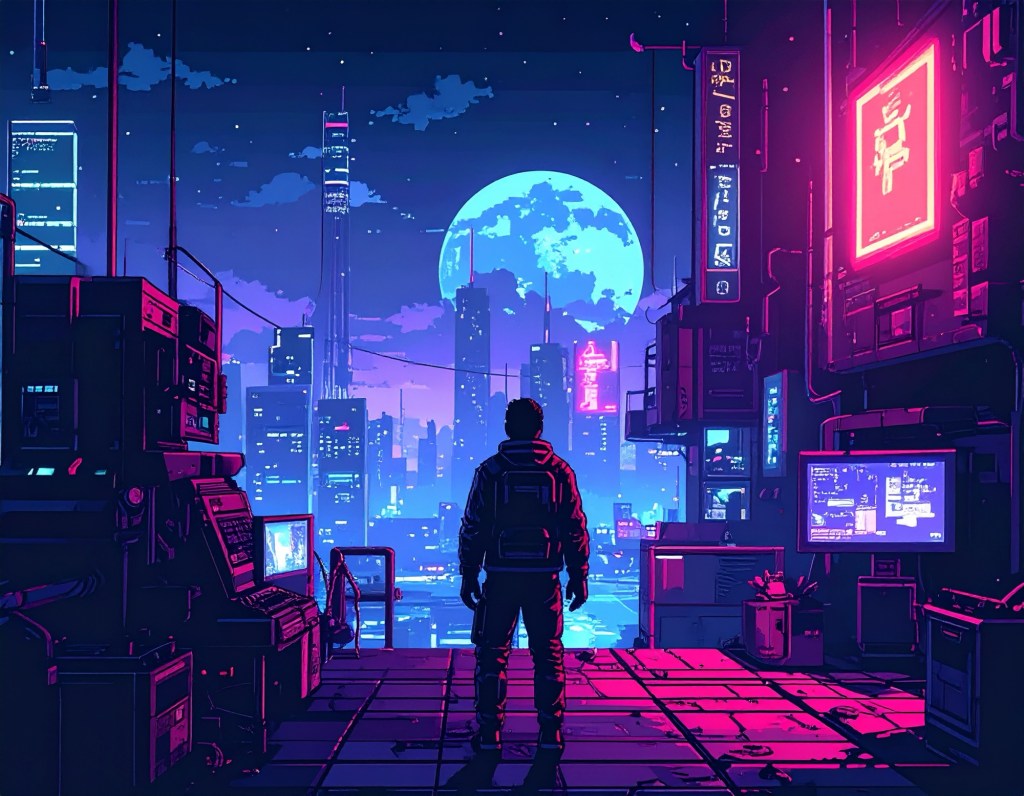
Night falls over the Lunar District — a place where neon light meets quiet reflection. Bars hum with low conversation, holographic menus flicker, and the streets shimmer under the glow of the full moon.
Players wander through this district between missions, uncovering side stories from street musicians, information brokers, and wanderers lost to the city’s rhythm. Every corner hides a memory — a fragment of someone’s past or a clue to what’s coming next.
The Lunar District isn’t about conflict. It’s about connection — a reminder that in Cyberpunk City, even under the coldest light, humanity still glows.
Neon Veins is an open-world cyberpunk RPG that trades endless firefights for the thrill of mystery and discovery. The city itself is the protagonist—alive with secrets, lies, and shifting allegiances. Players step into the role of a Seeker, someone who navigates both corporate towers and forgotten alleys, piecing together truths hidden in flickering neon and encrypted whispers. The experience is about peeling back the city’s layers, finding meaning in its fractured glow, and deciding which truths deserve to see the light.
The game is built around exploration. Each district has its own atmosphere, from the towering skyline of Neon Spire to the wild overgrowth of Nature Alley, and every corner holds clues—some obvious, some buried deep in coded graffiti, abandoned terminals, or the memories of strangers. The city changes as the player uncovers more, with factions reacting dynamically to choices, shifting who controls walkways, stores, and even the flow of rumors. Instead of grinding enemies for loot, progress comes from unlocking access, gathering influence, and upgrading augmentations that reshape how the player perceives the world.
At its core, Neon Veins is about mystery. Investigations unfold through branching storylines where evidence is rarely complete or unbiased. The player must make judgment calls—whether to trust a corporate defector, whether to follow a trail of whispers into a gang-controlled maze, whether to sell information for CyberTokens or protect it for someone else’s cause. Clues contradict, witnesses lie, and even the truth itself may shift depending on perspective. In this way, the game encourages replay, each path revealing a new shard of the city’s hidden heart.
The atmosphere is immersive and deliberate. The city breathes with a dynamic day-night cycle, citizens with routines, and environments that react to events. A gang turf war might suddenly flood Iron Alley with patrols, while a blackout in Neon Spire plunges whole blocks into shadow, forcing players to rely on instinct and augmented senses. Neon markets, underground labs, and derelict apartments aren’t just backdrops—they’re living puzzles. Every glowing sign, every stray animal with red eyes, every flicker of static has the potential to matter.
In the end, Neon Veins isn’t about defeating a final boss—it’s about unveiling the city’s pulse. What drives Cyberpunk City’s endless glow: the corporations, the underground factions, or something deeper? The truth is never handed neatly to the player—it’s pieced together, interpreted, and shaped by choices. Each ending feels like pulling back one more curtain, revealing both clarity and new uncertainty. The city keeps breathing, its veins still glowing, waiting for the next Seeker to wander its neon-soaked streets.
The deeper Marcus moved into the labyrinth, the less it felt like a lab and more like a machine. Corridors stretched in impossible symmetry, each one humming with hidden power, each door sealed by biometric locks. His cybernetic eye flickered through spectrums, mapping wires behind the walls—arteries feeding something colossal.
He came to a door unlike the others. Reinforced steel, lined with magnetic seals, flanked by two consoles pulsing with Zenith’s emblem. This wasn’t for test subjects. It was for something they didn’t want anyone to see.
Marcus knelt by the console, the plating of his arm sliding back to reveal the interface port embedded in his wrist. Sparks danced as he forced a connection. A flood of code rushed across his vision: encryption, data trees, schematics. His breath caught.
The Vault.
Inside, Zenith wasn’t just harvesting people. They were cataloging them. Every subject tagged, categorized, indexed. Neural maps, genetic markers, augmentation compatibility—all stored, all linked to something called Project Revenant.
Marcus’s fists tightened. He remembered the MagRail massacre, the families burned for efficiency. Now he understood what those flames had paved the way for. This wasn’t just research. This was a blueprint for building an army out of the city’s forgotten.
Then the console chirped—a high-pitched tone, sharp as a blade. Unauthorized access.
The corridor lights bled red. Sirens howled.
From the shadows ahead, Marcus saw them: Zenith’s enforcers. Not the ragged Devils or the street scum of Iron Alley—these were clean, efficient, and silent. Black armor with glowing gold eyes. Augmented beyond recognition.
Marcus yanked his arm free from the console, sparks biting his skin. He hadn’t expected to walk out quietly. He flexed his cybernetic fist, servo-motors groaning like thunder.
The alarms hadn’t tripped yet. Marcus moved like a shadow through the sterile corridors, his breath steady, the broken cuffs still dangling from his wrist. He kept to the edges, cybernetic eye cycling through spectrum filters—mapping cameras, heat signatures, and pulse monitors hidden in the walls. Zenith’s precision was everywhere.
He passed doors with reinforced glass, each one holding fragments of the harvest. Some cells held people sedated on gurneys, wires stitched into their temples. Others were filled with silence, their occupants already gone. Marcus clenched his jaw, his arm twitching with the memory of MagRail. He couldn’t free them now—not without bringing the whole facility down on his head.
At the end of the corridor, the space opened into a vast underground chamber. The sight froze him.
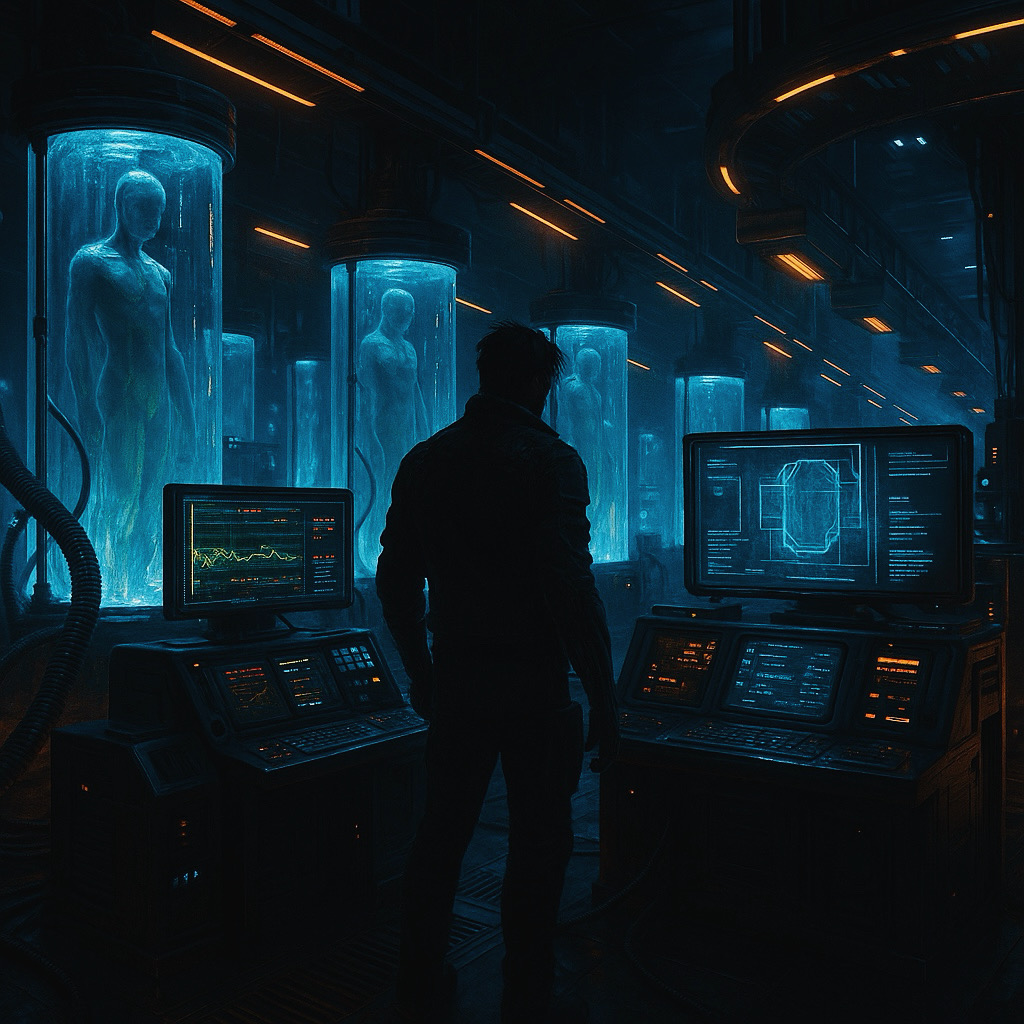
Banks of neon-lit screens pulsed with coded streams of data, their glow reflecting off chrome surfaces. Glass tubes stretched from floor to ceiling, filled with a bluish fluid where distorted silhouettes floated half-formed—human bodies suspended like experiments abandoned mid-sentence. Conveyor rails snaked overhead, carrying crates marked with Zenith’s insignia, sealed with biometric locks.
The lab wasn’t just a testing site. It was a production floor.
On one screen, schematics flickered—neural overlays, cybernetic augmentations mapped against unwilling human hosts. Notes scrolled beside them in stark white font: Iteration 34: stability remains unachieved. Further acquisition required.
Marcus’s stomach tightened. The harvest wasn’t random. It was feeding Zenith’s next weapon.
He crouched low behind a bank of tubing, scanning for guards. His instincts told him this wasn’t just about the people Zenith had taken—it was about what they were building out of them. Something new. Something dangerous.
The Zenith Dynamics storefront was too quiet. Marcus slipped through the glass doors after midnight, his boots echoing against immaculate tiles that didn’t belong in Iron Alley. The shelves were lined with sterile displays—cybernetic parts gleaming under cold white light. But they were decoys. He felt it in his bones.
He moved deeper, past a false wall that clicked open under his cybernetic touch. A stairwell spiraled down, the sterile brightness above giving way to industrial gloom below. The air grew colder. Quieter. Until everything went black.
When Marcus woke, his head was heavy, his arms shackled to a metal chair bolted into the floor. A dim strip-light hummed overhead, casting harsh shadows across a narrow cell. The scent of antiseptic and rust mingled in the air.
The door hissed, and a figure stepped inside—a Zenith agent in a crisp black coat, augmented eyes glowing faint gold. His voice was calm, clinical.
“Marcus Cain. The relic who betrayed his own. You’ve been a ghost a long time. Did you think we’d forgotten the MagRail?”
Marcus didn’t answer. His cybernetic eye scanned, quietly mapping the seams of his restraints. Servo-motors in his arm twitched against the metal cuffs, pressure building.
The agent leaned closer. “You should’ve stayed buried. Now, you’ll serve a different purpose. The harvest requires strong subjects.”
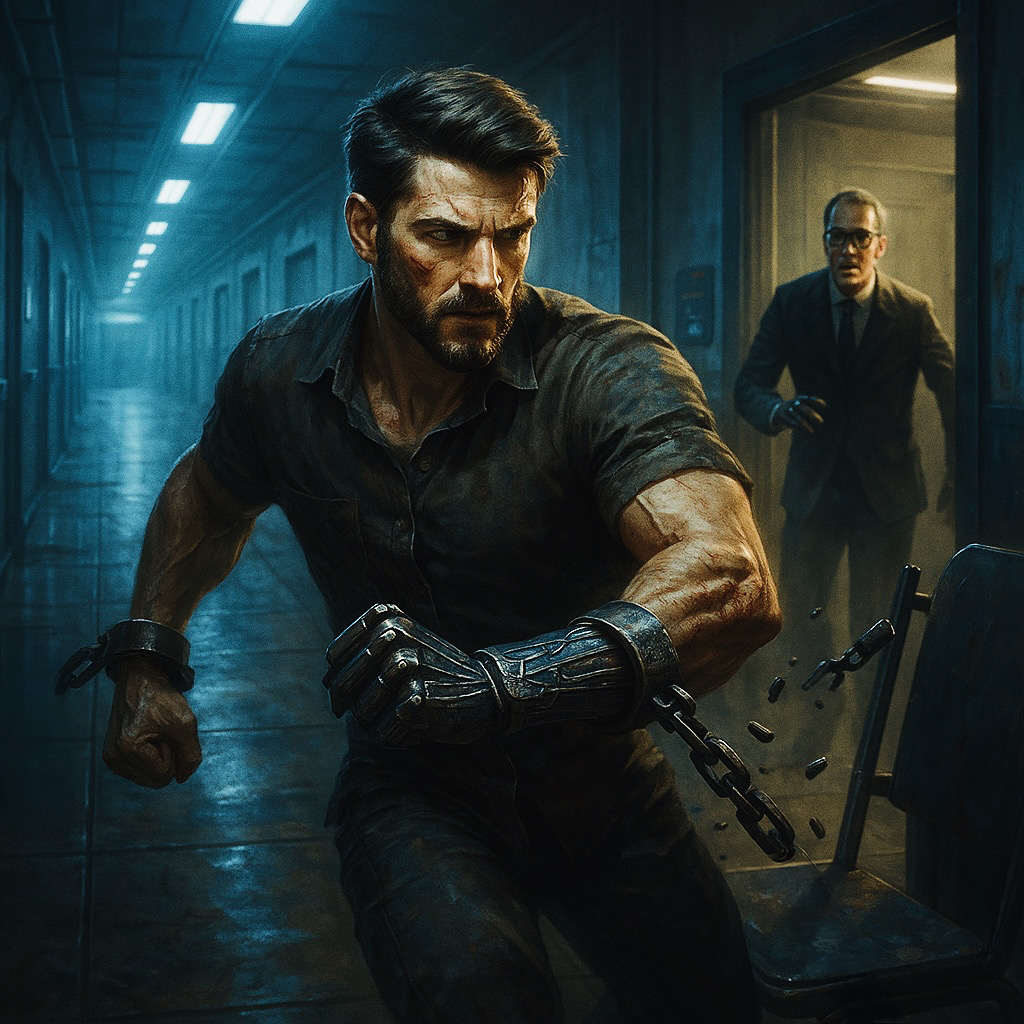
The word harvest was the spark. With a violent wrench, Marcus snapped one shackle, the groan of bending steel drowned by the agent’s startled curse. He surged upward, driving his shoulder into the man’s chest, sending him crashing into the wall.
The room exploded into chaos. Blows landed, metal against flesh, until Marcus stood over the agent, unconscious, the cuffs hanging broken from his wrists. He didn’t linger.
Throwing open the door, Marcus staggered into a wide corridor that stretched far beyond what could exist beneath Iron Alley. Cold blue lights lined the ceiling. Rows of reinforced doors marked each side. Behind some of them, muffled cries echoed. Others rattled faintly, as though something inside clawed for release.
The rain hit harder in Iron Alley, soaking them as they stumbled into a dead-end corridor lit only by flickering neon. Rika slammed her fists into the wall until her implants sparked. Kaio sank down against a trash-stained vent, glasses dimming as if even the code had gone silent.
Mira just stood there, drenched, staring at her hands. They were shaking, glowing faintly with the residue of blue-silver glyphs that pulsed beneath her skin.
The construct.
It had guided her. It had shown her Drexel. It had pulled her into the Devils’ den.
And he was dead.
Her chest heaved as she whispered through clenched teeth, “Why? Why lead me there if all it meant was him dying?”
The glyphs stirred, faint fractals swirling across her wristband and up her arms. Her head filled with the same layered metallic voice she’d heard when it first knelt before her.
Her scream ripped through the alley, bouncing off rusted steel and broken glass. She pounded her glowing wristband against the wall until sparks spat from the implants. “I hate you! I don’t want you!”
The lights flickered overhead in the corridor—pale blue strobes that hummed like insects trapped in wire. Water dripped from a cracked pipe into a bucket someone had long since forgotten. Kira, Kael, and Liora moved cautiously through the abandoned maintenance tunnel, their shadows stretching long across the concrete.
Kira stopped suddenly. “Hold up.”
Footsteps.
Not from them.
From ahead.
Kael’s drone hovered lower, its soft scanning pulse dimming as if it, too, was holding its breath. Liora raised the hood of her jacket, visor adjusting automatically to low light as her hand rested near the makeshift baton strapped to her leg.
A group rounded the corner—three figures.
None of them spoke.
At the front, a girl with a buzzed violet haircut and glowing implants scanned Kira with a single, sharp glance. The second, a teenage boy with wild hair and augmented glasses, seemed more curious than tense. The third—a quiet girl with a faint blue glow flickering beneath her jacket—looked from face to face, expression unreadable.
The corridor wasn’t wide enough for both groups to pass without brushing shoulders.
But no one moved.
A full beat passed in silence.
Kael shifted slightly. Liora gave Kira a glance, but Kira just kept her eyes forward, hand tightening around the satchel against her hip.
Finally, the girl with the buzzcut stepped aside, giving just enough room for the others to pass.
Kael nodded once. “Appreciate it.”
No reply.
The trio stepped forward, cautiously slipping past. Their clothes barely brushed in the cramped tunnel. No names were exchanged. No questions asked.
But as they passed each other, Kira’s eyes briefly met the quiet girl’s—just a flicker of something strange. Recognition, not of a person, but of a weight carried.
And then it was gone.
The moment dissolved behind them like steam.
Once they were out of earshot, Liora whispered, “You think they’re with a faction?”
“Maybe,” Kael muttered. “Didn’t look corporate. Didn’t look local either.”
Kira glanced back once, but the tunnel was empty now.
“Doesn’t matter,” she said. “Let’s just keep going.”
Far behind them, the other trio disappeared into the opposite shadows, each party unknowingly passing through the same fracture in a city that was changing too fast for anyone to keep up.
Kael, seated cross-legged on the floor, had strapped on a white augmented reality headset earlier. Its edges shimmered with soft light as he tinkered with the small recon drone in front of him. His fingers danced through ghostly menus only he could see, rerouting diagnostic protocols and whispering to the machine in the language of lost code.
“I’ve got it running lean,” he muttered, fingers still moving. “Lower emissions, smoother lift. Almost silent.”
Kira sat nearby, one leg pulled up to her chest, eyes distant. The drone hovered briefly, then landed beside a rusted hatch embedded in the wall, its surface marked with peeling stencils. She stood, brushing off her jacket.
“That go up?” she asked, nodding at the hatch.
Kael nodded, still immersed in the interface. “Rooftop. Wasn’t locked.”
Without another word, Kira climbed the narrow ladder. The hatch creaked as she shoved it open, releasing a breath of cool air laced with rust and ozone.
She stepped out onto the rooftop—and paused.
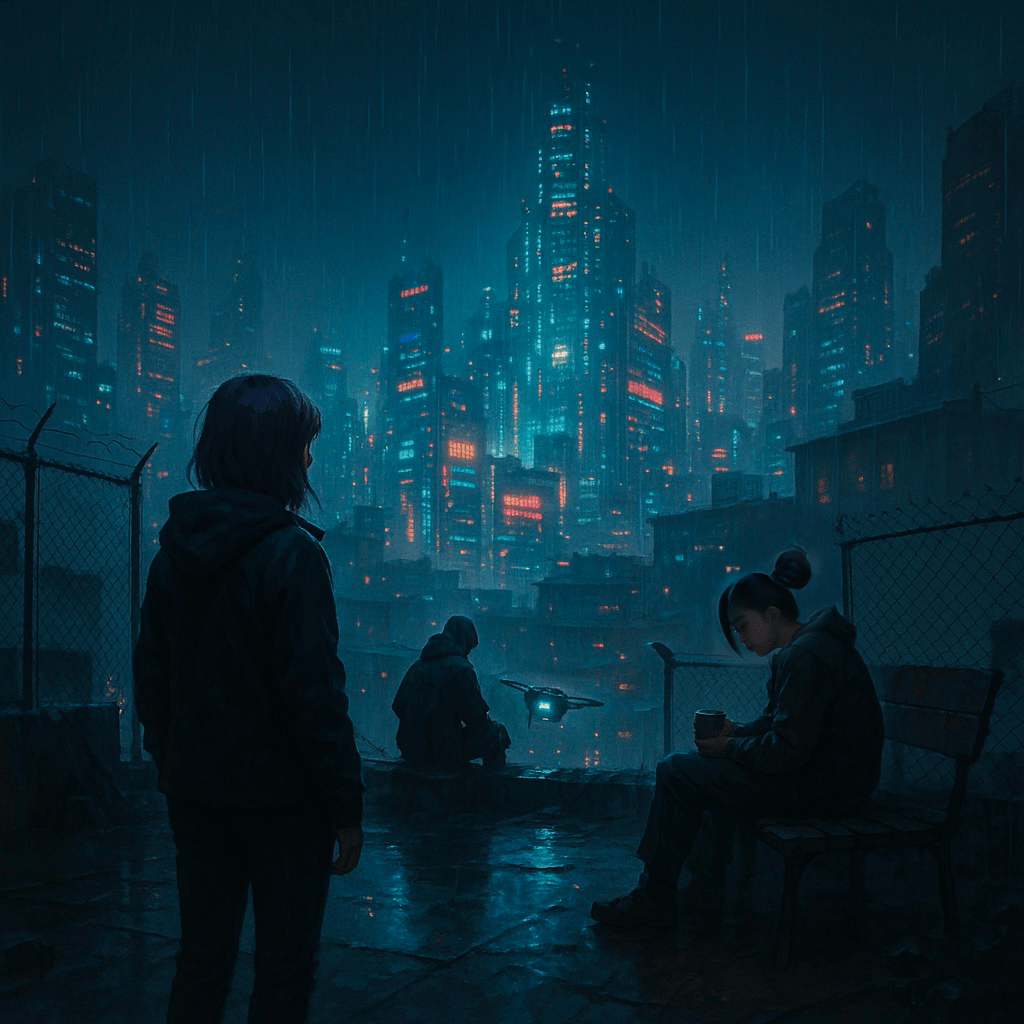
The skyline unfolded before her like a glitching dream. Iron Alley stretched in layers of rusted steel and flickering signs, and beyond it—just visible in the neon mist—Neon Spire rose like a glowing ghost. Its chrome towers blinked and pulsed, a city apart from the grime below.
Kael appeared next, pulling himself through the hatch, followed shortly by Liora. She stretched, pulling her visor back over her eyes as she stepped out into the wind.
The rooftop was cluttered: old vents, cracked solar panels, scraps of wire and conduit coiled like dead vines. The recon drone lifted silently behind Kael, hovering above the group like a watchful eye. Its faint red glow reflected off the puddles on the rooftop surface.
For a while, none of them said anything. They just looked.
Kira leaned against the bent railing, voice quiet. “Spire looks different from here.”
“Still looks fake to me,” Liora said, her voice still rough with sleep.
Kael reached up and adjusted the drone’s hover altitude slightly. It buzzed up a few feet, capturing wide-angle scans of the city below. “Maybe we do too,” he said under his breath.
The wind carried the scent of rain and steel. From here, the chaos felt far away. Just three runaways, a half-repaired drone, and the endless city watching in silence.
The ramen shop door hissed closed behind them, and they stepped into the misted twilight of Iron Alley’s lesser veins. Rain tapped gently on the aluminum walkways above, dribbling down rusted gutters and tangled wire bundles. The streets were quieter here—fewer drones, fewer neon signs shouting for attention. Just the soft hum of power lines and the occasional flicker of an old holo-ad struggling to stay awake.
Kira walked ahead, drawn by instinct more than memory. She paused at the mouth of a narrow stairwell, half-hidden beneath a warped awning that read “Maintenance Access – AUTHORIZED TECHS ONLY.” With a quiet glance to the others, she started down.
The stairs creaked under their steps, each one descending deeper into the bones of the city. At the bottom, they emerged into a long-forgotten maintenance break room. The air was heavy with dust and the faint tang of old coolant. One overhead strip light still glowed faintly, flickering in quiet protest against the years. Cracked tiles lined the walls. A row of lockers stood crooked, their doors barely hanging on.
“This’ll do,” Kira murmured, brushing cobwebs off an overturned chair.
Kael stepped past her, placing the salvaged drone from the ramen counter gently onto the only table that wasn’t rusted through. “This one’s from before the merge,” he said, running his fingers over the casing. “Legacy hardware. Sensor grid’s still responsive.”
Liora kicked open one of the locker doors and blinked at what was inside. “Well, look what we have here.” She reached in and pulled out a bundled foam mattress—dirty, but dry. She dropped it with a soft fwump in the corner, then dug out a thermal blanket from the pile. “Finally, something softer than concrete.”
She flopped onto the mattress and let out a long sigh. “This might be the best thing that’s happened to me all day.”
Kael chuckled, half-listening. He’d opened one of the drawers beneath the table and found something even better: a white augmented reality headset, its polymer shell dulled with age but still intact. “Now this,” he said, holding it up like a relic, “is treasure.”
He slipped it on, syncing it with a flick of his cyberdeck. Immediately, faint holographic layers sprang to life around him—lines of code, diagnostics, and schematics floating in the air only he could see. He dove into the drone’s systems, his fingers moving through invisible menus.
“I always wondered how you got so good at this stuff,” Liora said, watching the lights flicker.
Kael didn’t look up. “You learn quick when half the alley wants a piece of you. Besides…” he gestured to the drone, “these things make more sense than people most days.”
Kira had gone quiet again. She leaned against the cold wall, eyes on the flickering ceiling light. The tension in her shoulders was finally beginning to ease.
“I think I like it here,” she said softly.
Kael paused, the AR interface flickering across his lenses. “Yeah,” he said. “For now.”
Liora pulled the blanket up and closed her eyes. “Wake me up if someone tries to kill us.”
“Deal,” Kael muttered, already elbow-deep in subroutines.
And for a while, there was only the quiet hum of power, the soft clicking of Kael’s work, and the city above—forgotten for the moment, like a bad dream you weren’t ready to wake from.
The alley opened wider as they emerged into what should’ve been a familiar stretch of Iron Alley, but everything looked subtly… wrong. The walls of once-familiar buildings curved where they should’ve been straight. The old graffiti tags had been overwritten with symbols neither Kael nor Kira recognized—pulsing gently like slow heartbeats. LED cables coiled around the framework like ivy, flickering in glitched-out syncopation. It wasn’t broken. It was… evolving.
Liora slowed her pace, one hand gripping her stomach. “I don’t care if this part of the city’s morphing into some kind of neural hallucination. If I don’t eat in the next ten minutes, I’m going to pass out.”
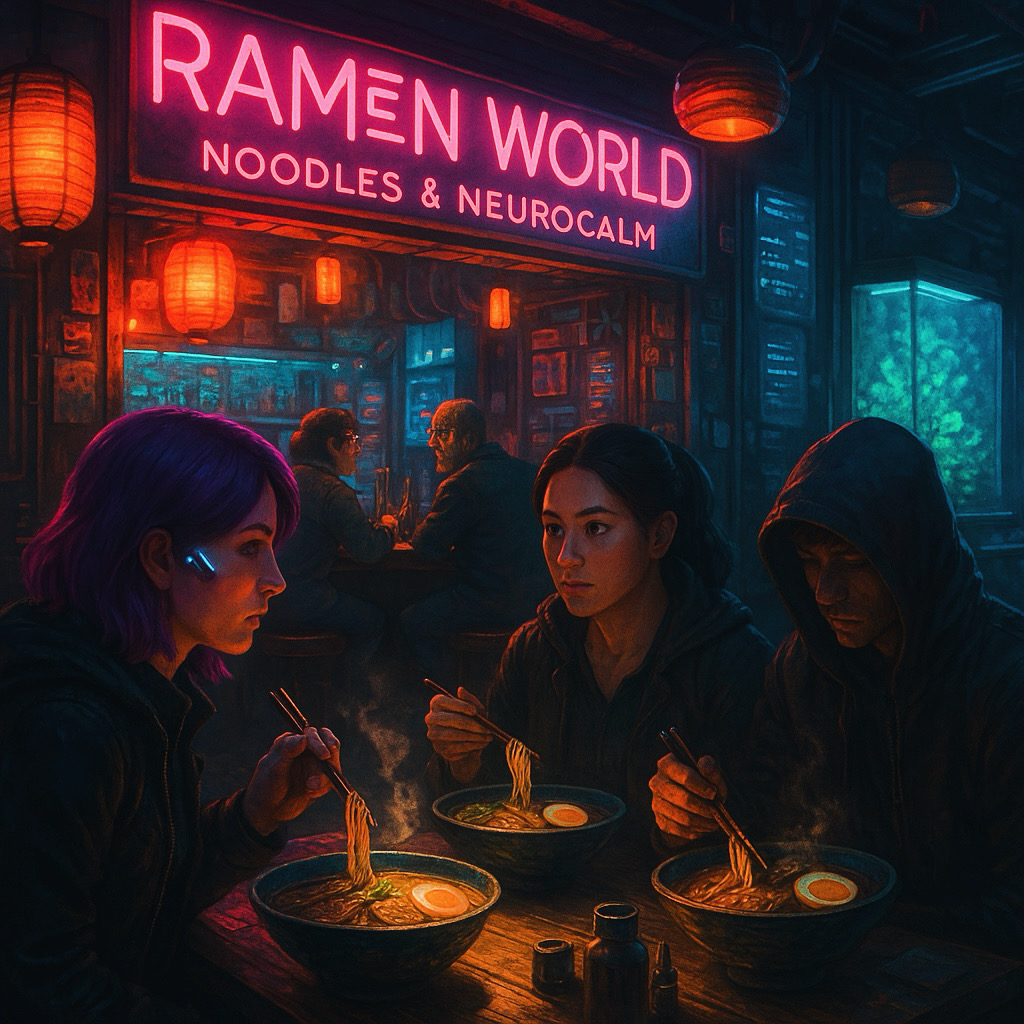
They stopped in front of a ramen shop wedged between two angular towers of rusted chrome. A cracked neon sign buzzed overhead:
RAMΞN WORLD – NOODLES & NEUROCALM
Steam poured from brass exhaust vents above the entrance, warm and fragrant, scented with soy, citrus, and something electric.
As they stepped inside, a gentle chime played—not a bell, but a soft synth tone that felt more chosenthan random. The interior was dim but cozy, lit by mismatched hanging lights with hues ranging from warm amber to deep violet. Tables were a mix of repurposed alloy panels and vintage wood, each with embedded holographic menus flickering just slightly out of calibration.
Along one wall, translucent display tanks housed climbing edible algae, their faint bioluminescence pulsing in sync with the jazz loop playing through ceiling speakers. The kitchen was partly open, revealing robotic arms ladling broth, plating noodles, and torching pork slices to a perfect crisp.
The server—a man with glowing cyan implants trailing down the side of his shaved head and a bored expression—greeted them with a nod. “Three house specials?” he asked without waiting for a reply. “You look like you need it.”
They settled into a booth shaped like a hollowed-out shipping crate, now upholstered and glowing from within. Kael took the seat facing the door, hood still low. Liora leaned back, soaking in the warmth. Kira scanned the room, her eyes lingering on the clientele—locals chatting, slurping, laughing. Unchanged.
Their ramen arrived in glossy black bowls that seemed to absorb the light. The broth shimmered faintly, a clear dashi layered with floating golden oils. A single perfect soy-marinated egg, its yolk nearly liquid. Slices of chashu pork browned at the edges. Floating bits of pickled radish, fermented bamboo shoots, and in Kira’s bowl—tiny blue flecks, like data fragments, drifting in and out of view.
The noodles? Hand-pulled by a bot in the corner—springy, glistening, and nearly glowing.
As they dug in, Liora waved down a middle-aged couple at the counter nearby.
“Hey—sorry to interrupt. Have you noticed anything… weird about the buildings out there? Like, shifting architecture? Or memory gaps?”
The woman raised an eyebrow. “This is Iron Alley, sweetheart. The buildings shift when they want to.”
Her partner chuckled, sipping from his steaming bowl. “You just get used to it.”
Kael leaned closer. “You don’t remember what used to be where this place is?”
The man shrugged. “This place has always been here. Best broth in the Alley. That’s all I care about.”
They turned back to their food without another glance.
Kira slowly set her spoon down, eyes narrowed as she scanned the softly glowing walls, the slow pulse of the algae tanks, the flickering menus. It was all so immersive… so consistent.
“This isn’t normal,” she whispered. “The city isn’t glitching. It’s rewriting.”
But as they sat in that steaming bubble of normalcy—elbows brushing, broth warming their hands—it felt harder to question it. Harder to hold onto what they knew Iron Alley used to be.





 Cyberpunk City AI