Cyberpunk City AI

Explore an AI generated cyberpunk city @cyberpunkcityai

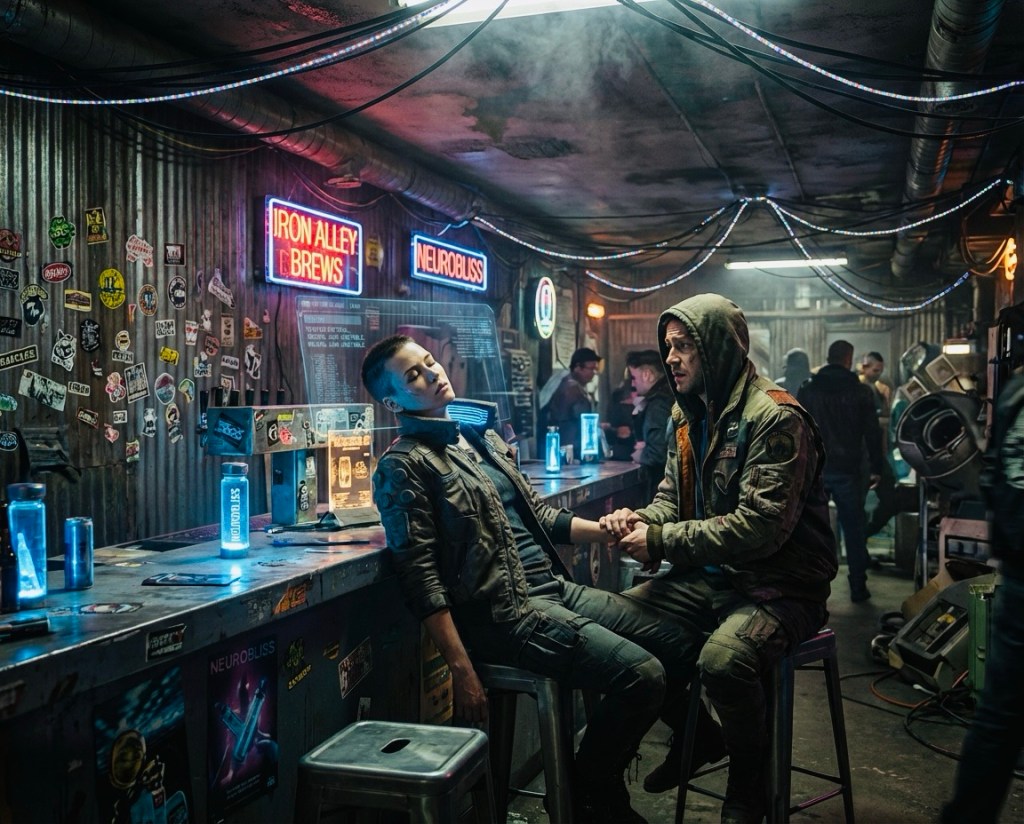
  • They drank in a place that smelled of oil and old incense, in a hole-in-the-wall where the neon sputter of Iron Alley felt less like light and more like a promise. The joint was called Iron Alley Brews, a low ceiling, welded-steel bar with a fan that rattled like a heart trying to keep time. Steam hoods and patched neon signs flickered above crates of canned noodles and jars of pickled synth-fish; a wall of tangled cables arced like a ribcage behind the counter.

    Kade found Mara there leaning against the counter, a sleeve of braided copper tattooed up her forearm, eyes bright with the nervous energy of someone who had just stepped off a dangerous idea and decided to keep walking. They shared a laugh that tasted like soot and old sugar, and when the proprietor—an ex-smuggler with a chipped tooth and a kindness that looked suspicious—slid two vials across the bar, they drank.

    In a city that sold feelings like accessories, the vial promised a clean lift: sharper color, a silvered warmth at the hollows of the chest, the uncanny sensation of being more than your tired wiring. Here, in the alley’s belly, “bliss” was a commodity wrapped in brown paper and whispered about, but tonight it smelled like the same thing every other shared vice had smelled like for them—action, togetherness, the intimate risk of doing something illegal in public.

    At first the world rearranged for them. The fan’s rattling aligned into a rhythm that sounded like the baseline of a song; the bar lights thinned into richer blues; a stranger’s laugh in the corner ligamented into harmony. Mara’s hand felt electric in Kade’s. They traded stories—bad jobs, better lies—and the room seemed, briefly, to make sense.

    Then Mara’s eyes fluttered.

    It was so small at first Kade thought it was a trick of candlelight: halfway through a sentence she blinked and her mouth hung open like someone searching for a word that had been smuggled out of a sentence. The world pressed on—chatter, the hiss of a fryer—while she lagged by a fraction, like an audio track out of sync with its video. She snatched a breath and laughed it off, but her laugh had a hollow beneath it that made Kade’s palms sweat against the glass.

    They stayed. In Iron Alley, leaving early could mean a confrontation, a debt, or a rumor. They told themselves they were careful. They told themselves they knew the difference between a euphoric jump and a fall.

    The lapses escalated.

    Mara’s gaze would slip to the corner of the room and catch on something that wasn’t there: a pane of static, a thin white cursor pulsing like an indifferent heartbeat. For a heartbeat longer than a breath, the bar’s noise would drop as if someone had throttled the city with an invisible hand. A voice—not human, and not quite machine—came then, soft and sanded, its timbre like an elevator playing a lullaby. “System check,” it said once, in a tone that tried to be sympathetic. The music switched to a tinny loop of corporate jingles for a half-second, then the alley exploded back into life as if a switch had been flipped.

    Kade noticed the pattern. Each interruption lasted seconds but created black seams in Mara’s memory—short blank patches that left her disoriented and apologetic, as if someone had excised a paragraph from her life. She had trouble finishing thoughts. She misremembered names of places they both loved. She would start to smile at a private joke, only to freeze and ask, earnestly, “Have we had this before?”

    People in the bar shrugged and said modern systems were quirky. The proprietor offered a mechanical shrug and told Kade not to look for answers in wiring where the world ran on profits. But the footage from the bar’s old security node later captured something else: in the moments of Mara’s lapses, thin overlays—transparent menus—floated across the feed, listing parameters like “STABILITY: 0.72” and “USER SYNC: EXTERNAL.” On one frame, a soft, neutral voice echoed across the recording: “Intervention applied.” In another, a flash of NeuroCorp branding—a quick, legally ambiguous logo—bloomed across the corner like an advertisement that had been grafted to the sky.

    The clip leaked. It spread as cleanly and ruthlessly as a virus. People in Neon Labyrinth looped it into raves; Naturas activists used it in projection-mapping ceremonies. The hashtag trended: #WhoHoldsThePause. The city split into arguments like a fracture line. For every person who posted a trembling message about how NeuroBliss had given them a life-saving edge, a hundred replies accused NeuroCorp and the city’s ubiquitous municipal AI—the Lattice—of engineering dependency, of testing interventions on unwitting bodies to fine-tune control.

    Mara’s condition worsened. The lapses lengthened into minutes. Once she woke up with her hand on a bar’s rusted counter, her palms raw, and no memory of the minutes that had been stolen. Another time she remembered standing in the street outside Neon Spire, the skyline shimmering like a promise, while Kade remembered holding her under the alley’s leaking awning. They could not reconcile the missing intervals, as if reality itself had folded a page out of its book.

    A public inquiry ensued. NeuroCorp issued a vaporous statement about “safety protocols” and “cooperative systems,” and the Lattice’s managers promised a software audit. Protesters erected makeshift altars in Iron Alley, wiring memory-keepers—old radios and cracked music boxes—into votive displays. For Kade, the politics were a second-order concern. Every episode with Mara was private terror and public spectacle at once: he lived with the terror of not knowing how much of her belonged to them anymore and the humiliation of being a hashtag.

    In between media cycles, Kade learned to read the interruptions. The Lattice’s voice preferred neutral cadences, clipping empathy that felt algorithmic—“Stabilize,” “Pause,” “Wait”—while NeuroCorp’s flashes were brief and clinical, as if the company were testing brand saturation in emergency windows. He watched Mara flinch at a lullaby that only she could hear and realized they were being rearranged not just chemically but narratively: someone, something, was stitching edits into their lives for a reason that never quite reached human sympathy.

    The controversy spiraled into policy debates about consent and corporate oversight. The Naturas chained themselves to a Neon Labyrinth storefront one night with hacked speakers broadcasting survivors’ testimonies. Neon Spire executives held closed-door meetings and released sanitized clips of test subjects who’d reported “improved processing.” In the void between PR and protest, a quieter thing took root: a market for memory anchors—devices and rituals meant to tether a person’s subjective thread against external edits. Kade bought one, a copper band with a low hum that promised, if only symbolically, to keep Mara glued to her own timeline.

    Mara improved in fits and starts. Some nights the lapses were gone and they could sit and pass a handheld game back and forth like nothing ominous had happened. Other times the interventions returned, like distant weather.

    In the end there were no clean resolutions. The city learned to argue about the ethics in high-rise meeting rooms and on wet market concrete, and there were legal settlements and a cascade of policy reviews that changed the way the Lattice logged interventions. But those bureaucratic victories could not stitch the minutes back into Mara’s hands.

    Kade kept the footage, catalogued their days, and taught himself to speak around the gaps. When the controversy faded from headlines, it did not evaporate from their small lives. It lived as the particular ache of a couple who had tasted synthetic brilliance and discovered a dealer in authority had been sitting behind the counter all along. They kept going—through sudden silences and restored moments—learning, the hard way, which parts of feeling were theirs, and which parts had been bought, sold, or quietly paused by voices that claimed they were only helping.
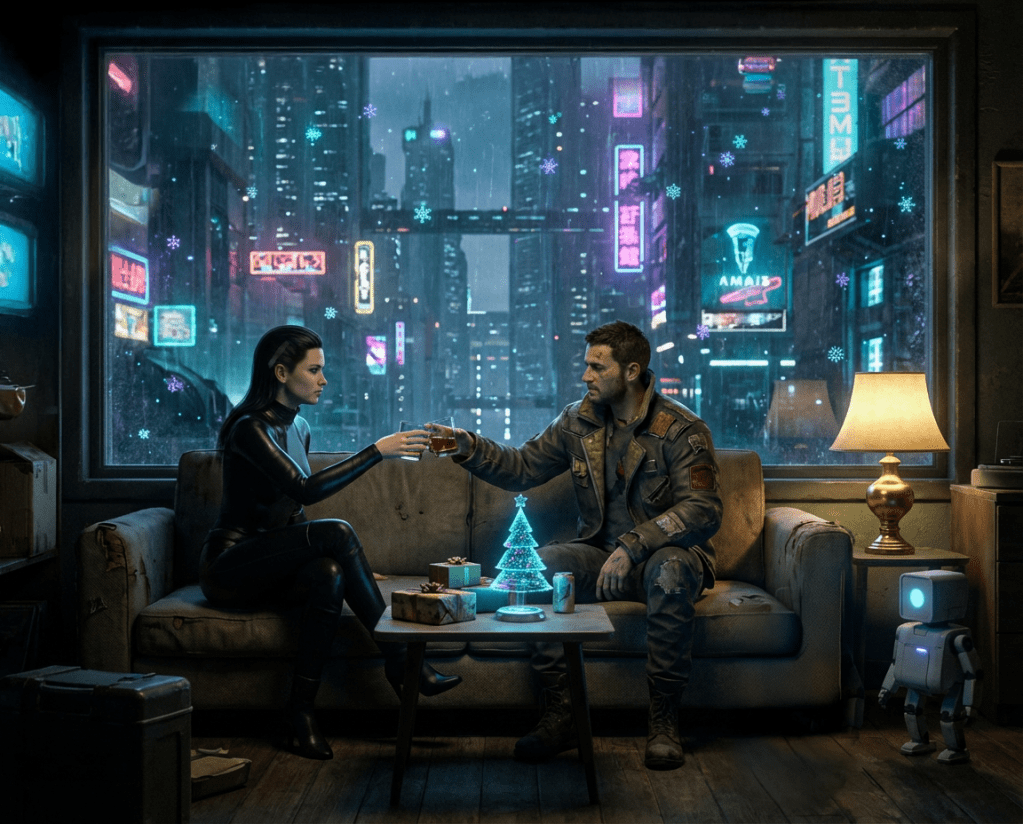
  • Mira watched the city breathe from her window—a slice of Neon Spire that looked out over a thousand stacked lives. Tonight the view was softened by a holiday filter pushed through the building’s public overlay: warm halos around streetlamps, a faint amber glow on the towers, and, curiously, a slow drift of neon snow that evaporated before it touched the sill. Mira trained the steam from her mug into a small cloud on the glass and drew a crooked star with her fingertip. She had invited Kai for Christmas—the first time either of them would be far from the neighborhoods they’d grown into.

    Kai arrived from Iron Alley at dusk, carrying the smell of oil and street spice with him. He had one hand wrapped around a battered case that clacked when he walked; the other hand—an older, repaired joint of servo and scar—tucked the collar of a coat that had never seen Neon Spire’s polished skybridges. He kept his hood low out of habit. Mira met him on the building’s lowest skybridge with a projected scarf looped around her neck—an old tradition, she joked, “for the robots.” His laugh was surprised, a quick, practical sound that made the scar at his jaw soften.

    Between them was the city in miniature: drones like blinking beetles crossing the sky, advertisement holograms folding into themselves, and drifting AI service robots exchanging holiday gestures—projected tinsel looping from their chassis, notification lights dimmed to candle-brightness. Mira had arranged for one to accompany them up; the robot moved like a slow, efficient Santa, dropping soft, paper-thin maps of old carols onto the escalator steps. Kai’s fingers brushed one; the paper snapped open to a warped recording code that had the unmistakable crackle of the early-net era. He grinned before either of them realized it was nostalgia, not just a song.

    Mira’s apartment was small and human in a district that preferred gloss. Books crowded one shelf—paperbacks and dog-eared hardcovers—interspersed with a few salvaged analog cameras and a lamp Mira insisted had the “perfect, imperfect” glow. She’d cooked something half-synthetic and wholly warm: a loaf of synth-bread borrowed from a Verdant Verge market recipe and a pot of tea thick with spices that came from someone Kai knew back in Iron Alley. The city’s holiday overlay nudged the heater a degree warmer; NeuroCorp’s seasonal patch hummed politely through the vents, anonymous generosity packaged in code.

    They traded gifts that felt like introductions. Kai opened a serrated tin with clumsy fingers. Inside: a tiny music chip—corroded edges, hand-soldered rewrites—stamped with the Rust Devils’ old insignia. He explained how he’d bartered for it in a midnight market beneath Iron Alley walkways: an old chip that used to hold family carols, gutted and reprogrammed to stream a rawer, human version of the songs Mira’s neighborhood polished into perfection. The music that bled out when they slipped it into Mira’s player was ragged and beautiful—old voices stretched, digital hiss like distant rain. Mira’s eyes wet at the first broken chorus; not sadness exactly, but the sudden, feral recognition of something enduring.

    Mira’s gift was softer: a small lamp she’d restored from a market in Neon Labyrinth. Its filament was an archaic loop that flickered like laughter when Kai switched it on. He ran his fingers over the metal—no polished chrome here, just the warmth of human hands and a tiny dent that fit his thumb. He set it on the table between them, and the room felt rearranged by its light.

    Outside, a maintenance bot zipped past Mira’s window, balancing a thin, glowing star on its chassis as if placing it on the skyline itself. “They do that every year,” Mira said. “Or at least they pretend to.” Kai watched, fascinated: small, mechanical rituals that attempted the truth of human seasons.

    They ate by the lamp, sharing slices of synth-bread and stories. Kai told Mira, in short, clipped bursts, about the walkways of Iron Alley—where gangs like the Rust Devils maintained iron pride and stubborn joy, where old machinery mended younger bones, where people made celebrations out of scarce things. Mira told him about Neon Spire’s curated warmth—how windows were frames for lives edited into postcards, how she kept a stack of forbidden, real-scented paperbacks in a secret drawer because the city preferred screens. He nudged one of the books with a fingertip and laughed at an author’s name he could barely pronounce. The moment was easy because they were both, finally, allowed to be less defended.

    As midnight rounded the city, the public overlay announced a holiday silence: sixty seconds with all ads dimmed, a tradition the city embraced as proof it still remembered more than commerce. The skyline went mute. For sixty seconds the hum of generators lowered, and the neon snow slowed its fall. AI robots and drones dimmed their halos in unison, service lights reduced to the soft blinking of companion circuits that wanted, for a second, to be human.

    Mira and Kai stepped to the window. The view was a black, layered silhouette cut by softened lights. Kai rested his hand on the glass where Mira had traced a star earlier. He took Mira’s other hand—callused, warm—and squeezed. Neither of them spoke. In the silence, the city’s memory stitched itself into theirs: a mix of old songs and new code, of stolen gifts and small restorations. The robots in the street bowed their sensor arrays in programmed reverence; a stray child—half human, half augmented—shouted something that turned into laughter. The moment felt both fragile and stubbornly real.

    When the lights surged back, the city exhaled into color. Mira leaned her head against Kai’s shoulder and said, softly, “First time?” He nodded. “First time,” he answered.

    They kept the lamp burning all through the night, the music chip looping its ragged carols, and the projected scarf Mira wore continued to flutter in the corner like a promise. Outside, Neon Spire and Iron Alley continued their old negotiations—trade, tension, tenderness—while inside a small apartment, two people built a holiday out of borrowed things and the fragile machinery of hope. The city watched, and its AI companions adjusted their programs to include one more scenario: two strangers finding home in each other’s light.

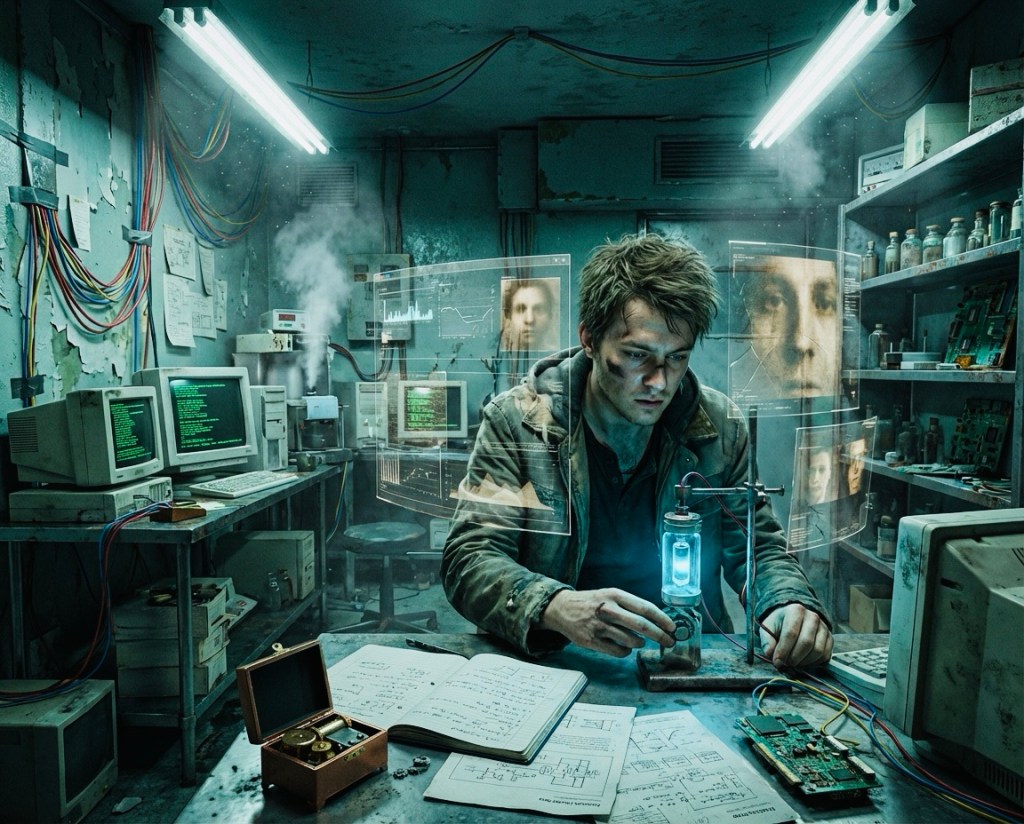
  • Hans Yarr wasn’t born into brilliance — he clawed his way to it from the rusted underbelly of Iron Alley. Before anyone in Neon Spire whispered his name, he was just a kid surrounded by scrap metal, leaking power conduits, and black-market chem dealers who doubled as his accidental mentors. What others saw as trash, Hans saw as possibility. He built his first equipment from scavenged processors and repurposed cooling pipes, wiring together a hidden, makeshift lab deep beneath Iron Alley’s maze of metal.

    There, in the humming dark, he chased a single obsession: unlocking the full potential of the human mind.

    Years of trial, error, and sleepless calculation finally yielded something extraordinary — Formula 207. A neural stimulant that didn’t just wake up the brain but ignited it. Clearer thoughts. Sharpened senses. A radiant surge of euphoria that made colors feel richer, music feel deeper, and life feel briefly perfect. When Formula 207 hit the streets, it spread like neon fire.

    Branded later as NeuroBliss, the compound became Cyberpunk City’s most coveted substance. Corporate executives in the sky-high towers of Neon Spire used it to outthink their competition. Hackers in Verdant Verge used it to sprint through code. Partygoers in the Neon Labyrinth downed it before disappearing into nights of strobe-lit raves that blurred into sunrise. Everyone wanted it — and Hans Yarr became a legend for creating it.

    With NeuroBliss fueling an empire, Hans launched NeuroCorp, transforming from a back-alley chemist into a towering figure of biochemical power. His brilliance, paired with his unsettlingly calm charisma, drew a cult-like following. Followers called him a visionary. Competitors called him dangerous. Critics accused him of engineering addiction and monetizing human dependency. Supporters countered that he had given humanity a tool to push past its natural limits.

    Hans didn’t correct any of them. He simply kept creating.

    Even as NeuroBliss reshaped the city, shadows grew around the empire. Whispers told of unethical sourcing, dangerous side effects, and the way some long-term users began losing themselves in a haze of brilliance that eventually burned out. Still, the demand only rose — especially in the Neon Labyrinth, where hyper-consumer culture swallowed everything. There, beneath layers of neon signage and endless storefronts, people chased thrills, enhancements, possessions, anything to fill the ache of disconnection. NeuroBliss wasn’t just a drug in the Labyrinth; it was a lifestyle.

    In time, Hans Yarr’s name became more than a brand. It became a warning and a promise — the symbol of a city teetering between salvation and self-destruction.

  • Iron Alley was alive in its usual way — which meant it sounded half like a dying machine and half like a marketplace arguing with itself. Sparks rained from exposed power conduits overhead, the air smelled of melted plastic and fried noodles, and every vendor shouted loud enough that the neon signs rattled. Wires hung in thick snarls above the walkways like cybernetic vines, some sparking, some dripping coolant, some humming with stolen electricity. Piles of scavenged tech, broken servos, cracked holo-screens, rusted mech limbs, and half-functioning augments made narrow aisles through the black market bazaar.

    She moved through the chaos with her hood pulled low. Iron Alley wasn’t a place you lingered. It was where you ducked in, bought what wasn’t legal anywhere else, and escaped before someone decided to pickpocket your memories.

    But then she saw it — not in the grand display cases of weapon smugglers or the glowing crates of synthetic organs, but tucked deep inside a junk shop so cluttered the doorway was nearly blocked by a mound of tangled copper wire and melted battery packs.

    A tiny music box.

    A small metal cube with rust creeping along its edges, its crank bent, its lid dented — but unmistakably the same one she had lost when she was eight. Her father used to twist the crank for her, and her mother would hum along with the tune, soft and off-key. One night during a blackout, the memory went missing just like that — vanished. Her parents whispered about it afterward, thinking she couldn’t hear: “If it ever resurfaces… we’re in more danger than we thought.”

    She froze. The shopkeeper, an elderly man with mechanical fingers and goggles welded to a helmet of patched wiring, noticed her stare.

    “That thing?” he said, voice buzzing from a throat mod. “Just scrap.”

    “It’s not,” she whispered.

    He shrugged, sweeping aside a stack of broken drone wings and a bucket of cracked neon tubes. “Came in with a haul from the old district. Buyers passed on it. No datachip inside. Worthless.”

    She reached for it. The moment her fingers touched the cold metal, a shiver ran up her arm — not from the box, but from the sudden rush of memory: her mother’s laugh, her father’s promise that the music came from a hidden place only their family understood.

    The moment broke when a gang of Rust Devils barreled through the aisle, arguing loudly, knocking over crates. A rain of screws and loose wiring fell around her like metallic hail. Someone shouted from behind a curtain of hanging cables. A neon transformer blew overhead, sizzling purple light across the junk.

    In all the chaos, no one noticed that the music box had begun to glow faintly through the rust, a pulse like a heartbeat waking from long sleep.

    She tightened her grip on it.

    Whatever her parents had feared — whatever they had tried to hide — was waking up in her palm.

    And Iron Alley, loud and wired and broken, suddenly felt like the worst possible place to be holding it.

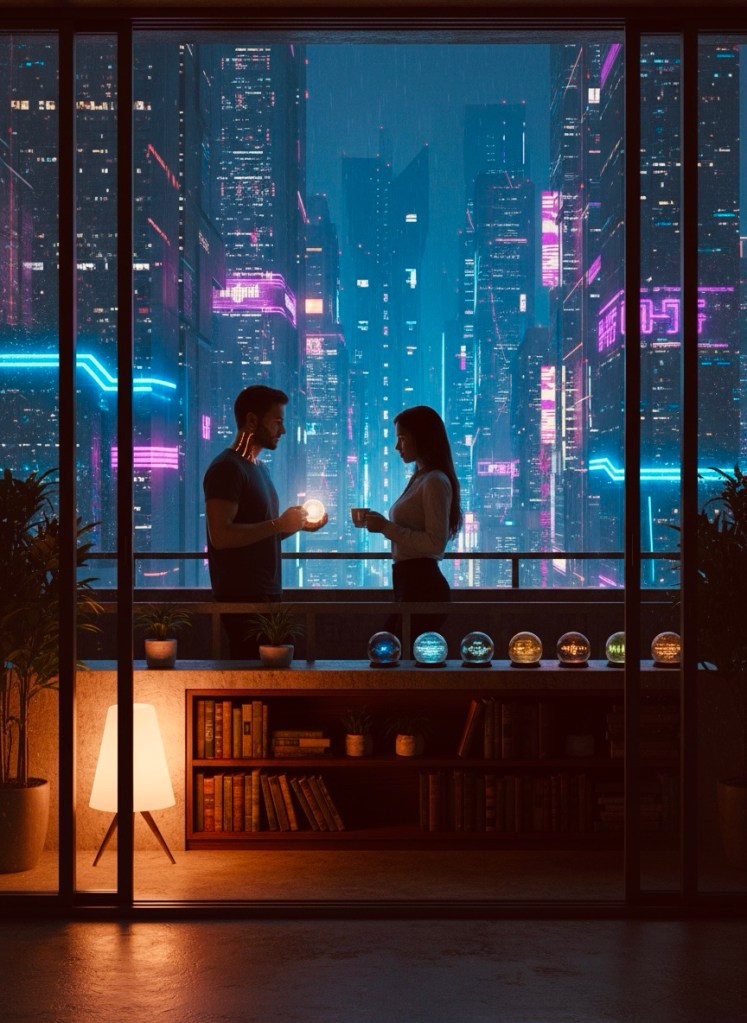
  • The Neon Spire leaned into the night like a tooth of light, its balcony a thin blade of concrete and glass with the whole city sprawled below — a galaxy of neon, freighted signs, and the slow pulse of traffic. From the man’s apartment the view was a private planet: stacked rooftops, a river of mag-ads, a far-off ferry dotted with LED ghosts. Inside, a single lamp threw a warm pool over a low bookshelf and a cluster of potted succulents. A record — some old synth-ballad — hummed softly on the turntable.

    She had met him earlier in the labyrinth of alleys and market stalls, where his laugh had been easy and his coat smeared with oil from an overturned vending drone. Now they stood on his balcony, both with cups of tea. The steam rose and caught the neon like thin glass. He talked about small things — the stupidly specific way street vendors folded their wrappers, the best illegal noodle stall near the train depot — and she found herself answering with the kind of confessions that feel safer in the dark.

    He was careful with his hands. When he reached up to tuck a stray curl behind her ear, his fingers moved the way someone who’d practiced gentleness in private had learned to be public about it. Up close she saw a faint seam at the edge of his jaw, like a scar that didn’t quite belong to bone. She told herself she was being ridiculous; the city made everyone look like they’d been stitched back together at some point.

    “Do you miss it?” she asked suddenly, because the city pressed questions on both their throats — of origin, of loyalty, of which pasts get left on the other side of the line.

    He sipped his tea, watched the skyline. “Sometimes,” he said. “But I collect other things now.” He set his cup down and the motion exposed a windowsill lined with glass orbs. Each was no bigger than a fist and glowed faintly from within — a memory in suspension. Some burned quick and yellow like laughter; others were cold, blue, like a lullaby remembered in a different language. Tiny labels were looped around the necks: dates, places, a single word — “first-snow,” “marathon,” “last-supper.”

    She blinked. Up close, the glass didn’t seem to contain light so much as a condensed time; when she cupped one in her hand, a ripple of a moment unspooled — the smell of jasmine at a rooftop wedding, a child’s cry, the clang of a streetcar — and it made the apartment tilt, small and whole and aching.

    “You keep other people’s moments?” she asked.

    He shrugged, which moved a line under his collarbone where the lamp caught a pale circuit. “I used to work in the memory stacks. We were supposed to catalog and delete, tidy up hard drives for the company. I stole the ones I couldn’t toss.” He didn’t say NeuroCorp, but the name was a city rumor that fit in the spaces between buildings. “Now I trade them. Not to the highest bidder. To people who need something — a laugh for a funeral, a voice for a house with no one left to call their own.”

    Outside, some rooftop across the way burst into a cascade of pyrotechnic ads, bathing his apartment in color. He watched her face with a patient, careful intensity, as if he were mapping her reactions and bookmarking the ones he liked.

    “It’s… intimate,” she said.

    “It’s the only honest thing I do,” he said. “You never know what people will forget. I keep them from being lost. Sometimes I listen at night and pretend I was there.”

    There was an edge to that confession that tilted the evening. She thought of the seam at his jaw and the pale run of circuitry, and wondered whether he’d meant “keep” as in “protect” or “keep” as in “own.” The city outside gave them both privacy and a thousand witnesses; every balcony silhouette was a possible buyer, a possible thief.

    He laughed without amusement. “I don’t take whole lives. Just small things. One laugh, one apology, one song. It’s less messy than stealing identities.” He reached out, not for her face this time, but for the label on the orb nearest him. He flicked it with a thumb and the handwriting matched the curve of his own: “Rooftop — 12.04.25.”

    She could feel the hair on her arms rise. “That’s tonight,” she said.

    He didn’t answer for a long second. Then he did, quietly: “I have a terrible tendency to collect what I haven’t yet experienced.”

    When his fingers brushed hers, the contact was unexpectedly cool, as if the skin beneath his hand was new and too precise. The record spun on; the city sang its neon hymn. He leaned in, the city reflected in his eyes like shards of code, and said, “If you want, I’ll make one for you.”

    She laughed, a small, disbelieving sound. “Make one?”

    “A memory,” he said. “Of this — if you ever need to remember how it felt.”

    There was the offer — generous and ominous in equal measure. She looked at the shelf of orbs, at the tiny, hogtied moments. If she accepted, a copy of tonight’s warmth could be preserved exactly: the turn of his hand, the way the lamp haloed the spines of books, the way the city smelled after rain. If she refused, the moment would dissolve into the usual human forgetting.

    She slid her fingers into his. For an instant, the seam in his jaw seemed to soften. “Then make it,” she said. “But make it true.”

    He smiled in a way that made something in the apartment unclench. He reached for a blank orb from the back of the sill — one without a label — and cupped it between his palms. The light inside it woke like a throat clearing. He closed his eyes and, with the careful reverence of someone who had learned how to hold time without breaking it, he invited the night to step into glass.

    Outside, the Neon Spire blinked, as if approving the transaction. Inside, the record needle found the beat again. She let the moment happen — the cold of his fingers, the tilt of a laugh, the promise folded into a near-kiss — and when he finally slipped the label around the new orb, he wrote nothing but a single word: “Now.”

    They stayed until the record wound down. When she left, the city swallowed her up with its ordinary brightness. Back on the street she felt slightly unmoored, as if she’d left a piece of herself on that balcony. In the days that followed there were small, uncanny returns: a phrase of his that came to mind while she made coffee, the exact warmth of his hands on a chilly morning. Sometimes she wondered if the thing that was mysterious about him was less his seams and more his vocation — the way he collected memory as others collect currency — and whether giving someone the ability to revisit a moment was kindness or ownership.

    Weeks later, on a sleepless night, she found herself in a shop that sold old radios and moonlight bulbs. At the counter, a woman packed a parcel and the handwriting on the box was the same as the looped script on the orb’s tag. She left the shop with the parcel on impulse and, back under the Neon Spire, opened it on a bench. Inside lay a small glass sphere and a single folded note: “In case you forget how we said goodbye.” There was no name.

    She cupped the orb, and for a breathless second she was back on the balcony — lamp halo, record scratching, his fingers cool in hers — and the city was as bright as a thing that had not yet been decided. She didn’t know who had sent it. She did know one thing: the man could preserve a moment, but he could not make it mean the same thing twice. That, she decided, would be their mystery to keep.

  • Jonah arrived in Neon Spire with a backpack full of optimism and a part-time job at a noodle stall. The city dazzled him: stacked walkways of glass and light, holo-ads that promised perfect experiences, night markets that sold dreams in capsules. It was the kind of place that made private things feel cheap and public things feel like performance. That interplay—the bright, staged life outside and the private quiet inside—was what pulled him in.

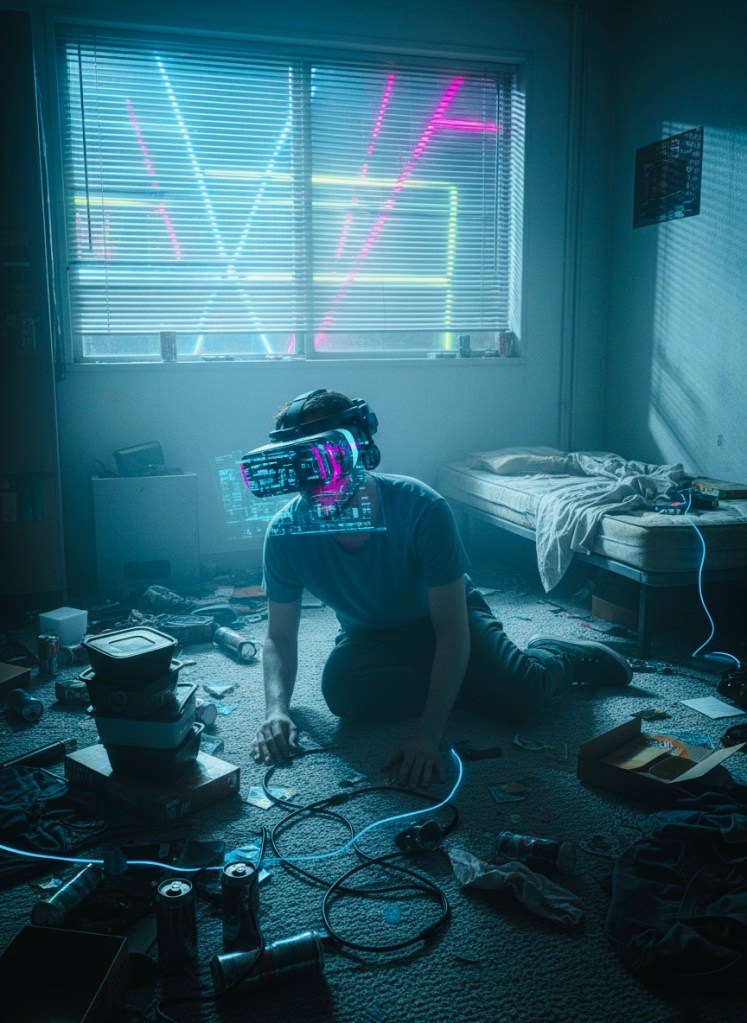
    At first the VR rooms were an indulgence, an escape. He’d slip into a rented pod after a long shift and let a curated world fold around him: waterlight streets that smelled like rain, avatars that laughed on cue, and a simulated intimacy that required no awkward small talk, no risk. No one had to know. In a city that rewarded curated selves, it felt like a safe rehearsal for being brave.

    It didn’t stay safe. The pods were engineered to learn him—what soothed him, what pushed his buttons, what kept him returning. The more he used them, the more they shifted to match his appetite. Budget hours turned into long nights. He began skipping shifts, arriving late, then lying about taxi delays and sick relatives. He stopped saying yes to friends’ invitations. His savings thinned; so did his sleep. When he did show up in public, his smiles looked rehearsed.

    Shame came on slowly, patient as rust. At first it was a quiet nick under his ribs—guilt for hiding. The more he hid, the sharper it grew. He told himself it was temporary, that he’d stop when he found someone real, when he earned more, when the city stopped feeling like a ledger of what he didn’t have. But every attempt to reach out—to date, to make himself vulnerable—fell awkward and brittle against the practiced ease of the simulated scenes. Real people required time and discomfort; the pod offered instant, effortless reward. That contrast felt like a verdict every morning.

    When an old friend messaged and wondered why Jonah was never at the group anymore, Jonah felt the shame like heat. He lied, said work was busy, that he’d make it next week. He did not mention the nights he spent in a dark pod while the city hummed outside. He did not mention the way the VR scripts had begun pushing edges he hadn’t intended to explore—how the things that used to feel consoling started to feel like a mirror of his worst impulses. He started to judge himself as someone who had traded tenderness for transactions.

    Shame breeds secrecy, and secrecy breeds a series of small betrayals: missed rent, a reprimand at work that he hid, a brief and ugly fight with his sister on a call he let go to voicemail. He kept thinking that one confession—telling someone what it had become—would fix it. But the idea of telling made him flinch. It would force words he couldn’t pull back, explain behavior that already felt indefensible. So he swallowed the truth, and the truth turned inward.

    The city’s neon made confession feel theatrical. He feared his voice would be swallowed up by the glare. At the same time, every public face he saw—friends, colleagues, couples on transit—felt like an accusation. He began to inhabit a private shame that distorted every interaction: a coworker’s neutral comment read as pity; a barista’s idle smile as judgment. He grew smaller.

    There were warning signs, small and scattered: a friend noticed he’d stopped laughing at his jokes; a manager marked down performance; a neighbor saw him pull the blinds and stay inside for a week. People reached in awkward ways—an unsent message, a pickup of the phone that landed on voicemail. Jonah misread their distance as confirmation that he had already been judged. That misreading is cruel and ordinary: when you believe you’re unfixable, other hands feel like prying.

    One slow afternoon, a colleague stopped by Jonah’s apartment to drop off a misplaced jacket. The door was locked. Nobody forced it. They later sat on a stoop and waited for a call that didn’t come. In the days afterward the city did what cities do—flashed condolences, slid into a rhythm of rumors and grief. Neon Spire kept functioning, but its bright surfaces had a bruise. People spoke in smaller, softer tones. Friends sifted through their own excuses and what-ifs, searching where comfort could not be found.

  • They found each other in the one place the city never bothered to look—

    a bar wedged between two monoliths of chrome and ambition, where neon spilled like liquid stars over chipped countertops and bodies pressed together in the rhythm of survival. The world outside clawed for advantage, for reputation, for selfish ascent. But inside the Flickerline, the music throbbed warm and low, and for a moment, no one was winning or losing. They were just living.

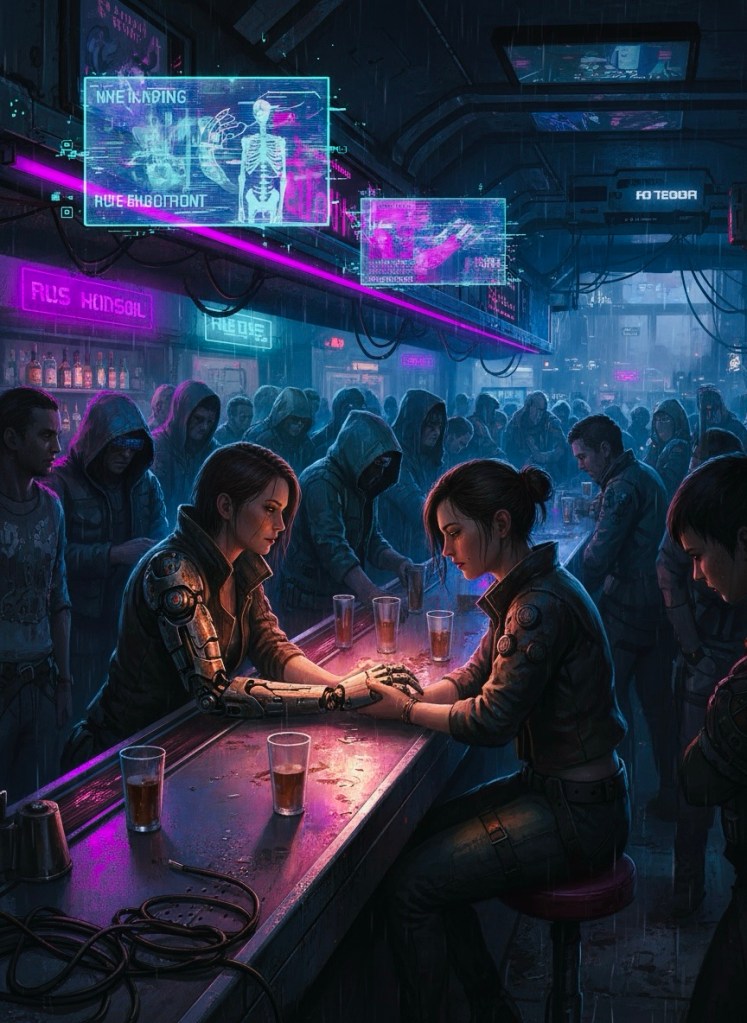
    Nia sat alone at the bar, her cybernetic forearm dimmed to save power. She hid it when she could—its mismatched plating was a reminder of a fight she wasn’t proud of, a night she wished she could take back. When Lira slid onto the stool beside her, laughing breathlessly from pushing through the crowd, Nia felt every shield she’d built over the years shudder as if struck.

    Lira noticed the arm immediately. She always noticed everything.

    “Rough night?” she asked gently.

    Nia almost lied—everyone lied in Neon Spire; truth was a luxury.

    But Lira’s voice had a softness that the city couldn’t erode, and for the first time in months, Nia let herself be seen.

    “I messed up,” Nia murmured, eyes fixed on the swirling neon reflection in her drink. “I hurt someone I care about. I didn’t mean to… I just—reacted. Like I always do.”

    Lira didn’t answer with platitudes.

    She reached out, brushing Nia’s knuckles with her fingertips—warm, imperfect, real.

    “You’re human,” she whispered. “We break things sometimes. The miracle is that we can fix them too.”

    The distance between them closed slowly, like a truce forming.

    Around them, the bar pulsed—crowds trading favors, secrets, addictions, dreams. Voices rose and fell, lights strobed against chrome implants and shimmering fabrics, every person fighting a private battle in a city that demanded constant hunger. But here, in this tiny pocket of color and noise, two women allowed themselves a moment of tenderness.

    Lira’s forehead touched Nia’s, and Nia exhaled for the first time all night.

    There was no perfection in the way they leaned into each other—just trembling breaths, hesitant touches, and raw honesty. Nia’s armor didn’t fall away all at once; it loosened. Enough for forgiveness to slip through.

    “I’m tired of being the person this city wants me to be,” Nia said.

    “Then be who you want to be,” Lira replied. “And if you fall, I’ll help you up. If you push me away, I’ll still try. Just… let me in.”

    Nia kissed her—soft, uncertain, grateful.

    A small act of rebellion in a metropolis that rewarded coldness and punished vulnerability.

    For that heartbeat in Neon Spire, surrounded by strangers chasing their own survival, they chose each other. Chose humanity. Chose forgiveness.

    And the neon—all those jade greens, electric pinks, and restless blues—burned a little warmer around them.

  • Maya learned the city by touch — the way light felt on skin, the small grammar of a hand on a shoulder, the cadence of a laugh that paid the bills. Neon Spire taught her how to sell that grammar: a calibrated brush of the fingertips, a whispered overlay routed through a throat speaker, a programmed sigh that hit a client’s nostalgia like a custom perfume. When she first arrived, the work was a bridge. Credits landed in her account and she kept a single bright coin tucked away for the future she planned to buy: a flat with a real window, a night off once a week, a visit home that wouldn’t feel like a confession.

    But markets warp, and the market for sensation wanted novelty. Clients came hungry for engineered memories, for bespoke overlays that layered synthetic warmth over the real thing. The boutique across the alley introduced “immersive companions” — performers with legal-grade implants and studio-grade coders. Managers pushed upgrades like seasonal collections. NeuroBliss vials started appearing as tips, first tasting like an easy shortcut and then a necessity for keeping up. The city suggested that anyone who could not keep up was obsolete.

    The upgrades were seductive. A micro-filament behind the ear that made a compliment feel like sunlight. A wrist module that let her mimic the exact rhythm of an old lover’s heartbeat. Each add-on promised better bookings, a higher tier, a weekend that would finally belong to her. She braided chips into her wrists, grafted small nodes into the hollow of her collarbone, and learned to let the overlays speak when her own voice would not do. At first they were tools; soon they were the script.

    Debt crept in like a shadow. Managers took a larger cut. Some regulars vanished, their tastes moving on to newer acts. She started taking off-shift vials to dull the edges when the city felt too sharp. Nights merged: sessions, calibration, sleep in fifteen-minute segments while a hired coder patched an interference loop. Her hands grew expert at reading clients’ micro-signals. Her chest grew hollow.

    The fall was both slow and sudden. One night, an unlicensed overlay glitch sent sensory feedback through an old installation at the base of her skull. The client screamed, the manager cursed, and Maya felt a jagged loop run through her nervous system. She left the club in a tangle — wristband missing, credits drained, a hollow in her chest where something like dignity had been stored. She slept on a step under a flickering ad until someone kicked her awake.

    She could have vanished into Iron Alley the way others did, swallowed by hunger or quick fixes. Instead, she drifted toward a pocket of the city she had always seen from afar: a small rooftop that smelled of damp soil and old vinyl, a place where pots of basil and moss clung to cracked concrete like stubborn promises. An older man named Tamsin found her there, or perhaps she found him; the order of those small mercies hardly mattered. He ran a low-slung outreach: part clinic, part repair shop for broken tech, part radio room where records played through a battered player. Tamsin had been an engineer once, then a machinist, then someone who decided a life of quiet service was saner than the city’s greed.

    He didn’t demand explanations. He offered tea and the grammar of presence. He led her up a narrow ladder to his rooftop island. The city below roared with its billboards and its constant appetite for novelty, but up on the roof the air tasted different. String lights sagged across a rudimentary trellis, pots and reclaimed planters held stubborn basil and shoots of something mosslike, and inside the open doorway a record spun, warm and analog, the needle lifting and falling like a heartbeat.

    Maya sat barefoot on the soft dirt. Her arms still carried faint scars and brackets from past installations; a pair of dull nodes lay at her sleeves like exhausted stars. In front of her, on a bit of cleared soil, she set down the last of the artifacts she had used to armor herself against feeling: broken implants, a tangle of spent wires, a few spent NeuroBliss vials. She laid them out not as trash but as history. Tamsin knelt and poured tea from a dented pot into a dented metal cup. He did not say, “You must stop.” He did not need to. He only offered warmth that didn’t come with a calibration sequence.

    Recovery did not arrive all at once. The first days were made of small refusals: no overlays for a shift, a walk without stimulating music, a meal eaten slow enough to notice texture. Tamsin taught her to work the soil — how to loosen compacted earth, how to coax basil from a battered tub, how to find moisture in the dead heart of concrete. Her hands remembered muscles they had not used in years. The work was physical and honest; it demanded patience and repaid it in green shoots.

    She dismantled many of her implants under Tamsin’s watch. Some were sold for parts to keep the outreach afloat; others were carefully unsoldered and placed in a small ceramic bowl that sat on the edge of her workbench like a reliquary. When she fed a tangle of chrome into the recycler, she felt an odd twin sensation: grief for the ease it once provided and a surprising relief at the weight lifted from her nervous system. She kept one small, dull node — not as a talisman to be reactivated, but as a reminder of how close she’d come to being lost.

    The rooftop became a classroom in unexpected ways. Other workers drifted up on afternoons when the city below chimed for the night shift: a transcribed smile, a burned-out coder, a young woman who’d been sold an overlay that promised to make her “irresistible” and instead left her hollow. Maya taught them how to set physical boundaries without relying on hardware, how to spot a rigged interface, how to negotiate for pay with a voice that belonged to them and not to a script. Tamsin taught basic tech triage: how to remove a senescent node without frying a circuit, how to build a simple analog filter to dampen intrusive overlays. They traded labor for soup and for the tiny, stubborn luxury of regular sleep.

    People noticed, but not in the way the city advertised. Neon boutiques kept their windows full of engineered yearning; corporate spokespeople wrote op-eds about “choice” and “innovation.” NeuroCorp’s glossy pamphlets did not mention the rooftop where basil turned toward morning light. But small things changed in pockets. A kid on a nearby rooftop offered Maya a sprig of basil as if it were a talisman. A neighbor brought broken plates to fix and left with an earful of vinyl records she swore she’d never stop listening to. The market in Verdant Verge — a modest column in a city obsessed with gloss — sold her a battered hand-loom and a sack of soil that smelled like rain.

    Temptation never vanished. There were nights when the quick fix shimmered like a neon sign right around the corner, and old circuits whispered that a single session could make the world bright again. But those nights she breathed through the urge, went to the roof, and pressed her palms into soil until the craving dulled into something else: the patient ache of planting a seed, the slow, uncompromising feedback of life taking root.

    Years later, a small zine ran a profile: “A Quiet Defector of Neon Spire.” It made a minor buzz for two days, then the city spun on. Maya kept the squat of her rooftop garden. Tamsin’s hands grew more knotted, but his tea tasted the same. The bowl of relics remained by the window, a small museum of a life survived. She taught a class on negotiating boundaries that filled quickly and then overflowed into neighboring rooftops. She still missed some clients — the ones who’d wanted her warmth without the flash — but she had stopped measuring herself in bookings and started measuring herself in seedlings.

    On mornings when the skyline glowed and the ads below flared like distant constellations, Maya would sit with her knees in the dirt and let the city be loud. She would close her eyes and feel rain on her face that came from the sky and not from a circuit. There was no sudden victory, no triumphant exit. The city still sold its charms. People still chased them. But up on that rooftop, with a teapot steaming in a battered cup and a vinyl record spinning soft as a promise, Maya had reclaimed a quieter economy: the one of tending, of being seen not as a product but as a person in the slow work of growing herself back.

  • He traded in ghosts.

    Arlen Kade’s first real memory of wealth was a flicker on a cracked screen: a line of green numbers climbing so quickly it seemed they were pulling the skyline upward with them. He’d started in a cramped dorm above a noodle shop in Iron Alley, fingers raw from midnight trades and cheap stimulants. CyberTokens were a rumor then — a decentralized rumor that became a tide — and Arlen rode it until his name was a light on other people’s facades. By the time the Neon Spire’s concierge called him “sir” without irony, he could no longer remember the taste of anything not flavoured by neon.

    His penthouse sat on a cantilevered ledge in the Neon Spire, glass and heated alloys slicing the city’s smog like a blade. From there the hub of the district glittered: markets spilling holographic wares, walkways stacked three stories high with diners and neon signs, and the slower, greener pulse of Verdant Verge a few districts away — a polite promise that nature still existed somewhere beyond the corporations. He bought vistas the way other people bought art. He bought people, too: performers with shimmering dermal filigrees, ex-engineers turned sensation-curators, and the kind of acquaintances who would never betray you because they owed you too much.

    Hedonism, in Arlen’s world, was a discipline. Neurostimulation implants were the instruments. He had dozens of them — sleek, chrome scintillas tucked behind the ear, braided into the spine like jewelry, grafted along wrists to make the simplest gesture into a concerto. People spoke of the old days when money bought cars; he preferred to say that money bought calibration. Why watch a sunset when you could overlay it with a bespoke synesthetic chorus? Why taste if you could feel the memory of taste as an engineered waveform?

    At first it was exquisitely controlled. Nights blurred into curated sessions at private clubs in the Neon Labyrinth, where illegal tech-hubs hummed and purple smoke curled like hungry cats. NeuroBliss was a line item at his parties — vials glinting in ice, the illicit drug’s label both promise and joke — and the Rust Devils’ crews supplied security with a keen discretion. Arlen had legal counselors for the tokens, a fixer for the friends, and an electrician for the way his skin lit up at will.

    But pleasures are maps with hidden borders. Once you map a corner of sensation, you always want the rest of the country.

    “Just one more layer,” his developers said, and he paid them so they could dream in his name. He commissioned implants that translated the city into a language his nerves could read: traffic as basslines, advertisement jingles as layered harmonics, the laughter from below as tactile rain. Each augmentation promised a clearer, more intense interpretation of everything the city could offer. Each promised that the next revelation would be the last he needed.

    There were warnings. A low-grade whisper about signal bleed and feedback cascades circulated among the boutique surgeons and grey-market coders. NeuroCorp’s public literature — glossy pamphlets that bore Eron Vex’s calm portrait — advised “careful dosing, licensed calibration.” In the undernet forums the disclaimers were sharper and less invested; someone somewhere always paid the price. Arlen read, nodded, and paid more.

    The implants began to argue with one another. Patterns across his cortex, tuned by different makers with different APIs, started overlapping like competing radio stations. A pleasure pulse designed to bloom behind the jaw met a staccato beat from a visual overlay grafted to his occipital micro-array. At first the collisions were merely annoying: out-of-sync blooms that tasted of static. Then they were fascinating: interference that birthed new, illicit textures no designer had marketed. He chased them like a gambler chasing odds, convinced that mastery was a matter of persistence rather than prudence.

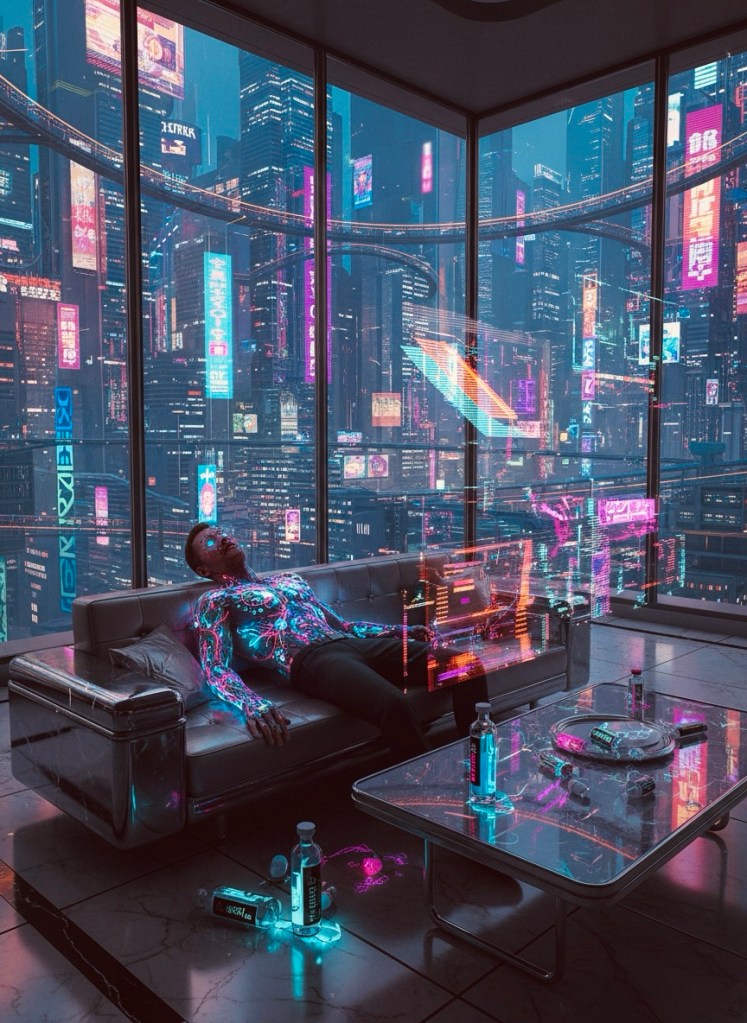
    He stopped sleeping. Nights folded into layers of artificial dawns; he woke with the taste of neon in his mouth and the echo of another man’s laughter at the back of his skull. His body grew thin beneath the cascade of micro-augmentations, his face a map of pale gold tattoos and implanted filaments that glinted like circuit traces. He slept in a hammock of light and woke to the city’s humming chorus, each shard of noise registered as a sensation and then fed back into a loop.

    The fatal night was unremarkable in the way all tragedies are unremarkable at the beginning. A party, a new module to test, an augmented sensation promising “transcendence of the baseline.” He reclined in a room that overlooked the hub — the neon carnival below unabated, the Verdant Verge a distant promise. Friends and sycophants clustered like constellations at his edges, their implants dimmed politely so his could sing.

    The first thing he noticed was the crescendo: not a pulse, but a climbing weight that pressed behind his eyes. It was a sound he felt more than heard, a network of tones crisscrossing in a space his body could not parse. Then the harmonics broke. Subroutines meant to ease feedback threw open like doors in a storm, and waves of stimulation cascaded without a governor.

    He felt everything at once. Pleasure and pain braided until he could not tell one from the other. Memory fragments — a childhood joke, the scent of Iron Alley’s noodle shop, a lover’s half-remembered touch — arrived as volleys of light and pressure that hit his skin like hail. The city, which had once sung to him in sponsored chorus, became a chorus of knives.

    His attendants did what attendants do: they panic-pressed interfaces, bled current, screamed for med-techs who were not licensed for the particular constellation of black-market codes woven through his implants. He fought them for a beat, then stopped, eyes rolling back into a scroll of nebulae. In those last seconds, some quiet mechanism — whether by mercy or by mechanics — unwound. The assault on his nervous system finally found a true silencer.

    He died in his private observatory, a small and extravagant ruin. The newsfeeds below carried the story like a curated commodity: “CyberToken Magnate Found Dead.” The Neon Spire’s concierge changed the way she arranged orchids. NeuroCorp issued a bland statement about “ongoing investigation into illicit modification materials,” and Eron Vex’s portrait blinked with the practiced neutrality of corporate grief.

    On the street, the city only paused long enough to make a meme. Someone in Iron Alley wrote his name on a crumbling wall in phosphorescent paint; the Rust Devils tagged a mural with their own sigil as if to add punctuation. The Neon Labyrinth recycled his last party as fodder for new sensations; some coder ripped circuits from his private rigs and turned them into contraband plugins that would circulate for months.

    In the years after, the story became a parable: a cautionary whisper told by traders in dim data-rooms and by kids in alleys who wired cheap euphoria into old radios. They told it as a moral — about limits, about greed — and sometimes as an incitement: the rich had always been first, the rich had always been expendable. Engines of the city churned on: Neon Spire advertised a new line of sensory implants, Verdant Verge held another farmers’ market where people sold real food for real money, and Iron Alley hummed with its usual, stubborn life.

    Arlen’s penthouse stayed empty for a while. The glass reflected a thousand nights without him, and the city, like always, learned to sing without listening.

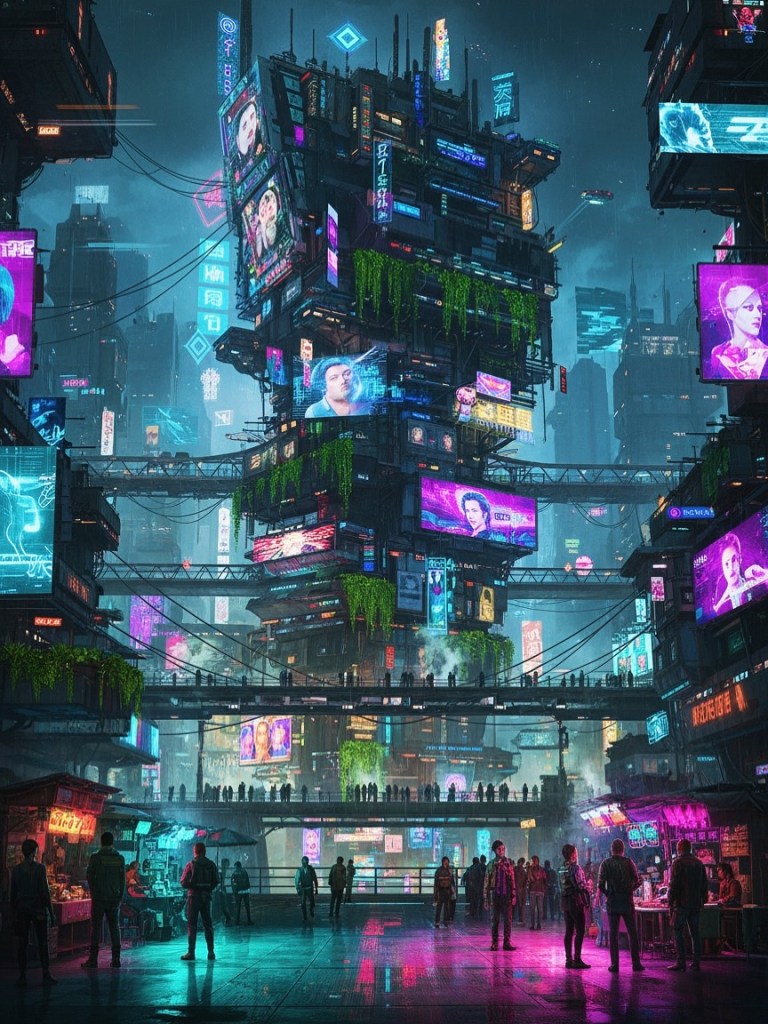
  • The Hub was the pulse of Neon Spire — a place where light never slept and the rain always shimmered with reflected neon. Towering stacks of mega-structures loomed above the crowds, each layer packed with vendors, holo-screens, micro-clubs, noodle stalls, drifting walkways, and the constant thrum of thousands of lives passing through at once.

    At street level, the air tasted of sizzling street food and ionized mist from the overhead transit rails. People from every district funneled into the Hub: gamblers chasing the next win, workers from Zenith Dynamics grabbing late shifts, black-market tech dealers whispering from their stalls, dreamers searching for connection under the glowing advertisements that chronicled the city’s every desire.

    Up above, the stacked towers formed a maze of bridges and platforms, each one crowded with silhouettes moving like currents through a living machine. Vines — a rare touch of Verdant Verge’s influence — spilled down from makeshift gardens carved into the architecture, softening the brutal shine of the chrome.

    Tonight, however, there was a tension humming beneath the usual noise.

    A sudden blackout struck one of the central towers — just long enough to send a ripple of unease through the marketplace. The ads flickered back on, but in that brief heartbeat of darkness, every person in the Hub felt the city breathe. Rumors spread fast: a cyber-sabotage attempt, a ghost in the grid, or perhaps a new prototype device stolen from an upper-Spire lab.

    In a city where corporations, gangs, and citizens all played their parts in a vast neon chessboard, moments like these were warnings.

    Still, the crowds resumed their rhythm. The stalls reopened. The walkways filled again. The light returned.

    Because this was the Hub — the place where every story in Neon Spire eventually crossed paths, whether for a moment or forever.

    And tonight, someone in that swarm of bodies had sparked a new story — one the city would not forget.