
NeuroBliss cleared Phase V when Elara Kade was still a junior analyst, back when the city thought regulation could keep pace with ambition.
Now she worked nights.
Elara rented a sublevel room beneath the Neon Labyrinth, concrete sweating from coolant leaks, air thick with solvent and ozone. She wasn’t a chemist by training — systems engineering, neural feedback loops — but the underground didn’t need purity. It needed speed. She understood signal amplification, and that was enough.
NeuroBliss was locked down. Receptor-selective, buffered release, AI-governed metabolism. Every safeguard NeuroCorp could afford. Elara had read the filings. She knew exactly where the brakes were installed.
So did everyone else down here.
The bio-cell called itself NullFold. Five members. No surnames. They worked in silence, lit by oscillating status LEDs and a centrifuge that screamed when pushed too hard. Their goal wasn’t improvement. It was omission.
The first batch Elara injected was labeled NF-A7K3.
No branding. Just black marker on a clear vial.
They stripped out delay buffers, pushed GLP-pathway activation past NeuroBliss tolerance, bypassed liver modulation entirely. Onset hit in eight minutes. Hunger vanished — not suppressed, erased. Focus narrowed into a hard, bright line. Elara logged vitals on a cracked tablet, hands steady, pulse already climbing.
Validation criteria were simple:
– Conscious at +12 hours
– No ventricular drift beyond consumer ECG thresholds
– Tremors resolved by +48
NF-A7K3 passed.
The next iteration, NF-B9Q1, did not. Elara collapsed four hours in, vision fragmenting like corrupted video. They dragged her onto a folding table, monitored oxygen saturation, waited. When she woke, they reduced the ratio and renamed it NF-B9Q2.
Versioning replaced trials.

Word moved fast. Street docs started asking for stock by code, not description. “Got any Q2 left?” “Heard C8M hits harder.” Elara watched enhancers leave the lab in unmarked cases, each vial carrying letters and numbers that meant nothing to the people injecting them.
Clinics aboveground started seeing anomalies.
Patients came in claiming they were still on NeuroBliss, but their scans told a different story — receptor burnout patterns, endocrine crashes, appetite signals permanently muted. NeuroBliss showed clean in every diagnostic. The variables didn’t match.
Elara knew why.
By the time NullFold released NF-C8M4, they weren’t even pretending to test properly. Elara injected first out of habit, then necessity. Sleep fractured. Her hands shook when idle. The focus was still there, sharp and cruel, but it came with static — missed words, delayed reactions, a growing sense that something fundamental wasn’t resetting.
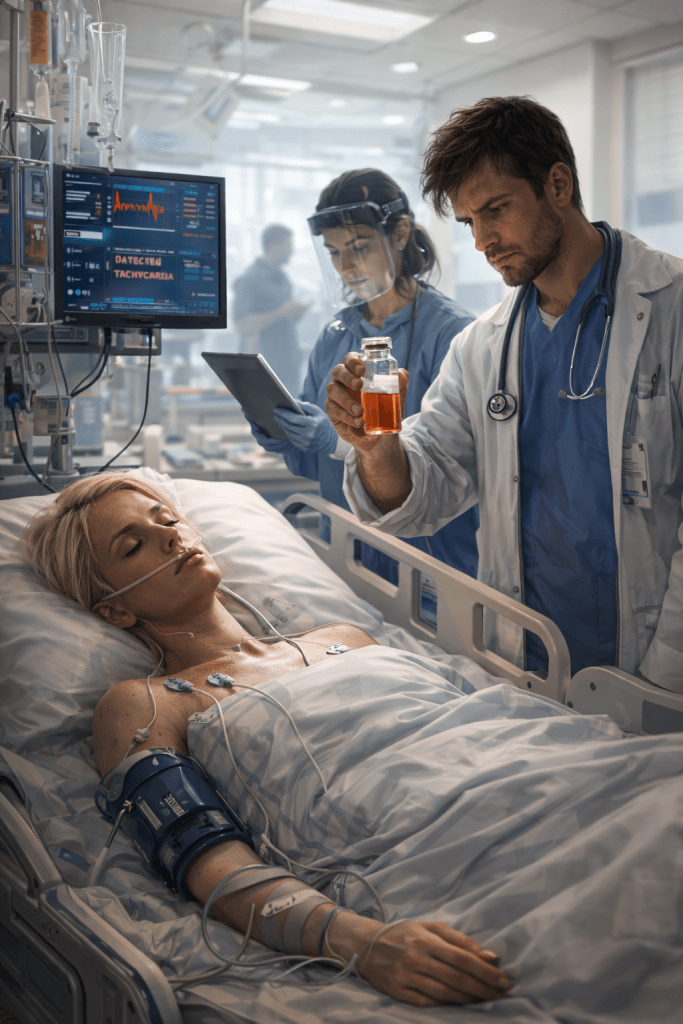
People disappeared.
A street doc stopped answering messages. A courier overdosed on a mislabeled J4-L2 from another cell. The City Health Authority pushed a warning overlay, but it named no compounds. It couldn’t keep up with alphanumeric ghosts.
NeuroBliss became a fallback — the safe option people returned to after enhancers burned them out. Elara watched users crawl back to clinics, thinner, quieter, older in the eyes.
One night, alone in the lab, Elara stared at a fresh vial marked NF-D1X0. Clean. Clear. Untested.
She understood the pattern now. NeuroBliss hadn’t been slow because NeuroCorp lacked skill. It was slow because it respected what happened after the results.
Elara set the vial down.
Above her, Cyberpunk City pulsed on — neon, hunger, optimization without pause. Below, the centrifuge cooled, waiting for someone else willing to mistake survival for proof.
 Cyberpunk City AI
Leave a comment