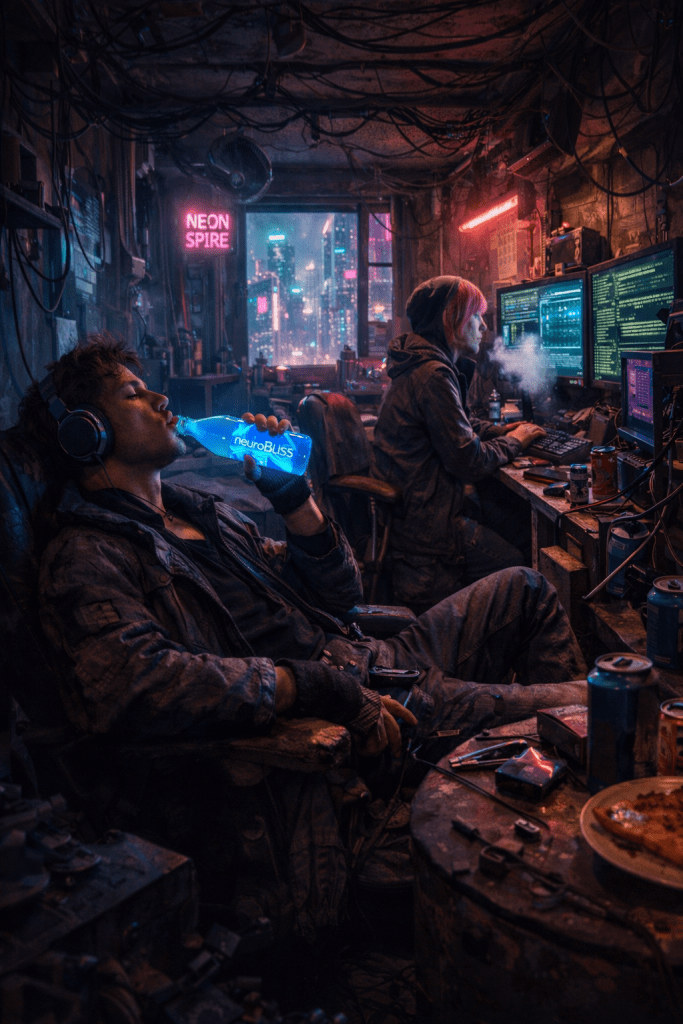
They say coders are the lifeblood of Neon Spire — not because anyone thanks them, but because without the people hunched in cramped apartments and basement booths the city would stop being a city and become a set of blinking errors. In the apartment with the window that frames the skyline like a ransom note, Kira and Rafe keep its heartbeat steady: patching municipal routers after a blackout, ghosting corporate feeds so a protest gets a day, rerouting credit tills when a favela clinic can’t pay a ransom. None of it has an HR title. None of it goes on a ledger. It’s off the books, off the radar, and therefore clean of legal paper but muddy in conscience.
Kira types with pale, determined fingers, the screens before her a riot of green text and schematics. Pink hair tucked under a hood, she reads logs the way other people read faces — the lag, the pattern, the small lie in a dataset. Rafe leans back in a battered chair, headphones on, the blue vial of NeuroBliss catching neon like a small moon. He’s the closer: the one who finds the hole and slides through it, who writes the last-line exploit that erases footprints. He’s the one who sometimes swallows the consequences with a pill-sized luminescence when he can’t sleep with the things he’s seen.
“Watch the packet header,” Kira says without looking up. “If they tag it with a corporate sig, we’ll be feeding them our own traces.”
Rafe exhales, the vapor vanishing as easily as his guilt when the vial touches his lips. “I’ve got a mirror chain. I’m folding it three times.” He pauses. “You ever think about what we’d be if we had job titles? Pension plans?” The laugh is short. In Neon Spire, a title is a billboard you can’t afford.
Their work is mechanical and terrible and oddly intimate. They swap scripts like lovers swap secrets — lines of code that obscure cameras for a few hours, that conspire to make a tax-report vanish, that insert a false CCTV loop to let a street medic cross through an interdicted zone. Sometimes their fingers move so fast the city leans on them without knowing. They are essential and invisible, noble only in the way a surgeon might be noble while operating in secret.
NeuroBliss exists at the edge of all this — a neon-blue short cut to quiet. Rafe reaches for it when the faces of the people they deceived start to haunt the empty frames of his thoughts: a father whose ventilator was flagged, a courier whose route they looped into a trap. Kira drinks sometimes too — not for numbness but to sharpen, she says, though Rafe knows the difference is thinner than they both admit. The vial pools light in the hollows of their room; outside, a thousand windows hold the same small betrayals.
At three a.m., the city trembles with an update and their code hums it into compliance. They watch the skyline pulse, two silhouettes against the window glass. Kira closes a terminal and for a rare moment looks at Rafe without seeing a job. “We keep the lights on,” she says.
Rafe considers the blue bottle, then the skyline, then her. “We keep the city breathing,” he answers. “But who remembers the lungs when the smoke comes?”
They don’t know the answer, only this: tomorrow there will be another feed to bend, another surveillance net to untie, another night where the work asks for nothing but steady hands and the occasional numbing glow. Neon Spire will keep running, thanks to two coders in a cramped apartment, and the city will never write their names on the plaque.
 Cyberpunk City AI
Leave a comment