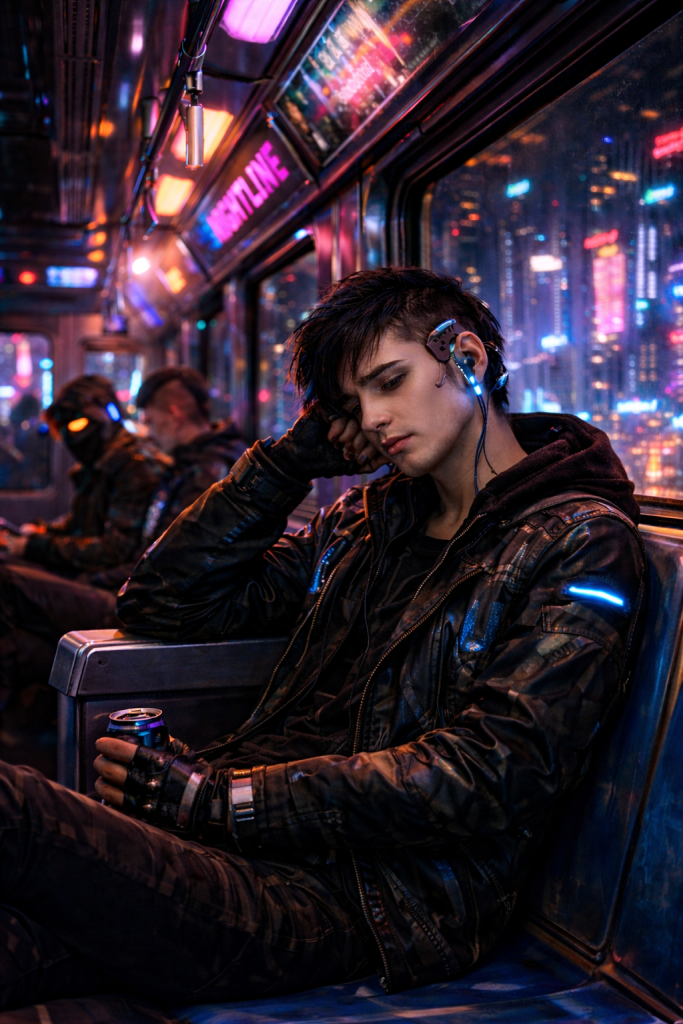
He watched the city smear past like a wound that never scabbed over, neon bleeding into rain-streaked glass. The train hummed on, indifferent, carrying him through neighborhoods that promised reinvention and delivered only more of the same. He folded himself into the seat and let his jaw slack—guilt and exhaustion doing the work of gravity.
It hadn’t been a single, cinematic choice that broke things. It was a string of small, persuasive acts, and among them one small mercy that became the undoing. Her—Maya—had been drowning in a class that mattered too much to her and meant nothing in the ledger of the city. Papers stacked like unpaid bills; professors who equated empathy with weakness. She’d come home one night hollow-eyed and shaking, whispering about deadlines and failing grades and the way the future looked like a locked gate.
He’d wanted to fix it. He’d wanted to lift her, to make the pressure ease for one night. In the dim light of his apartment he had emptied a tiny vial—pale, humming with a soft blue light—and told himself it was just a pocket of calm. “Try it,” he’d said. “Just a night off.” NeuroBliss: a luminous promise that folded sharp edges into warm, edible fog. He thought he was offering rescue, a bridge across a bad evening.
She loved it the first time. She laughed with the kind of reckless, unguarded joy that used to live between them, the laugh he’d been trying to find again for months. Her chest relaxed, her shoulders lowered, and for two hours she was not the sum of her anxieties. He watched her and felt the old hope—maybe this time he’d found something that could keep her from falling.
Then she didn’t come back.
At first it was small things: late replies, a missed dinner, a “sorry I fell asleep” text. Then the messages stopped. Calls went straight to silence. His phone lit with “last seen” timestamps that retreated like tide marks. He checked the places where the city stores people—sleeper dens, cheap motels, the backrooms of clinics that didn’t ask questions. He called friends and old contacts who knew how to pull a name out of the city’s underbelly. He found traces: a hostel bill paid in cash, a photograph of her at a rooftop market with her head tilted back, eyes closed. But every trace dissolved when he followed it.
He blamed the drug, wisely and loudly—the way NeuroBliss rewired longing into something that felt safer than life: easy, immediate, annihilating. He blamed himself. He told the story a hundred ways in a hundred directions, hoping one version would make him absolved. “I only wanted to help.” “I thought it would be one night.” Each explanation landed like a coin in a well and sank out of earshot.
Sometimes, late at night, he replayed the night she stopped answering: the way her pupils had dilated, the tilt of her head, the way she mouthed a single word—“stay”—as if begging him not to leave. He had promised himself he wouldn’t stop watching, but then he left the room for a minute to get water, and the minute had stretched into a silence that swallowed her. That single absence felt like betrayal, or the essential accident of a man who thought he could control outcomes he had never been trained to steer.
Now he rode the train and measured his life in stations and missed calls. People around him moved like planets around indifferent suns, their own orbits tight and private. He scrolled through his contacts until the names blurred: friends who drifted, numbers that wouldn’t pick up, old lovers who had nothing left to say. He’d left messages at clinics, registered missing-person reports that required patience he didn’t possess. Every lead either turned up nothing or something that raised the ache—an unfamiliar address, a grainy security photo, a rumor that she’d been seen on a different line.
The city kept its secrets well. NeuroBliss had a way of converting presence into absence—one user melting into many servers and shadow markets, identity diluted into feedback loops and synthetic comforts. He imagined her there sometimes, eyes glazed, a smile that never reached her jaw, content in a place that had no use for rescue. Other nights he imagined her fighting, angry and human, pulling herself back up from the velvet oblivion he’d handed her.
Powerlessness was the only new thing he had learned. Choices had not been dramatic; they had been pragmatic and small and easily rationalized. But small choices add up. They assemble themselves into the architecture of a life you don’t recognize until you’re standing at the top of it and there’s no ladder left.
The train slowed. The doors sighed. He kept his body still as if staying put might reverse time. He listened for a ring he knew would change everything, for breath on the other line. Silence answered. He folded his phone away and watched the city blink by—towers promising futures, alleys selling escapes, neon signs advertising lives that belonged to other people. He tightened his grip on the can until his knuckles hurt and tried to feel something more than the exhaustion of being the man who thought he could help and wound up losing what he loved most.
He didn’t know where she was. He didn’t know if she would ever answer. The only thing left was movement: the train, the errands, the calls, the small, relentless acts that might one day, by accumulation, tilt the world back toward mercy. Until then he rode the line, held in the city’s indifferent momentum, suspended between shame and a hope so thin it might be called stubbornness.
 Cyberpunk City AI
Leave a comment