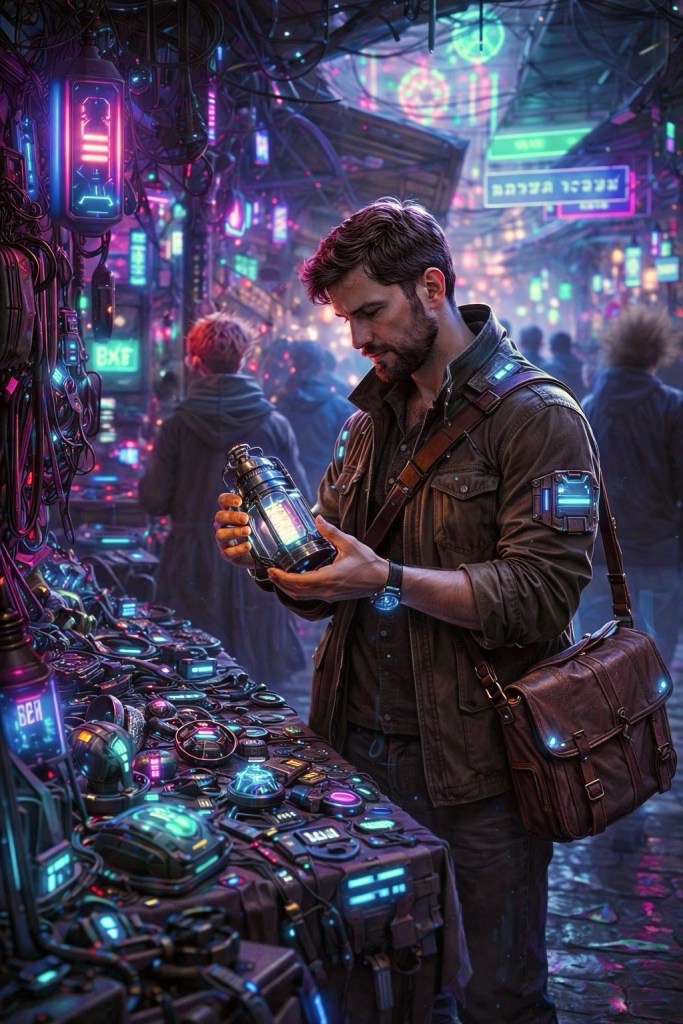
The market in Iron Alley never slept—it only flickered.
Neon signs buzzed overhead, throwing broken light across puddles of oil and rainwater, while cables hung like vines from the steel ribs of the alleyway. Vendors shouted in clipped code and half-legal dialects, hawking implants, cracked firmware, obsolete tech no one else wanted anymore. That was why he was here. New parts were useless to him. Too expensive. Too incompatible.
He stood quietly at the edge of a cluttered stall, fingers closing around a cylindrical modulator that glowed faintly blue from within. His breath caught—not from the cold, but from recognition.
His father’s respirator sat back home on the kitchen table, older than most of the tech sold in Iron Alley. A relic from before subscription-based healthcare, before medical devices locked themselves behind corporate firewalls. It wheezed when it ran, coughed when it shouldn’t, and lately it had stopped regulating pressure altogether. The modulator was missing—salvaged years ago, sold off when rent mattered more than tomorrow.
They couldn’t afford a replacement respirator. They couldn’t afford hospital access, either. The clinics wanted credits up front, and insurance tiers they’d never qualify for. So they made do. Cleaned filters by hand. Patched cracks with sealant meant for industrial pipes. Prayed the machine would last another night.
He turned the modulator slowly in his hands. The casing was scratched, the serial number half-burned away, but the ports matched. Old-standard. Pre-lock firmware. The kind of part no one bothered manufacturing anymore because it didn’t generate recurring revenue.
His pulse thudded in his ears.
Around him, the market surged—boots splashing, drones humming, someone arguing over the price of a neural jack—but it all faded into background noise. He imagined fitting the piece into the respirator, imagined the steady rhythm returning, imagined his father sleeping without that strained, rattling sound in his chest.
“Careful with that,” the vendor muttered from the shadows. “Doesn’t play nice with modern systems.”
“That’s the point,” he replied.
He checked the connector again, tracing it with his thumb like a memory. This wasn’t just scrap. This was time. This was breath. This was one more chance to keep his father alive in a city that treated survival like a luxury upgrade.
He didn’t know yet if it would work. Old parts failed. Iron Alley lied. Hope was dangerous currency.
But for the first time in weeks, as neon light reflected off the modulator’s glow, he allowed himself to think:
I may have finally found it.
 Cyberpunk City AI
Leave a comment