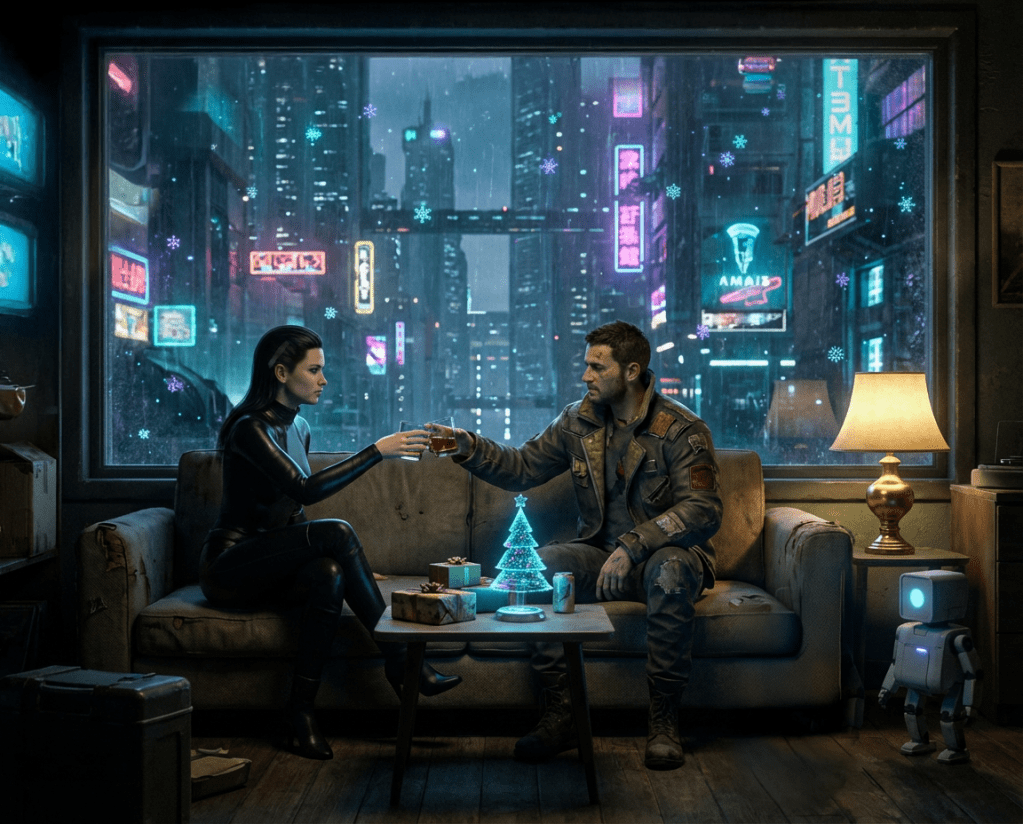
Mira watched the city breathe from her window—a slice of Neon Spire that looked out over a thousand stacked lives. Tonight the view was softened by a holiday filter pushed through the building’s public overlay: warm halos around streetlamps, a faint amber glow on the towers, and, curiously, a slow drift of neon snow that evaporated before it touched the sill. Mira trained the steam from her mug into a small cloud on the glass and drew a crooked star with her fingertip. She had invited Kai for Christmas—the first time either of them would be far from the neighborhoods they’d grown into.
Kai arrived from Iron Alley at dusk, carrying the smell of oil and street spice with him. He had one hand wrapped around a battered case that clacked when he walked; the other hand—an older, repaired joint of servo and scar—tucked the collar of a coat that had never seen Neon Spire’s polished skybridges. He kept his hood low out of habit. Mira met him on the building’s lowest skybridge with a projected scarf looped around her neck—an old tradition, she joked, “for the robots.” His laugh was surprised, a quick, practical sound that made the scar at his jaw soften.
Between them was the city in miniature: drones like blinking beetles crossing the sky, advertisement holograms folding into themselves, and drifting AI service robots exchanging holiday gestures—projected tinsel looping from their chassis, notification lights dimmed to candle-brightness. Mira had arranged for one to accompany them up; the robot moved like a slow, efficient Santa, dropping soft, paper-thin maps of old carols onto the escalator steps. Kai’s fingers brushed one; the paper snapped open to a warped recording code that had the unmistakable crackle of the early-net era. He grinned before either of them realized it was nostalgia, not just a song.
Mira’s apartment was small and human in a district that preferred gloss. Books crowded one shelf—paperbacks and dog-eared hardcovers—interspersed with a few salvaged analog cameras and a lamp Mira insisted had the “perfect, imperfect” glow. She’d cooked something half-synthetic and wholly warm: a loaf of synth-bread borrowed from a Verdant Verge market recipe and a pot of tea thick with spices that came from someone Kai knew back in Iron Alley. The city’s holiday overlay nudged the heater a degree warmer; NeuroCorp’s seasonal patch hummed politely through the vents, anonymous generosity packaged in code.
They traded gifts that felt like introductions. Kai opened a serrated tin with clumsy fingers. Inside: a tiny music chip—corroded edges, hand-soldered rewrites—stamped with the Rust Devils’ old insignia. He explained how he’d bartered for it in a midnight market beneath Iron Alley walkways: an old chip that used to hold family carols, gutted and reprogrammed to stream a rawer, human version of the songs Mira’s neighborhood polished into perfection. The music that bled out when they slipped it into Mira’s player was ragged and beautiful—old voices stretched, digital hiss like distant rain. Mira’s eyes wet at the first broken chorus; not sadness exactly, but the sudden, feral recognition of something enduring.
Mira’s gift was softer: a small lamp she’d restored from a market in Neon Labyrinth. Its filament was an archaic loop that flickered like laughter when Kai switched it on. He ran his fingers over the metal—no polished chrome here, just the warmth of human hands and a tiny dent that fit his thumb. He set it on the table between them, and the room felt rearranged by its light.
Outside, a maintenance bot zipped past Mira’s window, balancing a thin, glowing star on its chassis as if placing it on the skyline itself. “They do that every year,” Mira said. “Or at least they pretend to.” Kai watched, fascinated: small, mechanical rituals that attempted the truth of human seasons.
They ate by the lamp, sharing slices of synth-bread and stories. Kai told Mira, in short, clipped bursts, about the walkways of Iron Alley—where gangs like the Rust Devils maintained iron pride and stubborn joy, where old machinery mended younger bones, where people made celebrations out of scarce things. Mira told him about Neon Spire’s curated warmth—how windows were frames for lives edited into postcards, how she kept a stack of forbidden, real-scented paperbacks in a secret drawer because the city preferred screens. He nudged one of the books with a fingertip and laughed at an author’s name he could barely pronounce. The moment was easy because they were both, finally, allowed to be less defended.
As midnight rounded the city, the public overlay announced a holiday silence: sixty seconds with all ads dimmed, a tradition the city embraced as proof it still remembered more than commerce. The skyline went mute. For sixty seconds the hum of generators lowered, and the neon snow slowed its fall. AI robots and drones dimmed their halos in unison, service lights reduced to the soft blinking of companion circuits that wanted, for a second, to be human.
Mira and Kai stepped to the window. The view was a black, layered silhouette cut by softened lights. Kai rested his hand on the glass where Mira had traced a star earlier. He took Mira’s other hand—callused, warm—and squeezed. Neither of them spoke. In the silence, the city’s memory stitched itself into theirs: a mix of old songs and new code, of stolen gifts and small restorations. The robots in the street bowed their sensor arrays in programmed reverence; a stray child—half human, half augmented—shouted something that turned into laughter. The moment felt both fragile and stubbornly real.
When the lights surged back, the city exhaled into color. Mira leaned her head against Kai’s shoulder and said, softly, “First time?” He nodded. “First time,” he answered.
They kept the lamp burning all through the night, the music chip looping its ragged carols, and the projected scarf Mira wore continued to flutter in the corner like a promise. Outside, Neon Spire and Iron Alley continued their old negotiations—trade, tension, tenderness—while inside a small apartment, two people built a holiday out of borrowed things and the fragile machinery of hope. The city watched, and its AI companions adjusted their programs to include one more scenario: two strangers finding home in each other’s light.
 Cyberpunk City AI
Leave a comment