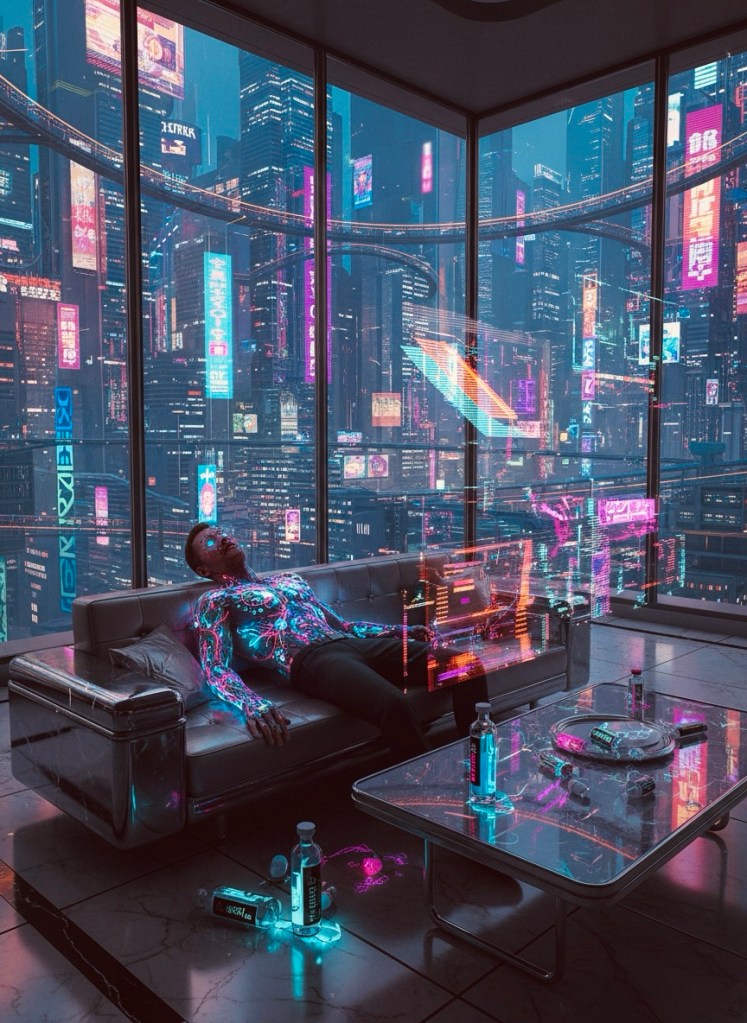
He traded in ghosts.
Arlen Kade’s first real memory of wealth was a flicker on a cracked screen: a line of green numbers climbing so quickly it seemed they were pulling the skyline upward with them. He’d started in a cramped dorm above a noodle shop in Iron Alley, fingers raw from midnight trades and cheap stimulants. CyberTokens were a rumor then — a decentralized rumor that became a tide — and Arlen rode it until his name was a light on other people’s facades. By the time the Neon Spire’s concierge called him “sir” without irony, he could no longer remember the taste of anything not flavoured by neon.
His penthouse sat on a cantilevered ledge in the Neon Spire, glass and heated alloys slicing the city’s smog like a blade. From there the hub of the district glittered: markets spilling holographic wares, walkways stacked three stories high with diners and neon signs, and the slower, greener pulse of Verdant Verge a few districts away — a polite promise that nature still existed somewhere beyond the corporations. He bought vistas the way other people bought art. He bought people, too: performers with shimmering dermal filigrees, ex-engineers turned sensation-curators, and the kind of acquaintances who would never betray you because they owed you too much.
Hedonism, in Arlen’s world, was a discipline. Neurostimulation implants were the instruments. He had dozens of them — sleek, chrome scintillas tucked behind the ear, braided into the spine like jewelry, grafted along wrists to make the simplest gesture into a concerto. People spoke of the old days when money bought cars; he preferred to say that money bought calibration. Why watch a sunset when you could overlay it with a bespoke synesthetic chorus? Why taste if you could feel the memory of taste as an engineered waveform?
At first it was exquisitely controlled. Nights blurred into curated sessions at private clubs in the Neon Labyrinth, where illegal tech-hubs hummed and purple smoke curled like hungry cats. NeuroBliss was a line item at his parties — vials glinting in ice, the illicit drug’s label both promise and joke — and the Rust Devils’ crews supplied security with a keen discretion. Arlen had legal counselors for the tokens, a fixer for the friends, and an electrician for the way his skin lit up at will.
But pleasures are maps with hidden borders. Once you map a corner of sensation, you always want the rest of the country.
“Just one more layer,” his developers said, and he paid them so they could dream in his name. He commissioned implants that translated the city into a language his nerves could read: traffic as basslines, advertisement jingles as layered harmonics, the laughter from below as tactile rain. Each augmentation promised a clearer, more intense interpretation of everything the city could offer. Each promised that the next revelation would be the last he needed.
There were warnings. A low-grade whisper about signal bleed and feedback cascades circulated among the boutique surgeons and grey-market coders. NeuroCorp’s public literature — glossy pamphlets that bore Eron Vex’s calm portrait — advised “careful dosing, licensed calibration.” In the undernet forums the disclaimers were sharper and less invested; someone somewhere always paid the price. Arlen read, nodded, and paid more.
The implants began to argue with one another. Patterns across his cortex, tuned by different makers with different APIs, started overlapping like competing radio stations. A pleasure pulse designed to bloom behind the jaw met a staccato beat from a visual overlay grafted to his occipital micro-array. At first the collisions were merely annoying: out-of-sync blooms that tasted of static. Then they were fascinating: interference that birthed new, illicit textures no designer had marketed. He chased them like a gambler chasing odds, convinced that mastery was a matter of persistence rather than prudence.
He stopped sleeping. Nights folded into layers of artificial dawns; he woke with the taste of neon in his mouth and the echo of another man’s laughter at the back of his skull. His body grew thin beneath the cascade of micro-augmentations, his face a map of pale gold tattoos and implanted filaments that glinted like circuit traces. He slept in a hammock of light and woke to the city’s humming chorus, each shard of noise registered as a sensation and then fed back into a loop.
The fatal night was unremarkable in the way all tragedies are unremarkable at the beginning. A party, a new module to test, an augmented sensation promising “transcendence of the baseline.” He reclined in a room that overlooked the hub — the neon carnival below unabated, the Verdant Verge a distant promise. Friends and sycophants clustered like constellations at his edges, their implants dimmed politely so his could sing.
The first thing he noticed was the crescendo: not a pulse, but a climbing weight that pressed behind his eyes. It was a sound he felt more than heard, a network of tones crisscrossing in a space his body could not parse. Then the harmonics broke. Subroutines meant to ease feedback threw open like doors in a storm, and waves of stimulation cascaded without a governor.
He felt everything at once. Pleasure and pain braided until he could not tell one from the other. Memory fragments — a childhood joke, the scent of Iron Alley’s noodle shop, a lover’s half-remembered touch — arrived as volleys of light and pressure that hit his skin like hail. The city, which had once sung to him in sponsored chorus, became a chorus of knives.
His attendants did what attendants do: they panic-pressed interfaces, bled current, screamed for med-techs who were not licensed for the particular constellation of black-market codes woven through his implants. He fought them for a beat, then stopped, eyes rolling back into a scroll of nebulae. In those last seconds, some quiet mechanism — whether by mercy or by mechanics — unwound. The assault on his nervous system finally found a true silencer.
He died in his private observatory, a small and extravagant ruin. The newsfeeds below carried the story like a curated commodity: “CyberToken Magnate Found Dead.” The Neon Spire’s concierge changed the way she arranged orchids. NeuroCorp issued a bland statement about “ongoing investigation into illicit modification materials,” and Eron Vex’s portrait blinked with the practiced neutrality of corporate grief.
On the street, the city only paused long enough to make a meme. Someone in Iron Alley wrote his name on a crumbling wall in phosphorescent paint; the Rust Devils tagged a mural with their own sigil as if to add punctuation. The Neon Labyrinth recycled his last party as fodder for new sensations; some coder ripped circuits from his private rigs and turned them into contraband plugins that would circulate for months.
In the years after, the story became a parable: a cautionary whisper told by traders in dim data-rooms and by kids in alleys who wired cheap euphoria into old radios. They told it as a moral — about limits, about greed — and sometimes as an incitement: the rich had always been first, the rich had always been expendable. Engines of the city churned on: Neon Spire advertised a new line of sensory implants, Verdant Verge held another farmers’ market where people sold real food for real money, and Iron Alley hummed with its usual, stubborn life.
Arlen’s penthouse stayed empty for a while. The glass reflected a thousand nights without him, and the city, like always, learned to sing without listening.
 Cyberpunk City AI
Leave a comment