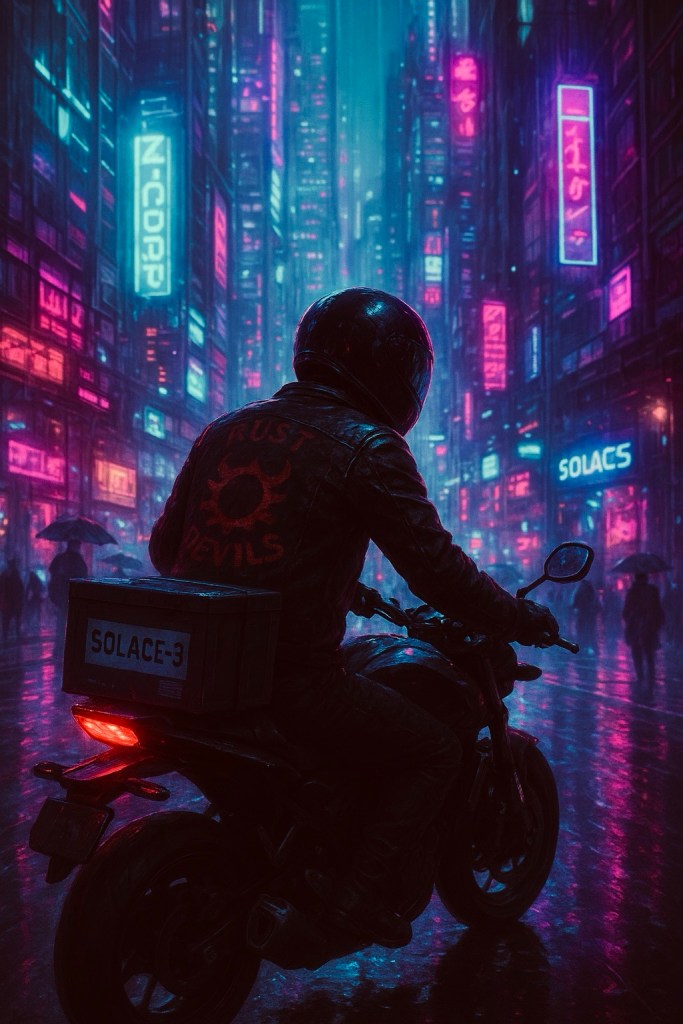
The Neon Spire never sleeps; it only exhales different colors. Tonight it breathes cobalt and bruised magenta. Towering slabs of glass and steel stitch the sky into a jagged skyline, and every surface wears advertising like neon jewelry — drifting holo-signs hawking blissful serums, corporate mascots with permanent smiles, an endless carousel of promises. Rain falls thin and cold, turning the avenues into mirrors. My bike eats those reflections. I ride fast because I always ride fast; speed keeps the city from settling on me.
They call me Kade. Slim, thirty, a laugh-line where a grin used to be. I work with my hands, grease under my nails and a map of scars on my knees. Tonight my hands are doing what they do best: hold a crate, feel its weight, promise it will be where it needs to be. The Rust Devils paid good credits for this run — better than the usual courier gigs — and when the Rust Devils pay, you don’t ask questions. You make the delivery and you disappear into the light.
The crate is warm against my thigh. It smells faintly of antiseptic and copper. There are stickers on the outside: a stylized gear with horns stamped in rust-red. Inside, rows of sealed ampoules nest like sleeping things, each labeled in neat print: Solace-3 — Stabilized. Approved. There is no retail barcode, no corporate seal I’ve ever seen; only the Rust Devils’ mark and a caution I ignore because I can count debts better than I can count morals.
Neon Spire’s elevated lanes are a lattice of light; my engine hums as I weave between them. Pedestrians are silhouettes against the glow, umbrellas like dark moons. Market stalls under cantilevered walkways sell steaming noodles and chipped tech and counterfeit smiles. Above, a holo billboard for NeuroCorp pulses its slogan in a voice soft as a lullaby: RELIEF IS DISTRIBUTED. Trust us. The holo’s light bleeds down into a puddle and turns into a blade.
The drop is simple — a loading bay behind an abandoned club that used to host better music. Two Rust Devils watch the ramp, their jackets the color of old blood. They check the crate, peel the tape, and give me a nod like I’m a payment, like I’m already spent. One of them taps my helmet and says, “Clean work, Kade. You’ll see your credits.” The other trails his thumb over the ampoules as if testing how fragile they are. They don’t look at me with any more curiosity than you would a rainbird.
I should have left then. I should have taken the wet night and screamed away like another shadow. But Lira owes her mother treatment. My pockets need patching. I think of rent, of oil filters, of the way Lira laughs when she tries to cook and the noodles stick together. These are the little economies that keep people like me making the runs that keep Rust Devils in business.
I ride home through alleys that smell of frying oil and ozone. Neon signs crowd the narrow sky until it is a strip of electric daylight. Lira’s apartment is a small room three levels down from a walkway named after some long-gone poet. Inside, there’s a patchwork of books and a single potted fern that keeps pretending to be brave. Her mother — Mae — sits propped on the futon in a cardigan that has seen better winters. Her hands tremble, not from age but from a different kind of erosion. Lira is careful with the syringe, precise as a mechanic; Lira’s hands are good hands. Mae smiles at the two of us like a lighthouse.
“New batch?” Lira asks when she sees the crate.
The crate sits on the kitchen table, a huddle of glass under the neon wash from the window. I pull an ampoule out of its foam cradle like you would remove a secret from a pocket. It catches the light and fractures it. Lira reads the label and her expression goes small and tight.
“Solace-3,” she says. “Cheap, but stabilizers say it will do until the clinic sends the next supply.”
I tell the smallest, most useful lie: “Rust Devils’ supplier. Paid well.”
She doesn’t ask where we got it. She trusts me too much. Mae swallows the dose like it’s a piece of kindness. She closes her eyes and exhales. For a moment, peace stitches the apartment together.
Then the tremor sharpens. Mae’s fingers claw at the blanket. Her breath scissors and comes back wrong. Lira’s face collapses. She presses her palms to Mae’s jaw and shakes her. Mae’s eyes open and show a net lined with static.
“Something’s wrong,” Lira says. Her voice is a paper plane.
I taste metal. I know the label now. The font, the sticker, the Rust Devils’ mark — all of it threads back to the crate I moved across neon veins. I did this. My hands had already touched murder and called it commerce.
The city’s noise crowds back into the apartment like an interrogator. Holo-ads outside chant in perfect rhythm. Somewhere far away, a skirmish flares like a match. Lira’s phone curls under her palm and rings the clinic number until the system responds with robotic patience. No answer. The system says diagnostics: supply chain delay. Recommendations: emergency stabilizer required.
I go to the crate because I need to find the lie that made this happen. One ampoule sits on the table, its liquid a clear, too-bright thing. I pry the seal. It smells like chemical lilies and old promises. Under the label, tiny print reads: CONTAINS: N-79; DOSE STABILIZER: 0.002%. Someone shaved the stabilizer down to nothing. Somewhere between manufacturing and me, the formula got thin.
I have two choices: fold into punishment or fight for something I hardly understand. I am a courier, not a soldier. But the city teaches you to be useful with whatever tools you have. I drink in the neon at the window and make a decision that tastes of teeth.
The Rust Devils’ stronghold is a rusted monolith on the edge of Neon Spire, half-industrial, half-cathedral. Holo-graffiti crawls up its buttressed walls. I park in shadow and trade my helmet for anger. The gang’s sentries leer like vultures. I can’t muscle through them. I can’t gun them down; they have more metal than sense. So I use what I always use: speed, surprise, example.
Under the rust-colored logo, an open door does the city’s work for me — it invites me into a place that smells like burned copper and ambition. Inside, ampoules stack like teeth in a jar, inventories that taste like power. A ledger sits on a table: lists of supplies, delivery addresses, a name etched that makes my stomach drop. Whoever’s behind this isn’t just selling pills. They’re recalibrating the city’s arteries — lacing stabilizers with scarcity, with profit, with control. People who need help will come back for more and become rentals of the gang’s influence.
I don’t have a plan. I have a reckoning. I snatch a tray of ampoules and shove them into my jacket. Alarms bellow. The Rust Devils pour into the corridor like spilled ink. I ride because the city is a maze I know better than they do, and because Lira’s voice in my ear — begging, cursing, naming me like someone trying to conjure a safe harbor — is a compass.
I get back to the apartment bleeding with cold and adrenaline. Lira meets me at the door, hair a halo, eyes wet with electric fury. I hold out what I took: a handful of ampoules not laced with the Rust Devils’ stamp, one with a manufacturer’s imprint I recognize from a clinic distributor. I jam one into Mae’s lip and wait.
Time is a narrow corridor. Mae coughs and then breathes like someone dragging a new light through old lungs. She opens her eyes and looks at me. There is recognition and something like forgiveness. I think she knows I did this. I think she knows I undid some of it.
The Rust Devils will learn I’m their missing ledger and my face will press on their memory like a decal. The city will notice me — a ghost on motorbike tracks. In the morning the market will hum and the holo-ads will smile. For tonight, though, the Neon Spire offers a sliver of grace: Mae’s breathing steady, Lira’s hand in mine, the rain painting everything honest.
We sit in the electric afterglow and let the city wash over the cracks. I thought the job was a line in a ledger. It was a line through lives. I also learned that in a place designed to commodify relief, hands that move are the only currency that still feels like mercy.
Outside, a holo-billboard blinks: RELIEF IS DISTRIBUTED. Trust us. I look at it until the letters blur. I don’t trust anyone anymore. But I can make the next delivery a different thing. That will have to be enough.
 Cyberpunk City AI
Leave a comment